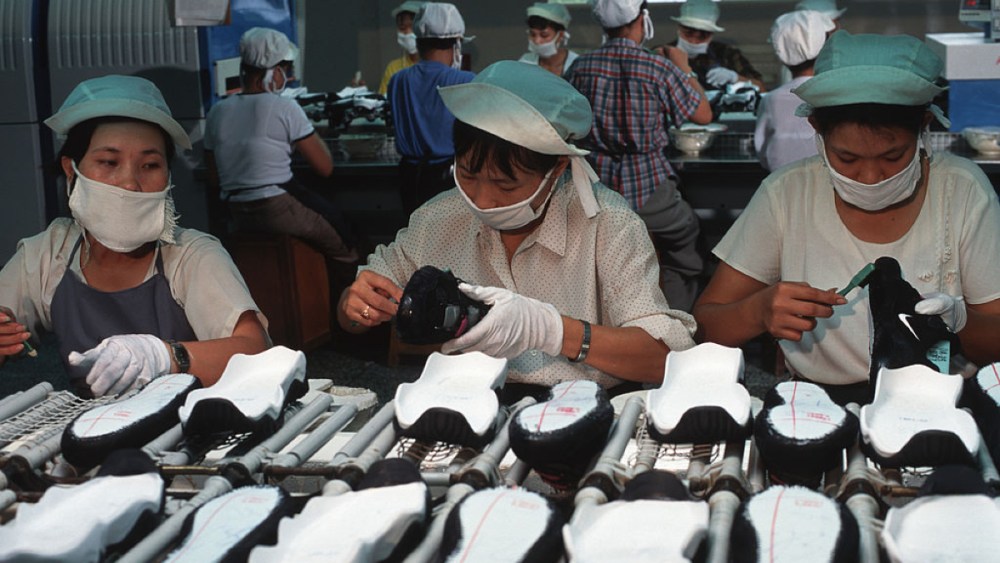
Hong Kong-based footwear and leather goods manufacturer Stella International Holdings Ltd. said it provided tariff support to select U.S. customers in 2025.
That effort to help some customers “as they worked to pass through price adjustments” impacted overall performance at Stella, which was also impacted by shortfalls in production efficiency at its facilities in Indonesia and the Philippines. “As a result, we recorded a net profit of $137.0 million,” the manufacturing firm said. In comparison, the company last year said net profit in 2024 was up 21.2 percent to $170.1 million.
Stella also said that for the year ended Dec. 31, revenue rose by 1.6 percent to $1.57 billion. It also noted that shipment volume rose by 3.8 percent, mostly driven by its sports segment. In comparison to 2024, revenue was up 3.5 percent to $1.55 billion from 2023 levels, while shipment volume rose by 8.2 percent.
You May Also Like
“In 2025, we navigated a year marked by stronger macroeconomic headwinds and constant shifts in the global tariff landscape. Yet demand for our products and our diversified manufacturing capacity remained strong, demonstrating both our resilience and the strength of our relationships with customers,” Stella’s CEO Chi Lo-Jen said.
Looking ahead to 2026, the company said: “We expect the shifting global tariff landscape to remain a headwind in 2026 and we will continue to monitor the situation and our customers’ responses.”
Stella said it expects 2026 to be a key investment year, with modest contribution from the three new factories in Indonesia, Bangladesh and Vietnam. The company further noted strong demand from new sports and high-end fashion customers.
“Given our strong product development pipeline, we remain well placed and focused on winning additional customers in these segments as more brands reassess their supply chain strategies and consolidate with strategic vendors that offer differentiation, high quality and value,” Stella said.
Stella’s three-year plan starting in 2026 is focused on diversification and expansion of its production capacity for its new luxury and fashion customers, as well as production for new sports customers via product innovation and development at the firm’s research and development (R&D) base in Vietnam.
“On the supply side, we are focused on commissioning and ramping up our three new factories in Indonesia, Bangladesh and Vietnam, which together with our factory in Solo, Indonesia, will add approximately 20 million pairs of additional capacity over the coming years,” Stella said.
Lawrence Chen, group chairman, said the plan includes the completion of a new R&D and product development hub in Vietnam. “We are confident in our ability to minimize ramp-up risks by applying the lessons we learned in 2025, including strengthening production-quality training, enforcing greater discipline in production planning and material utilization, and enhancing upstream quality control,” Chen added.
Last week, Taiwanese footwear manufacturer Yue Yuen said U.S. tariffs also impacted its 2025 profits and revenue. It noted that shoe shipment volume fell 1.2 percent to 252.2 million pairs due to more cautious ordering policies by brands.
The U.S. Supreme Court’s ruling that President Donald Trump’s global reciprocal tariff policy under the International Emergency Economic Powers Act (IEEPA) is illegal has left the footwear industry with some uncertainty over what is the plan for future trade policy. For now, Trump has implemented a 15 percent tariff based on Section 122 of the 1974 Trade Act. The new duty is temporary as it is set to run just fro 150 days through July 24.