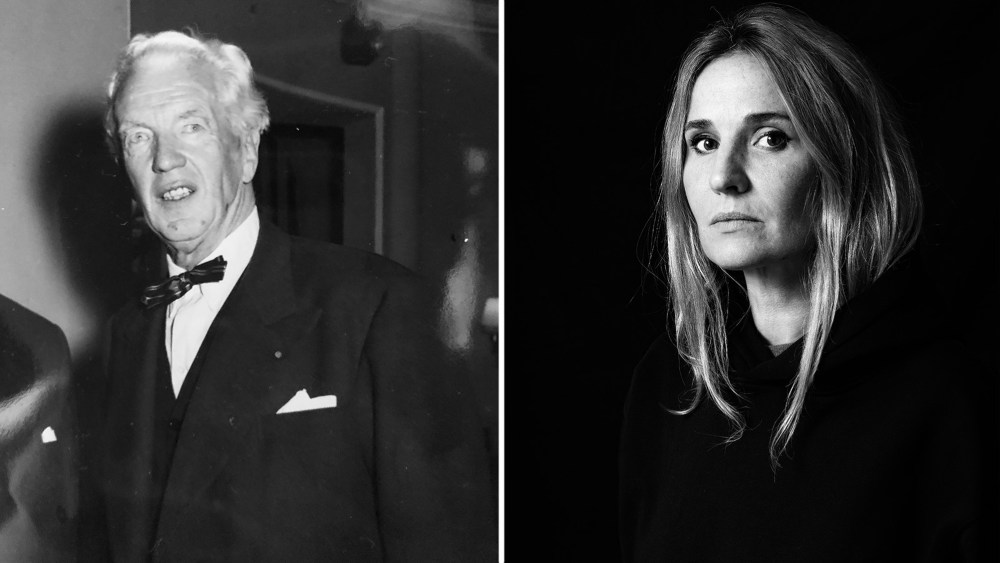
PARIS — To be clear, Alexia Leleu, a former pharmaceutical marketing manager, didn’t inherit Maison Leleu, which was founded in 1910 by her great-grandfather, the ebullient designer Jules Leleu. It was an unexpected brush with destiny, she recalled in an interview ahead of Milan Design Week, where the firm will debut a collection of fabrics and rugs named “Empreintes,” or “Imprints,” through a new collaboration with textiles and wall covering specialist Lelièvre Paris. It also will launch its first outdoor collection.
In the 1930s Jules’ three children joined him and Leleu became a family company. Following his death in 1961, Alexia’s grandfather and his sister and brother carried on the family business until the Persepolis project in 1973 — an elaborate project they carried out for the 2,500th anniversary celebration of the Persian Empire, which was held in 1971. But that led to their downfall due to unpaid bills on the part of the Shah of Iran, one of its biggest clients, which led to the closing of a firm that had attracted art lovers and collectors like the Japanese emperor.
You May Also Like

Until one day, on a quest to learn more about the family’s company, Alexia met a woman named Françoise Siriex, who had worked for 40 years for both her great-grandfather and grandfather as a personal assistant. Alexia visited Siriex multiple times as part of her journey to understand her family’s story. Françoise later directed Alexia to an apartment in Boulogne-Billancourt, where she presented her with boxes of archival designs by her great-grandfather Jules that had been preserved for 50 years.
“When I arrived at the apartment, I discovered it full of archives—from the floor to the ceiling. Everywhere, there were boxes full of archives. I came back to see Françoise and said, ‘I don’t understand what this is,’” she said in an interview with WWD at the firm’s 15 Rue des Saints-Pères headquarters.

Françoise then revealed that she had saved it all for Alexia, believing she was the right person to revive the family’s legacy. She said she had been waiting for her for five decades.
Inside the Maison Leleu studio, Alexia sits next to Maison Leleu’s Fine Meridienne Longue chair characterized by its rounded base, originally designed by her great-grandfather in the early part of the 20th century for the Normandie Transatlantic cruise ship. She explained she upgraded it in a modern age with the choice of a side table and enhanced it with elegant piping.
Initially, she grappled with feelings of fear that she had to overcome, going alone and with no other family members who were up to the task of reviving these precious archives. “It was my destiny,” she said, adding that this was the moment she decided to pivot, later garnering a degree in interior design. She previously earned a degree in furniture history at École Boulle, the prestigious French school that specializes in design, fine arts, crafts and applied arts.
Such experiences allowed her to work on projects involving interior decoration, including bespoke designs for high-profile clients and collectors. It also enabled her to tackle complex architectural layouts and space planning.

Leleu restarted the company in 2018. Markets like the U.S. were fascinated by the family’s re-booted legacy, which peaked with the Art Deco period. In the U.S., her top foreign market, the company’s furnishings are sold at Maison Gerard, the prestigious art gallery in Manhattan. Alexia mentioned that Maison Gerard was one of the first galleries she contacted when reviving the company due to its history of selling Leleu vintage creations. Today, Maison Gerard features both vintage pieces and new editions from Maison Leleu, highlighting the brand’s legacy and contemporary craftsmanship, she added.
“The American market is very big for us. At the beginning, American clients wanted to buy individual pieces, but now they want fully curated universes,” she said, adding that all of Leleu’s creations are signed, numbered and delivered with a blockchain certification to prove authenticity in 10 or 20 years.
Contract and hospitality make up about 40 percent of the firm’s sales and this facet of the business is growing steadily. “The hospitality industry has shifted toward creating more experiential spaces that require high-quality furniture matching the luxury level of the hotels,” she added, noting that she works with brands like the Wynn and Raffles.
Alexia’s touch involves modifying archival designs to better suit contemporary lifestyles with innovative, more durable materials, finishes and accents like metallic borders. “When I saw this archive, I found this corner sofa so modern,” she enthused.

“Empreintes,” she said, was born from a close dialogue between heritage and contemporary creation and involves a reinterpretation of the Leleu archives, working with scale, weaves, threads and reliefs to reveal a new reading of the original designs. From this synergy emerges a collection where transmitting does not mean repeating, but transforming. For “Empreintes,” jacquards, embroideries, chenilles and velvets have been deconstructed or reinvented by Alexia’s approach, amplified by plays on textures.
Five years ago, the two firms unveiled “Retrospectives,” a collection of contemporary fabrics and wallpapers based on iconic designs from Maison Leleu’s archives and manufactured by Lelièvre Paris.
Growing Textiles, Rugs, Wall Coverings and Introducing Outdoor
Maison Leleu ventured into rugs during the early 20th century when Paule Leleu, the daughter of Jules Leleu, managed the textiles department of the company. She was responsible for designing patterns for rugs, wallpapers and fabrics, making these creations an integral part of the Maison Leleu legacy.
In recent years, Alexia Leleu revived and adapted some of these archival designs for modern use, showcasing the continuation of the family’s rich tradition in textiles.
Maison Leleu’s Equinoxe collection of outdoor funiture was unveiled in March.

Comprising 10 models — chairs, armchairs, benches, tables, sun loungers and lighting — the outdoors is not uncharted territory for Leleu. As early as the 1930s, the company was involved in fitting out large transatlantic liners and working on iconic locations, where the furniture interacted with the architecture and landscape.
For each design, Alexia said she transposed her own decorative flair to the exterior with keen attention to detail and comfort.
“The invisible and demanding assembly work took more than two years to perfect. Each joint, each curve and each leg has been designed to combine structural strength with visual delicacy,” she explained.