
That elastane rhymes with “bane” is a fitting quirk of the English language. Also known as spandex or Lycra, the fiber is produced at a rate of up to 1.5 million metric tons annually. Yet it’s rarely used on its own. Instead, elastane is typically blended with other materials to add stretch, recovery and comfort, making it a ubiquitous part of everything from yoga leggings to jeans to swishy summer frocks. By 2035, its market size is expected to surpass $15 billion, or 2.5 times its 2025 value. In short: elastane isn’t going anywhere.
And therein lies the problem. Beyond the nightmare it poses for textile recycling, gumming up machinery and contaminating other materials, elastane is also petroleum-based, meaning it doesn’t break down naturally and adds to the long-term environmental burden of even so-called “responsible” clothing. As governments increasingly require products to meet circular design standards and reduce their carbon footprint — the European Union’s Ecodesign for Sustainable Products Regulation is one leading example — its drawbacks are getting harder to ignore.
Material innovators are starting to figure their way around the problem with a new breed of “next-gen” elastane that, while not perfect for the planet, is at least measurably better. While some, like CiCLO and Roica, are looking at making conventional elastane more biodegradable at its end of life, others are counting on bio-based feedstocks to cut petrochemical use and greenhouse gas emissions from the start — even pouring tens of millions of dollars, if not more, into making it happen.
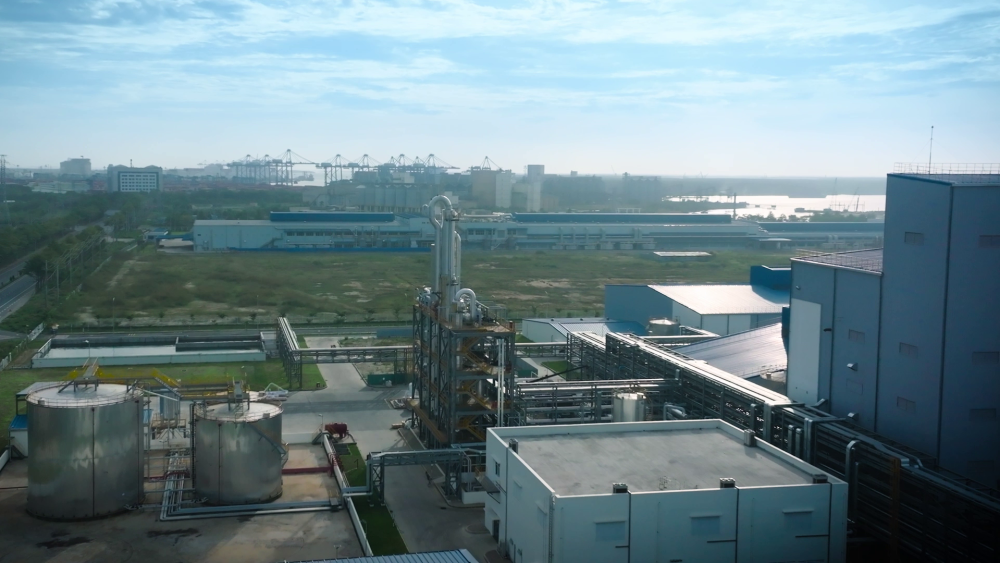
They include Hyosung, the world’s largest manufacturer of elastane through its Creora brand. Increasing commercial demand aside, Hyosung is convinced it needs to make a grand gesture to help the industry transform at scale. After a brief foray with dent corn, it decided to go all in on sugarcane, investing nearly $1 billion in a bio-based production facility in Vietnam — where it’s already churning out spandex — that kicked off production in May.
“Moving away from fossil-fuel-based raw materials to more renewable bio-based feedstock is the most significant structural lever we can use to lower carbon emissions,” said Simon Whitmarsh-Knight, global marketing and sustainability director of textiles at Hyosung.
The South Korean company has tinkered with its inputs before, releasing in 2020 the world’s first 100 percent pre-consumer recycled spandex made from manufacturing offcuts — its own. But Hyosung quickly realized it was limited by how much waste the industry produces. (Textile Exchange, in its latest materials market report, estimated that recycled elastane comprised just 3 percent of total elastane production in 2024.) It also wasn’t solving the issue of avoiding petrochemicals, a massive driver of pollution.
Hyosung opted for sugarcane, which it imports from Brazil, for a couple of reasons, Whitmarsh-Knight said. For one thing, its biomass and root systems sequester carbon more efficiently than most traditional crops like corn or wheat. For another, it’s far easier to refine into sugar and then ferment into the chemical building block known as bio-1,4-butanediol, or bio-BDO for short. To ensure ethical sourcing, the company employs VIVE, a tracking system that uses various third-party certifications to monitor raw materials from plantation to factory and guard against deforestation or forced labor.
The facility will start out producing roughly 50,000 metric tons of BDO in its first year, then ramp up to 200,000 metric tons. The resulting Regen Bio spandex, which is already being adopted by brands such as Pangaia and Icebreaker, cuts the carbon footprint of production by up to 55 percent compared to its conventional counterparts. As technologies evolve, it might phase sugarcane out for a better starting material.
The idea, Whitmarsh-Knight said, is not to wait for the “perfect thing” but to recognize that doing something is better than doing nothing. Bio-based, for instance, isn’t synonymous with biodegradable. The spandex, for all intents and purposes, looks, feels and behaves like its conventional form — which is how buyers like it because the “sustainability story can only go so far,” he said. But this, too, may change as Hyosung doubles down on its investment and increases its share of more sustainable spandex.
“We’ve always believed in making iterative improvements to the product,” Whitmarsh-Knight added. “Could we make recycled bio-based or biodegradable bio-based in the future? Combining benefits is certainly another medium-term opportunity until we get to that full circularity.”
Progressive improvement is also the goal for The Lycra Company, the OG of stretch that pioneered the first bio-derived elastane more than a decade ago. Scale wasn’t a problem, but timing was: It was too early, and brands weren’t ready to make the switch.
Just before COVID-19 hit, however, the Delaware-based firm tried again, this time working with Qore, a joint venture between Minnesota food processor Cargill and German chemical giant Helm, to commercialize bio-derived Lycra fiber made with Qira, a bio-BDO derived from dent corn — Hyosung’s original feedstock before it turned to sugarcane. Investment, too, is significant: Last July, Qore opened a $300 million facility in Eddyville, Iowa, to pump out 66,000 metric tons of Qira using corn grown primarily within 100 miles of the site.
“We have all the Lycra fiber types available in the bio-derived version,” said Arnaud Ruffin, vice president of brands and retail at The Lycra Company, which guarantees at least 70 percent bio-based content in its EcoMade fiber, slashing emissions by 45 percent compared to regular spandex.
The manufacturer has plenty of ideas about what to do with the remaining 30 percent. Right now, it tops up the balance with conventional elastane, though it plans to add increasing percentages of the recycled kind, which it has successfully extracted from mixed-fiber textiles through a process it developed with Swiss-German lingerie brand Triumph, allowing it to tap into post-consumer waste, a more than abundant resource.
“The two types — bio-derived and recycled — don’t have to be in opposition,” Ruffin said. “They’re very complementary in the sustainability journey. And it’s a journey, right? If we wait to get the perfect solution, we will do nothing for 10 years.”
For The Lycra Company, Iowan corn made the most sense. There’s always the risk of a problematic substitution with its own environmental baggage, but the industrial form the company landed on checked several boxes: it’s rain-fed, it doesn’t compete with food and it doesn’t contribute to deforestation. The corn is further certified under the International Sustainability & Carbon Certification and U.S. Department of Agriculture BioPreferred standards, ensuring compliance with sustainability, traceability and minimum biobased content requirements.
From there, the bio-BDO is shipped overseas, with most of the Qira-derived Lycra spun and finished in Singapore and smaller volumes produced in the United Kingdom.
“As demand grows, we’ll incorporate more sites, but it’s a ramp-up process as we convert customers,” Ruffin said. He estimates roughly 100 projects in development right now that will translate into retail products in the first quarter of 2027. “It takes time.”
Yulex, a textile company headquartered in Seattle, skips corn and sugarcane for a third option: Forest Stewardship Council-certified rubber from Thailand and Vietnam. It got its start making foams, most notably the neoprene-free polymer that features in Patagonia’s wetsuits. Last year, it made a play for the elastane market with Yulastic, which it touts as “fully renewable, responsibly sourced and poised to become the go-to stretch fiber” for brands seeking to wean themselves off synthetic materials.
There isn’t a Yulex factory per se. Rather, the firm licenses its technology to a network of vendors — easy enough to do since it uses existing machinery. This gives Yulex less control but more flexibility.
“We’re asset-light in that way,” said Liz Bui, CEO of Yulex. “Our motto has always been to try to keep everything as close to the raw materials,” with the added benefit of reducing shipping emissions.
Yulastic, according to Bui, marks a return to nature’s first elastomer. It also does something Hyosung and The Lycra Company’s bio-elastane don’t: biodegrade, which, depending on conditions — preferably commercial compostable — can take between one and two years.
“Some people do ask, ‘Will it biodegrade while I’m wearing it?’ and I’m like, well, unless you’re sitting in a compost, it’s just as durable as spandex in that regard,” she added.
As for companies that will be incorporating Yulastic, all Bui can say is that they’re major American denim brands and that the first products could roll out as soon as fall/winter of this year. Even so, while brands have a strong appetite for sustainability, they’re not always willing to pay more for it —which can be a problem since nothing is cheaper than petroleum, though recent geopolitical gyrations are starting to shake up that calculus. Consumers, too, are susceptible to the well-documented “say-do” gap.
But this also goes back to Hyosung’s earlier point: progress, rather than perfection, is how the industry moves forward.
“Of course, you get better pricing as you get better scaling,” she said. “It’d be nice to make a healthy margin, but I think in this climate, we’re just trying to be reasonable.”