
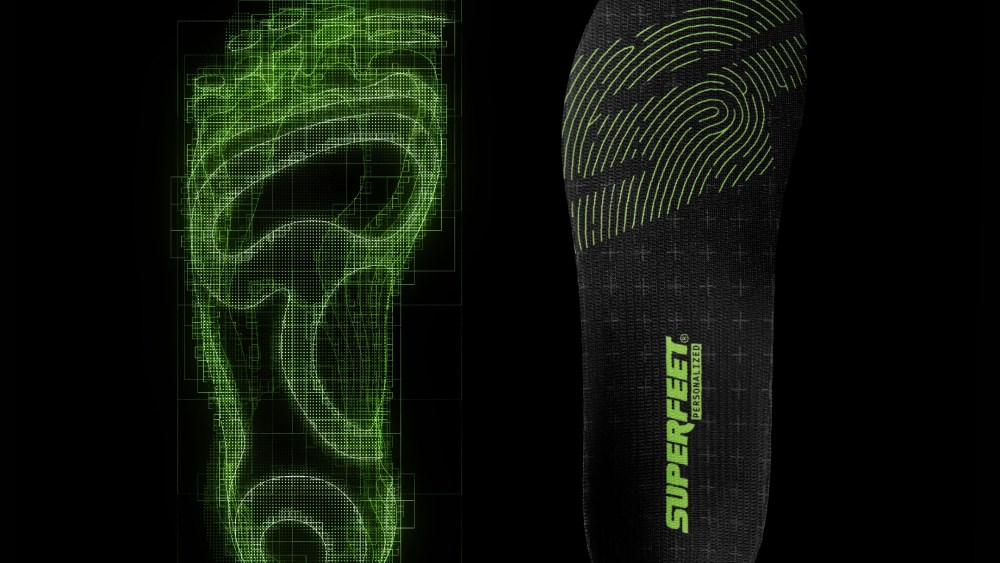
Custom insole maker Superfeet has a new version of its ME3D platform that brings high-precision 3D foot scanning into consumers’ homes.
Consumers can still opt for in-store scanning at select specialty run retailers, but no longer need to, provided they have compatible technology. The mobile scanning option does not require a standalone app for iPhones. Anyone with an iPhone 13 or newer, running iOS 26, are capable of scanning directly from superfeet.com.
Superfeet’s latest option follows the industry move toward “one-of-one” personalization trend, in this case custom insoles based on the needs and measurements of each foot. According to the company, the process is powered by a proprietary algorithm using podiatric data and biomechanical research. And the scan can provide specific details about each foot’s unique profile, shoe size and arch height. There are two high-performance options. One is a lightweight versatile design for runners at $109 and the other features a supercritical beaded foam matrix targeting kinetic cushioning and a high-rebound feel for roomier running shoes at $139. Both are printed from data scans sent to the company’s 3D printing facility in Bellingham, Wash. For now, the focus is on insoles for running shoes
Trip Randall, Superfeet’s CEO, told Footwear News that while company also sells its over-the-counter insole product that can be trimmed to fit, and continues to offer in-store scanning at select retailers, it had long wanted to bring the “opportunity” of having a custom product into people’s homes. And with the technology of a smart phone in most people’s pockets, the mobile scan through the phone’s camera made that personalized option come to fruition. Randall said there’s been a lot of testing and “tons of trial and error” to make sure average consumer doesn’t encounter friction points as they do their own scanning.
You May Also Like
Matt Gooch, vice president of product and innovation, explained that the insoles also have stability ribs in a cross-hatch pattern that are scaled based on body mass. “The higher the body mass, the thicker that those get,” he said, explaining that people with higher body mass are going to put more stress on the insole relative to the geometry of their feet. He also noted that because body mass wouldn’t change, the stability ribs would be the same for the right and left insoles, even if their respective contours and sizes could be different to account for uniqueness between one’s two feet. According to Gooch, both versions of the customized insoles are projected to last over 1,000 miles, per third-party testing done by Heeluxe.
The company in 2018 opened Flowbuilt Manufacturing, its mass customization footwear facility, in Ferndale, Wash. The firm last year unveiled a new logo and refreshed visual identity, tapping former Olympic track star Sanya Richards-Ross to help with the brand refresh.