Target, seeing second-quarter topline and traffic gains trickle down to the bottom line, produced its second positive quarter in a row.
The gains, while coming off easy comparisons from last year’s declines, were nevertheless welcome signs that turnaround efforts, led by chief executive officer Michael Fiddelke who took the reins of the discounter last February, are beginning to bear fruit. They also prompted Target to raise its forecast for the year.
“Our strategic choices, combined with the hard work of our team, are driving change that is resonating with guests,” Fiddelke said during a press briefing discussing the Q2 results.
“In the second quarter, we saw broad-based strength across multiple dimensions of our business. All six core merchandising areas grew versus a year ago,” Fiddelke said, citing double-digit growth in the Fun 101 department for toys, sporting goods, electronics, books, music and movies, and high, single-digit growth in beauty, food and beverage. “Topline growth carried over to the bottom line.”
You May Also Like
However, Fiddelke also said that Target’s apparel and home businesses were “barely positive” last quarter. “Frankly, we need a lot more improvement in those two categories,” he said.
Meanwhile, traffic – 3.6 percent above last year’s quarter – was “especially encouraging. Guests are choosing Target more often,” Fiddelke said.
For the quarter ended Aug. 1, net sales rose 5.3 percent to $26.5 billion, from $25.2 billion a year ago, beating Wall Street’s projection that sales would rise 3.5 percent to $26.1 billion to $26.15 billion. There was a 5 percent increase in merchandise sales, and a 20.1 percent increase in non-merchandise sales which includes Roundel, Target’s retail media network; the Target Circle 360 membership program offering perks, and Target Plus, the retailer’s selective online marketplace.
Comparable sales grew 3.8 percent in the second quarter, store comp sales were up 2.7 percent, and digital comp sales rose 8.7 percent, driven by more than 25 percent growth in same-day delivery.
Second-quarter operating income – including a $994 million benefit from tariff refunds – was $2.6 billion, compared with operating income of $1.3 billion in the year-ago period. Without the tariff benefit, Q2 2026 operating earnings came to $1.61 billion, still ahead of last year’s quarter.
Net earnings in Q2 rose to $1.8 billion, or $4.11 per diluted share, from $935 million, or $2.05 per diluted share, in the year-ago period. Target’s bottom line also beat Wall Street’s projection that Q2 earnings per share would reach $2.26 to $2.34.
With momentum at its back, Target now expects full-year net sales growth of around 5 percent, which is one percentage point higher than prior guidance. Target expects earnings per share ranging from $9.90 to $10.90, including the Q2 tariff impact of $1.65. Excluding the repayment, the range would be $8.25 to $9.25 per share, compared with its previous outlook of $7.50 to $8.50 per share.
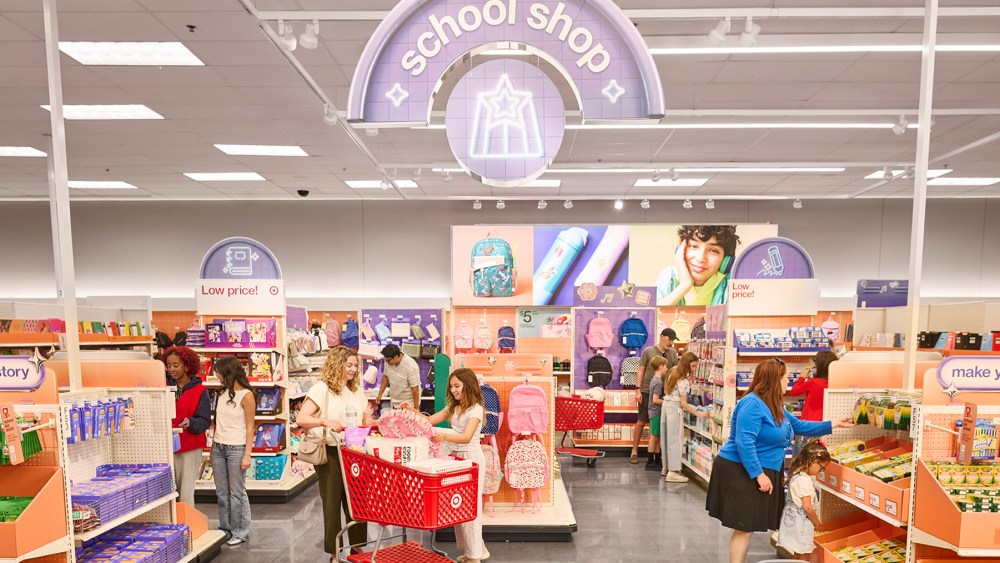
Regarding business so far in the second half, Fiddelke said, “We’re really encouraged by what we see so far in the back-to-school and back-to-college season. I’ll admit my biases here. This might be my favorite time of year to be out in the stores. That week before kids go back to school or move back on the college campus, there is nothing like the excitement you see in our stores,” Fiddelke said, noting that B-T-S is Target’s second largest volume season of the year, next to holiday.
Change is happening rapidly at Target.
Last quarter, nearly half of Target’s center grocery assortment had “enhanced presentations,” Fun 101 was “reinvented,” and there were “major” changes in the home category, Fiddelke said. There was also a “steady cadence of only-at Target partnerships,” he added, citing those with Hollister, LoveShackFancy, and Pokeman.
There is a new approach to groceries. “Our aspiration is to move our food business from a basket builder while you’re at Target, to actually a reason why you come to Target,” explained Cara Sylvester, executive vice president and chief merchandising officer. “That’s why we made such a significant bet in food this year. We completed our largest reset of the center dry grocery in over a decade. So we’re leaning with wellness, global flavors, newness, emerging brands. The snack business, one of our largest businesses, is driving double-digit comps in Q2. We are seeing momentum in areas like protein and better-for-you snacking. It’s still early, but we’re beginning to see evidence that (with) our more differentiated point of view, guests are really responding.”

In apparel, “We have much greater clarity on what needs to evolve,” Sylvester said. “We’re focusing on maximizing our in-house design and sourcing capabilities, getting sharper on newness, editing where we need to, and frankly, making sure we’ve got really compelling value across the board.”
In time for back-to-school, Target put a renewed focus on two in-house kids brands, Cat and Jack and Art Class, and the kids floorpad was relaid to make it easier to shop, Sylvester said. “Our kids basic business ran double digit comps in Q2, and Art Class ran up 50 percent,” she said.
Fiddelke indicatd that this year, Target lowered prices on more than 10,000 items “with more to come” and that for the current back-to-school season, 95 percent of the school supplies are priced at or below last year.
On the personnel side, this year designer Isaac Mizrahi was appointed creative director so Target can, as Fiddelke said, “lean into Target’s roots in style and design,” and Chandhu Nair joined Target as its first-ever chief AI officer to develop an AI strategy further growth, improve the guest experience, improve operational efficiencies and simplify certain tasks.
Fiddelke said that the “curtains go up” on Target Beauty Studio, which will launch in more than 600 stores in the third quarter this year, filling the void left by the departure of Ulta Beauty at Target earlier this year.
In addition, Fiddelke said 100 full store remodels are underway “on the path to around 130 this year.”
“Our strategy is centered on serving busy families with a focus on style, design and value,” Fiddelke said. To deliver on the strategy, Fiddelke said Target had four key priorities: “leading with merchandising authority, elevating the guest experience, accelerating technology and strengthening our team in communities.”
Putting the most recent financial results into perspective, the CEO said, “Two strong quarters is not the goal. Sustained, durable top and bottom line growth over time is what we’re after.”