The Trump administration has dealt another blow to historically weak United States-Canada relations by levying sweeping 50 percent duties on imports from America’s neighbor to the north—including textiles and apparel.
Imposed under Section 338 of the Tariff Act of 1830, which empowers the president to impose duties to offset a relative trade disadvantage for U.S. exporters created by another country, the tariffs will impact 550 Canadian product categories, most notably motor vehicles, alcohol and dairy.
But unlike the other trade statutes the administration has leveraged in building out its tariff regime, like steel and aluminum duties under Section 232 of the Trade Expansion Act of 1962 and global 10 percent duties levied in March under Section 122 of the Trade Act of 1974, these tariffs will not exclude goods covered by the U.S.-Mexico-Canada Agreement (USMCA).
The trilateral trade pact has facilitated duty-free trade between North American nations for six years, as President Donald Trump brokered the deal to replace the North American Free Trade Agreement, or NAFTA, which did so for more than 26 years before that.
Throughout Trump’s second term in office and across the varied approaches his administration has taken to penalizing other nations for trade imbalances and “unfair” trade practices—even the broad-based tariffs imposed dubiously under the International Emergency Economic Powers Act in April 2025—the sanctity of the USMCA has remained intact. Products covered by the agreement (which represent the bulk of categories traded between the nations) were excluded from new duties. Not so anymore.
Trump’s justification for hitting Canada with the staggering new levies has to do with certain tariffs and quotas the country has imposed on American-made cars—barriers to trade that he said other countries don’t have to deal with. According to the White House, Canada’s imports of U.S. motor vehicles declined by 22 percent year over year.
Also cited was the fact that all but two Canadian provinces and territories have stopped purchasing or distributing American made spirits, which has caused Canadian-bound alcohol exports to fall by 81 percent since 2025. The federal government reiterated long-held frustrations about Canada’s complex dairy system, which it said has created an unnecessarily harsh trade environment for U.S. cheeses and other dairy products, providing better terms for competitors in Europe, for example.
The 50 percent tariffs, which will take effect on Aug. 19, have already proven contentious among both allies and adversaries of the president, but Trump reiterated his reasoning on Tuesday, telling reporters from the Oval Office, “Canada has been very, very tough on us over the years, for many years, and no other president’s done anything about it.”
“In all fairness to them, they need us to survive. Without us, there’s no way they can survive,” he added.
USTR Ambassador Greer was more measured in tone when his office announced the duties on Monday, saying that while the administration continues to negotiate and secure reciprocal trade deals with other partners, Canada has pushed back on American efforts to “rebalance trade” and protect U.S. industry.
Canadian Prime Minister Mark Carney responded swiftly to the trade action, bemoaning the “violation” of the USMCA—which, despite facing a failed renewal process earlier this month, will remain in place through 2036, inherently blanketing the bulk of U.S.-Canada trade in protection from duties. He said that Canada had made “a series of detailed and comprehensive proposals to resolve this dispute,” as well as to modernize the trade agreement, taking into account concerns from the U.S.
“We stand ready to intensify those discussions in the coming weeks,” he said, emphasizing the need for the countries to engage in further negotiations to rectify the deepening, and highly consequential, rift.
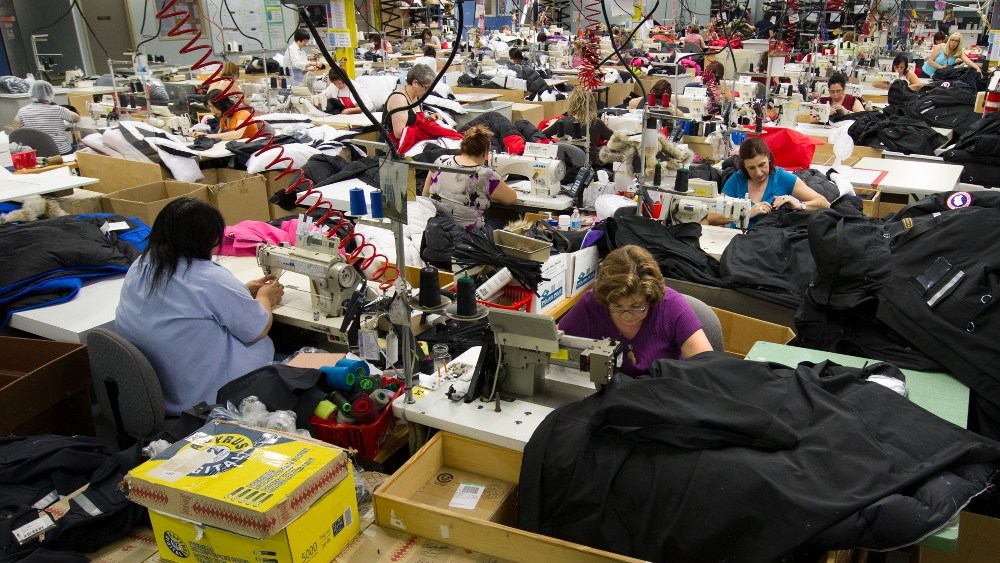
The Canadian Apparel Federation (CAF) quickly surmised that the new duties could have devastating effects on the country’s apparel exports, as “[t]he product coverage captures a wide range of textiles and apparel” across Chapters 50–63, including knits, wovens and made-up textile articles.
“If the announcement from yesterday is implemented as outlined, it would be a very significant thing,” Bob Kirke, the group’s executive director, told Sourcing Journal.
In Kirke’s estimation, apparel shouldn’t be caught up in the maelstrom brewing between Washington and Ottowa over exports like steel, automotives, dairy or alcohol. “When we speak to organizations across the [apparel] supply chain, there is no appetite for this,” he said. “We shouldn’t be part of the collateral damage because the U.S. doesn’t like what Canada did on auto tariffs.”
Trade tension is “the last thing” that the Canadian-American co-production apparatus—an integrated marketplace and supply chain—needs to thrive, he believes.
“We are buyers of U.S. textiles and yarns and sewing threads and consulting services and machinery and so forth. If this 50 percent tariff were implemented, there would be a significant reduction in production in Canada, and a significant reduction in the customer base for U.S. textile companies,” Kirke said.
CAF is calling upon U.S. textile suppliers with customers in Canada to speak out on behalf of regional cooperation—”to also stand up and say, ‘No, this is not the right way to approach this. We need to get back to normal business, where we set longer-term plans, build partnerships with willing companies, and we build competitive supply chains.’”
“This is anathema to that,” Kirke said.
Despite the weeks’ unsettling developments, the CAF lead said he believes that if talks are indeed “accelerated” as Prime Minister Carney promised, the U.S., Mexico and Canada could see a successfully renegotiated deal within three to six months. “Because at the end of the day, I don’t believe higher levels of protectionism, especially on the part of the United States, does anyone any favors.”
Mexico and Canada have demonstrated a willingness to play ball, he believes, and while certain critical sectors remain a source of disagreement, the focus should be on finding consensus.
“The longer the U.S. maintains this threat of duties, the less likely all that’s to happen,” he added. “At some point, Canada is going to have to retaliate… and then we get into a spiral.”
Continued trade uncertainty could unnecessarily threaten a collaborative industry that has been chugging along with some success for many years, he believes.
“We have a stable trading relationship with the United States in regard to apparel. It’s not growing dramatically, but it’s stable, and we want to keep it,” Kirke said. “I think that’s a very reasonable proposition on the part of our industry, and I think we have a lot of support for that in the United States.”