There’s no sneaker out there quite like the Nike Air Force 1.
Without it, it’s very possible that sneaker culture wouldn’t even exist as we know it today. Designed by Bruce Kilgore and introduced in 1982 as a performance basketball model, it was one of the first athletic shoes to be coveted by serious collectors; first, with an array of regionally exclusive color combinations and later, with the limited-edition collaborations and styles have helped make it iconic. An argument could even be made that the seminal model was singlehandedly the catalyst for the sneaker industry’s ever-flourishing retro business. But how did it get here?
The most shocking factor of the Air Force 1’s rich legacy is that it could have easily become nothing but a faded memory of the early 1980s rather than the icon it’s become. Following its ’82 debut, Nike planned to discontinue production of the Air Force 1.
You May Also Like
This wasn’t due to poor sales performance or manufacturing mishaps, but instead because the Beaverton, Ore.-based brand hadn’t yet begun the practice of reissuing its footwear. Just as the production plug was about to be pulled in 1983, a group of savvy retailers from Baltimore — where the Air Force 1 had spawned a cult-like following — teamed up in effort to convince Nike to keep the shoe in stores.
Baltimore-based Charley Rudo Sports, Cinderella Shoes and Downtown Locker Room saw something in the Air Force 1 that even Nike itself didn’t see at the time. The sportswear company was swayed, agreeing to produce a handful of colors exclusively for the Maryland vendors. The “color of the month” program, as it became known, soon caught attention outside of the Baltimore area and had customers from New York and Philadelphia traveling up and down I-95 in hopes of getting their hands on the regional-exclusive pairs. With the model rescued from becoming a relic, its reputation continued to grow in the ‘80s as a staple of street culture.

“The Air Force 1’s longevity is solely from the streets,” Omar Maultsby, a sneaker and hip-hop historian who runs the popular Instagram account @no.idea.is.original, told Footwear News. “This is a shoe with little to no marketing that has well over 2000 different colors. How can you have that many colors of a simplistic style sneaker that’s been out since the early ‘80s still relevant today? You had a high-top era, the lows. Then it went to mids. Many eras. No marketing. The pavement.”
As the shoe’s popularity picked up steam in the late 1980s and ’90s, it maintained relatively simple material makeups and colorways. Two-tone color combinations were common, often with contrasting Swoosh branding. This led tastemakers like Harlem designer Dapper Dan, who’s largely credited with popularizing custom sneakers, to offer more options by outfitting the shoe with logos from Louis Vuitton, Gucci and other luxury brands. Decades later, Dapper Dan’s ahead-of-their-time creations would influence Virgil Abloh’s official Air Force 1 collaboration between Nike and Louis Vuitton.
In the 2000s, the Air Force 1 would go full-on mainstream with heightened visibility from rappers like Jay-Z and Nelly, the latter of whom’s 2002 song “Air Force Ones” helped the sneaker break out in the midwest and southern U.S. This era would also usher in coveted collaborations and special-edition Air Force 1 SKUs, a blueprint which Nike employs to this day.
Although Nike does not disclose sales figures for specific sneaker models, the company has referred to the Air Force 1 as “by far” its best-selling shoe of all time.
With so many influential Air Force 1 releases in its nearly 45-year history, a “best of” list could fill a book, but FN has whittled it down to the 10 most important pairs of all-time. The styles featured below were selected based on cultural relevance, design influence, and resale aftermarket demand.
Air Force 1 High White/Silver

Although many enthusiasts consider the Air Force 1 Low to be the quintessential version of the sneaker, it didn’t start there. In an era when basketball shoes emphasized ankle support, high-tops were the market standard and thus, were the AF1’s original form. There are several significant colorways including brown and purple-based styles, but the white-and-silver iteration was the true original.
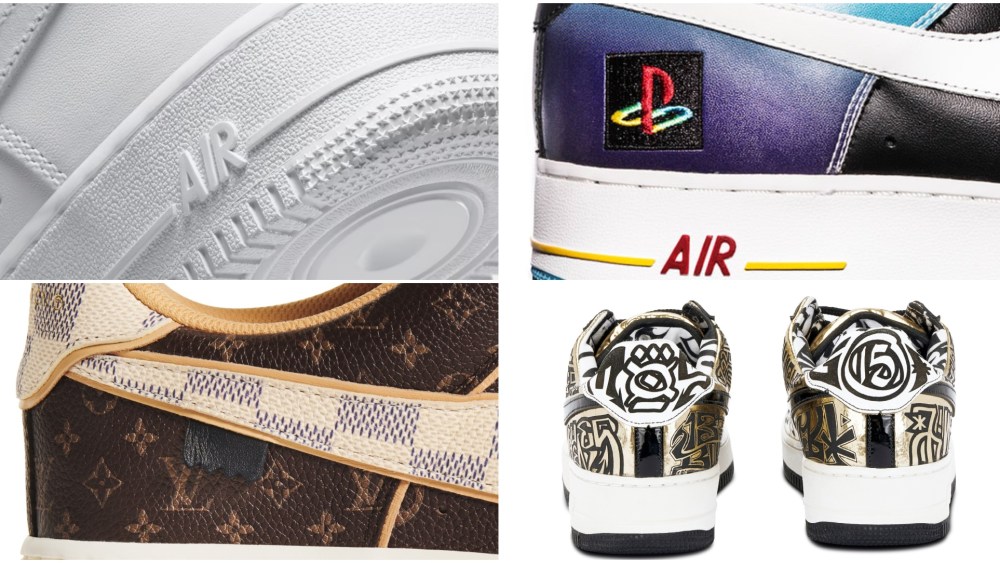
Louis Vuitton x Air Force 1

You can’t mention Virgil Abloh’s work on the Air Force 1 without covering what was arguably the late designer’s magnum opus: the sprawling, 47-pair collection with French fashion house Louis Vuitton. There were plenty of luxurious Air Force 1s before it, but the official link-up with Louis Vuitton raised the bar to unprecedented heights.
While secondary market value isn’t the only measure of a great sneaker, it’s worth noting that the collection’s Monogram Brown/Damier Azur colorway is the most expensive item ever sold in resale platform StockX’s 10-year history with a sale of $85,000.
Air Force 1 Low Triple White

This is it. This is the pair people picture when they think of an Air Force 1, and for good reason. The crispy, all-white leather low-top version of the shoe is the most ubiquitous of its countless variations. It’s the most versatile of them all — it can be dressed up or down, kept pristine or worn into the ground. Notably, some white-on-white Air Force 1 devotees are so serious about the sneaker, they’ll only wear a pair once before replacing it with a new one.
Sony PlayStation x Air Force 1 Low

These days, there are numerous officially licensed video game sneaker collaborations, but there was a time not long ago when such projects were novel. Originally issued in 2006 as a friends-and-family exclusive colorway, and again in 2009 as a gift to Sony employees in celebration of the PlayStation 2’s 10th anniversary, the patent leather-adorned PlayStation AF1 has always been one of the model’s most coveted variations. In 2018, Nike released a completely different PlayStation x Air Force 1 and while there have long been rumors of the original version returning, nothing has materialized yet.
Off-White x Air Force 1 Low “The Ten”

Nearly any iteration of Virgil Abloh’s coveted Off-White x Air Force 1s could have taken this spot, but it was “The Ten” pair that really set things in motion. Part of the collection’s “Ghosting” theme, Abloh’s first Air Force 1 collaboration featured translucent materials and his signature deconstructed design. Later, Nike and Off-White would release more colorful leather-based versions of the Air Force 1 celebrating Abloh’s “Figures of Speech” museum exhibitions.
Terror Squad x Air Force 1 Low

It’s almost impossible to cover the legacy of the Air Force 1 without mentioning Bronx-born rapper and Terror Squad founder Fat Joe. He’s hardly the only artist with close Air Force 1 ties — Jay-Z, Lil Yachty, Nelly and Rob Base also deserve nods — but Fat Joe’s connection to the sneaker is perhaps the most intimate. In the mid-2000s, several Terror Squad-branded Air Force 1s were produced exclusively for the rapper and his crew and in 2023, Nike finally released versions of the collaboration to the public.
Air Force 1 Low Linen

A paramount piece of the Air Force 1’s legacy is its regional-exclusive styles. From the shoe’s early days with availability solely in Baltimore to more modern examples that span the globe, engaging specific regions has been key to the AF1’s lasting appeal. One of the most notable examples is the khaki-colored Linen colorway, which debuted in 2001 as a Japan-only release before being reissued as a Kith Miami-exclusive in 2016 and finally receiving a widespread global launch in 2024. And while it may not carry the same aftermarket demand that it once did, the history behind this once-elusive pair simply can’t be erased.
Air Force 1 Low Triple Black

Love it or hate it, the all-black Air Force 1 Low has made a lasting impact on sneaker culture. On the internet, the style is infamous for its “black Air Force 1 energy” meme, which pokes fun at the shoe’s reputation for being worn by unsavory characters. Built to take a beating and easy to clean, it’s the type of sneaker you can throw on in the rain, when you’re putting in work on the job site or simply when you want to let everyone know you mean business.
Air Force 1 Low “Entourage”

It doesn’t matter which of the two “Entourage” Air Force 1 Lows you pick — they’re both among the best versions of the sneaker ever produced. Although neither pair was actually released to the public, they’re still fondly remembered by AF1 enthusiasts 20 years after the sneakers were featured in a 2006 episode of the HBO comedy series. Both colorways featured intricate laser etching by retired Nike designer Mark Smith and are among the most coveted AF1s ever. In 2021, a gold pair sold in a Sotheby’s auction for $113,400.
Air Force 1 “Sheed”

NBA legends like Moses Malone might have put the Air Force 1 on the map in the early ‘80s, but it was former hoops star Rasheed Wallace who really made the sneaker his own. Beginning in the late ‘90s and throughout the early 2000s, Wallace — affectionately known as Sheed — would wear the retro sneaker in both its high and low-top iterations during on-court action. Clad in premium and patent leather and a variety of color-ups, Wallace would eventually receive his own exclusive versions stamped with his shooting silhouette logo.