
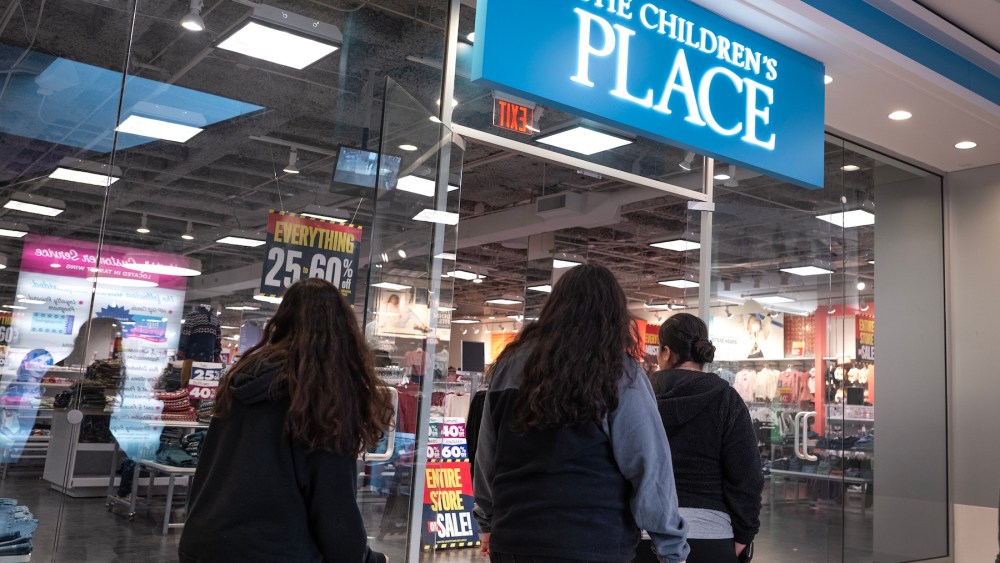
The Children’s Place owes apparel manufacturers tens of millions of dollars as it liquidates inventory and searches for a buyer through Chapter 11 bankruptcy.
South Korea’s Hansae tops the retailer’s list of its 30 largest unsecured creditors—excluding insiders—with a $15.4 million claim. The filing also lists $6.7 million owed to J.D. United Trading Corporation and $6.2 million to Vietnam’s TNG Investment and Trading.
The Secaucus, New Jersey-based retailer and 13 affiliates filed for bankruptcy protection Nov. 8 in the U.S. Bankruptcy Court for the District of New Jersey. The company, whose brands include The Children’s Place and Gymboree, is seeking to sell substantially all its assets to continue the business.
All stores and e-commerce sites remain open as the retailer reviews its footprint, a company spokesperson said in an emailed statement.
“The Children’s Place has determined that it will be necessary to close certain stores during this process,” the spokesperson said.
The company reported about $141.2 million in accounts payable at filing, according to co-chief restructuring officer Rudy Morando. Its efforts to conserve cash had already stretched its payment obligations before it entered court protection.
“Accounts payable grew increasingly past due as the Debtors sought to preserve cash,” Morando wrote in a Nov. 9 declaration.
During Chapter 11, vendors are to receive payment for authorized goods delivered and services rendered after the filing.
Other listed trade claims include $5.5 million for U-Knits, $4.4 million for Atraco Industrial Enterprises and $3.2 million for Masood Textile Mills. Jay Jay Mills’ Bangladesh and India businesses are listed separately, with claims of approximately $3 million and $1.1 million, respectively.
The 30 listed unsecured claims total approximately $93.9 million. All are classified as trade debt, although the list goes beyond garment suppliers to companies including Maersk, Google and Salesforce. The amounts disclosed do not establish how much individual creditors will ultimately recover.
Suppliers contacted for this story did not respond to requests for comment by deadline.
In a Nov. 9 motion, the retailer asked the court for permission to pay certain claims from critical vendors, foreign vendors and other qualifying suppliers that predate the bankruptcy filing. Its vendor-payment motion requests $10 million combined for critical-vendor claims and claims from parties that could assert liens, with estimated allocations of $3.5 million and $6.5 million and flexibility to move money between them.
That allocation excludes claims from foreign vendors and suppliers seeking priority for goods received within 20 days before the bankruptcy filing. Payments in those categories would be subject to the company’s financing terms and budget.
The company said in the motion that it does not expect to maintain relationships with all foreign vendors. It seeks discretion to pay particular overseas suppliers if their merchandise is needed for a potential sale of the business. The request does not earmark funds for those suppliers or establish that money is available for their claims.
The motion also seeks authority to condition payment of old bills on suppliers continuing or resuming deliveries on specified trade terms and supporting the restructuring process.
To fund operations during the sale process, the company is seeking approval of a revolving credit facility of up to $166 million, with Wells Fargo serving as the agent, and a term loan facility of up to $116 million, with SLR Credit Solutions serving as the agent, per the Nov. 9 motion.
The combined $282 million includes refinancing of existing obligations. Morando said court approval would provide access to more than $11 million in new liquidity. The initial 13-week cash forecast filed with the financing request groups operating and other disbursements without identifying individual supplier payments.
Inventory liquidation sales began Nov. 6 under an agreement with Tiger Capital Group, SB360 Capital Partners and GA Retail Solutions.
The liquidation is proceeding alongside efforts to find a buyer for the business or its assets. Cascadia Capital contacted approximately 50 potential strategic and financial buyers before the filing, according to Lorie Beers, the investment bank’s managing director and head of restructuring and special situations.
The retailer received nine proposals, including six involving sales of the operating business or intellectual property and three involving liquidation. The preliminary proposals were “not currently actionable,” Beers wrote in a Nov. 9 declaration, though negotiations were continuing
Leadership changed shortly before the filing. Muhammad Asif Seemab resigned as president and interim chief executive officer Nov. 1 but remained a director, according to a Nov. 4 securities filing. Chief financial officer John Szczepanski became acting president and principal executive officer.
The company had granted Szczepanski a $550,000 cash retention award Oct. 19, scheduled to vest after six months, subject to continued employment and other conditions. The agreement includes repayment provisions.
The board also created a special committee with exclusive authority over restructuring, financing and sale decisions. Independent director Elizabeth LaPuma is its sole member. Its mandate includes investigating potential claims against officers, directors, shareholders and other insiders, according to the board resolutions and Morando’s declaration.
The company’s 2026 proxy statement says it relied on Nasdaq exemptions for companies with a controlling shareholder, including exceptions to requirements for a board with an independent majority and fully independent compensation and governance committees.
Mithaq Capital took control of the retailer in 2024 and continued to fund it as losses mounted. Morando’s declaration puts Mithaq’s stake at about 61.1 percent and identifies two additional advances: $15 million in July and $25 million in September.
The September advance exhausted the remaining availability under Mithaq’s $40 million credit commitment, according to a Sept. 30 securities filing.
In the quarter ended Aug. 1, net sales fell 18.9 percent to $241.8 million and comparable retail sales declined 16.7 percent. The net loss widened to $31 million from $5.4 million a year earlier, bringing the first-half loss to $84.1 million.
Morando cited weaker demand, inflation, tariffs and competition as pressures on the business. The company reported approximately $40 million in tariffs imposed under the International Emergency Economic Powers Act, or IEEPA, during fiscal 2025 and 2026. His declaration also disclosed approximately $39 million in subsequent refunds.
The company had sold $38.2 million in refund claims to Alnus Investors for $25.7 million, according to its quarterly report. Most of the refunds subsequently received were remitted to Alnus to reduce the associated debt.
The company reported 512 North American stores at the time of filing, including 56 in Canada. The liquidation agreement allows closures to be halted if an actionable offer to continue the business emerges, according to Beers.
The retailer is requesting a Dec. 9 bid deadline and expects to complete the sale process by the end of December.


