
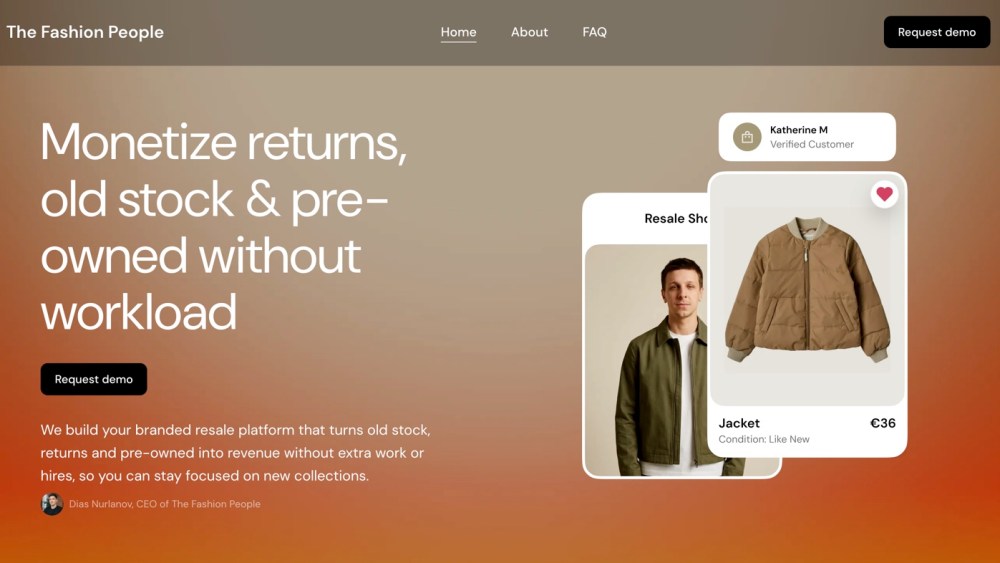
LONDON — As the fashion resale industry booms, a new sustainable platform called The Fashion People is aiming to help to change the way brands and designers offload end-of-season stock and returns.
Founder Dias Nurlanov believes resale works best when labels control the stock themselves, which is why TFP aims to help businesses operate their own secondhand marketplaces.
Backed by 5 million pounds in seed funding, the platform has positioned itself as an alternative to third-party resale outlets such as Vinted. It aims to offer brands greater control over pricing, and to promote customer loyalty and sustainable practices.
“In every European country, Vinted will be the number-one fashion marketplace, and that creates a challenge for brands. Customers will first check Vinted rather than looking at the brands’ websites and stores” for secondhand clothing and accessories.
You May Also Like
Nurlanov said he founded TFP to solve two main problems he was seeing in the market. Brands, he said, might be considering selling their old stock, but have little visibility on whether there is demand for it, or how much money they might make.
“TFP addresses this by showing these labels the extent of demand for their products in the secondary market,” he said, adding that brands are also concerned with the time and resources required to launch their own resale services.
He has pitched TFP as “plug-and-play system” that handles order management and customer support, with a dashboard that allows brands to view their financial metrics. “We have integrations with delivery companies and payment systems. It’s a very operational, easy model for them,” he said.
Using the TFP platform, existing customers can resell past purchases directly back to the brand and receive either a cash payout or store credit. By including past collection samples and “B-grade inventory,” such as damaged returns, brands can use TFP as a resale channel while keeping their main e-commerce platforms focused on new collections with higher margins.
“It’s probably the only business model that makes being sustainable very profitable for the brands, and it also resolves the problem of authenticity,” Nurlanov said, adding that it’s possible to trace every item through its order history on the platform. He argues that traceability is a service that other resale platforms cannot offer customers.
Before launching TFP in Kazakhstan in 2022, Nurlanov built Garderob, a leading resale platform in Central Asia. Based on his prior experience, Nurlanov said he’s confident he can help brands scale their resale businesses.
TFP, which currently works with around 30 brands, launched in Poland, and has since expanded into Belgium, Spain and the Netherlands.
It has recently launched in the U.K. in partnership with The Fashion Roundtable, an independent, not-for-profit organization that addresses fashion’s social, environmental and economic challenges. The plan is to launch in Germany and Scandinavia in a few months’ time.
Tamara Cincik, founder and chief executive officer of The Fashion Roundtable, said TFP will help prevent brands from losing millions of pounds a year to Vinted and other third-party sites.
“I’m well aware of how challenging it is for businesses, and we will do everything we can to support them. And I 100-percent believe that the secondhand economy is the growth opportunity for businesses,” Cincik said.
Nurlanov is ambitious for TFP’s future. “The main goal is to become a primary resale provider,” he said, adding that his goal is to onboard about 200 brands across Europe by the end of 2026.
The expansion comes at a time when Europe and the U.S. are wrestling with mountains of unsold stock.
In Europe, about 4 to 9 percent of unworn textiles are destroyed each year. In the U.S., textile recycling companies estimate that Californians spend $99 million a year on sending materials to landfill.
Both the European Union and the U.S. governments are taking action by implementing new regulations to mitigate the impact of surplus goods in the fashion chain.