MILAN — As much as the modern Olympics are a well-oiled machine with 130 years of history, any new iteration presents its share of challenges and opportunities — as well as expectations from the global audience watching.
Enter the Milano Cortina 2026 Winter Olympics — which kicks off here and in other five locations Friday night with the opening ceremony.
They inaugurate a new, widespread format, across multiple destinations, which has required an even greater level of fluidity, all in the name of providing athletes and audiences with a unique experience.
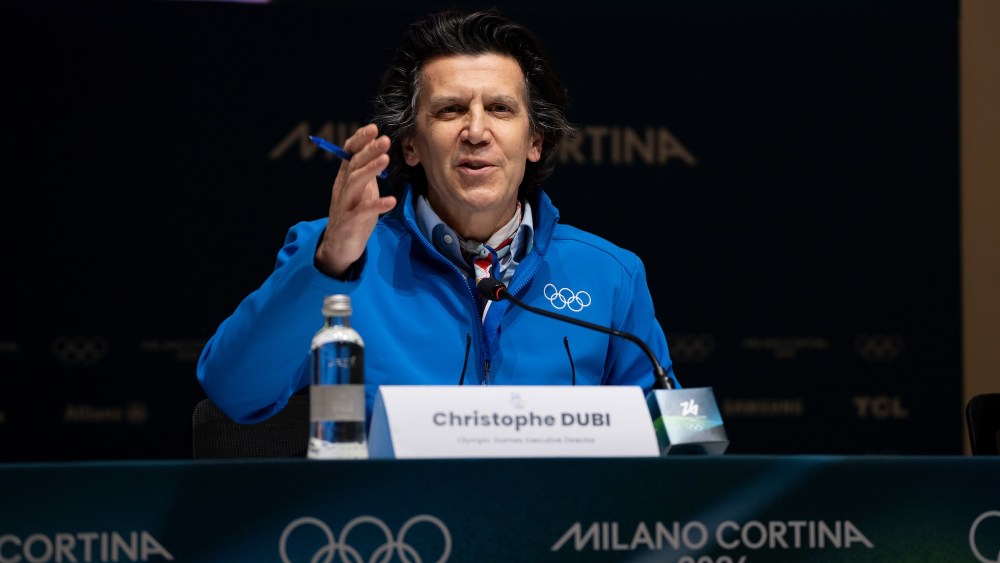
The man who runs it all — with help from his team of 750 employees and 18,000 volunteers — is Christophe Dubi, Olympic Games executive director. Outfitted in the official Olympic uniform, he can be easily spotted thanks to his lucky charm, a scarf he wears all the time, both to stay warm and as a personal fashion touch.
You May Also Like
“We’ve progressively moved away from measuring the Games’ success purely through logistics and operations, even though it has always been a complex and sophisticated exercise. Today, the key marker is experience,” Dubi told WWD in an interview.
“This shift is happening across sports and many other industries. Whether you call them clients or stakeholders, the focus is on people: athletes first and foremost, spectators in the venues, the media, local communities and, of course, the global audience. What matters is the experience we create for all of them….Ultimately, success is measured by the excitement you generate, whether that’s in a venue or behind a screen — on television or on a phone,” he said.
Dubi was appointed to his current role in 2014, but he is a seasoned member of the International Olympic Committee, or IOC, which he joined as an intern exactly 30 years ago, over time holding various roles, including IOC sports director.
The executive’s ties with the Olympic world and spirit are rooted in his family history.
His father, Gérard Dubi, is a retired Swiss ice hockey player who was part of the national team competing in the 1972 Winter Olympics in Sapporo, Japan. Growing up, Dubi recalled the affection people in his native country would express toward his father anytime he was in public, and the photograph of the opening ceremony in the Japanese town hanging in their apartment.
“Through that environment, I came to understand the importance of the Olympic Games very early on,” Dubi said. He channeled that spirit in his own career as an ice hockey player, becoming the captain of the teams he played with.
“From a practical standpoint, that experience [as an athlete] directly informs what I do today: overseeing a very large and complex system in which I don’t have all the expertise myself, but where my role is to bring that expertise together, ensure it works cohesively and report back to governance,” he said.
“When you plan the Games, you start from the assumption that logistics and operations will work —that’s the baseline. The real challenge is how you bring together all these additional elements to create a truly unique experience.
“This hasn’t transformed my role alone; it has transformed the role of everyone in the system. It represents a profound cultural shift over time, one that has fundamentally changed where our focus lies,” Dubi opined.

As sports cater to growing audiences, the Olympics have increasingly become part of pop culture at large. Consumer industries — including luxury and fashion — are rushing to tap into the event’s global spotlight, playing a role in shaping the Games’ experience.
“When it comes to the platform that is the Olympics, you have to perform at your very best, just like the athletes. You try to innovate, you try to make a statement….And the fact that more brands find the Olympics appealing brings more diversity, which is exactly what the Games are about: diversity of host locations, diversity of participation across sports, diversity in what athletes represent and display,” Dubi said.
“And here we are in Milan, one of the capitals of fashion. Of course, everyone is making an effort to make it a truly special occasion. So I think it’s only a positive development when more brands — from every end of the spectrum — are part of it: high-end fashion, but also more accessible labels. That diversity enriches the imagery, and it also allows people to connect, to say, ‘I want to be like these athletes,’” Dubi said.
Beyond the echo the Games generate, Dubi’s mantra has always been “athletes at the center,” he said.
“Milano Cortina has truly taken that to heart and said: let’s create this opportunity,” he said.
Acknowledging the logistics and operational hurdles of organizing widespread Games and opening ceremonies, Dubi said that the decision reflects the geographic reality of the Alps.
“There’s a geopolitical book called ‘Prisoners of Geography,’ and its core idea is simple: events, countries and populations evolve within a geographical context. Geography shapes how you operate and how you live day to day. The same is true for the Games….You have to adapt to the terrain,” he said.

“What we have in Milano Cortina — and also in the context of the 2030 [Winter Olympics in the French Alps] — reflects what the Alps, as a field of play for winter sport, truly offer. That adaptation is necessary. It’s an absolute reality,” Dubi said, touting Cortina d’Ampezzo, anointed “Queen of the Dolomites,” as home to some of the most recognizable downhill racing in the world, and Bormio and its Stelvio piste as winter classics.
“So what you lose in having to move people between locations, you gain in local expertise and, importantly, in world-class conditions for athletes….There are pros and cons, but overall, it reflects reality. You have to adapt and make the best use of the circumstances. And I think that’s exactly what we’re going to show here,” Dubi said.
There is hardly an aspect in the Olympic ecosystem that escapes Dubi’s oversight — down to what food is served, which “has to be Olympic food — the very best,” he said, singling out “the world’s best pizzoccheri [a type of pasta]” on the menus in Livigno, Italy.

Juggling his days between operational and institutional meetings that in the lead-up to the kickoff can start as early as 7:30 a.m., Dubi is guided by one ruling principle.
“Success is measured by the excitement you generate, whether it’s in a venue or behind a screen, on television or on a phone,” he said.