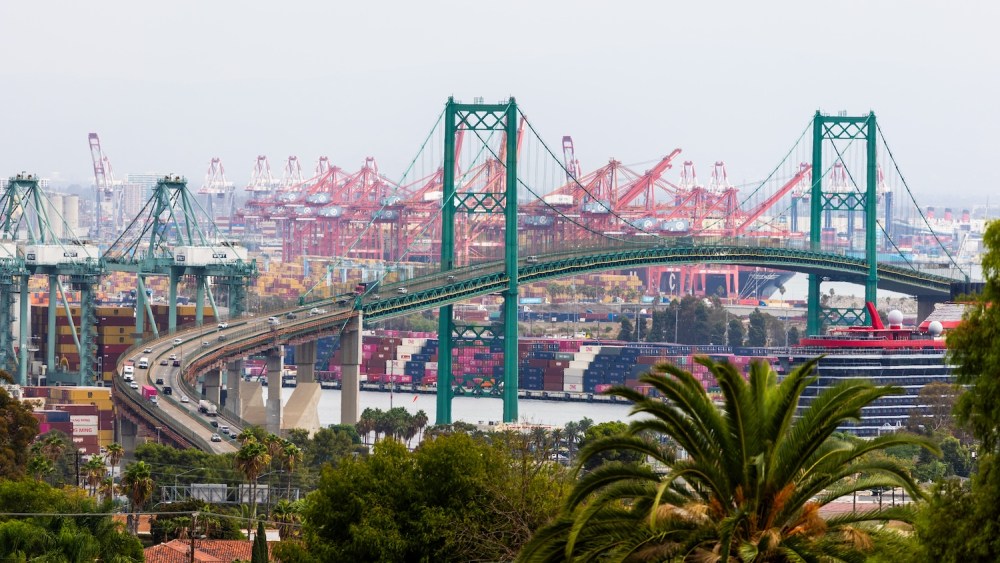
Labor negotiations for security workers at the Ports of Los Angeles and Long Beach have been extended for the third time, again pushing back the possibility of a strike at the twin gateways.
The Pacific Maritime Association (PMA) and the Local 26 branch of the International Longshore and Warehouse Union (ILWU) have agreed to extend their contract through Nov. 20, with additional talks scheduled during that period. The negotiation deadline for a new contract was initially pushed back from Nov. 1 to Nov. 4, before being delayed a second time to Nov. 6.
While the union representing the security guards has not commented publicly on the negotiations, the PMA said it “remains committed to reaching a fair agreement at the bargaining table that avoids disruption at the nation’s two busiest ports.”
The roughly 250 port watchmen have been working under a contract extension since the deal between the local union and the PMA expired last July. Despite the parties meeting regularly for talks, according to the association, there has been no progress on a deal.
The guards operate under a separate contract from the rest of the ILWU dockworkers who negotiated a six-year deal in June 2023.
Jonathan Gold, vice president for supply chain and customs policy at the National Retail Federation (NRF), acknowledged the strike threat, but did not sweat over the potential work stoppage’s impact on holiday sales.
“Most holiday merchandise is already here, and retailers are working closely with their supply chain partners to ensure that the supply of holiday gifts continues to flow smoothly,” said Gold in a statement.
The port watchmen represent just 2 percent of the ILWU employees who work at the ports, but they are employed at terminals responsible for about more than half of the combined cargo at the two ports.
According to data cited by the PMA, the impacted terminals handle roughly 85 percent of the cargo moving through the Port of Long Beach and 33 percent at the Port of Los Angeles.
Additionally, The Wall Street Journal previously reported that the PMA is worried that if the watchmen went on strike, that other ILWU dockworkers would walk off the job in solidarity.
The ongoing labor negotiations capped off an extended peak shipping season of sorts, in which volumes entering the U.S. remained strong through October. According to the monthly Global Port Tracker from NRF and trade consultancy Hackett Associates, major U.S. ports are expected to handle 2.26 million 20-foot equivalent units (TEUs) in October, up 9.1 percent from the year prior.
The strong October followed up the busiest throughput month of the year in September, when ports handled a 12.6 percent surge in containers to 2.37 million TEUs. That was the third-busiest month since Global Port Tracker began keeping records, topped only by 2.39 million TEUs in July 2025 and 2.4 million TEUs in May 2022.
“U.S. ports have seen high volume levels throughout this year’s longer-than-usual peak season and numbers are still strong even as the season winds down,” said Gold. “Unfortunately, these volumes have led to backups at some ports, particularly on the West Coast where cargo has sat for extended periods waiting to be transferred to rail cars.”
Gold is referring to the ongoing container dwell concerns which have persisted at the L.A. and Long Beach ports in recent weeks due to the influx in imports.
According to a compilation of both ports’ daily rail reports from The Dwell, the Port of Los Angeles had 23,716 import containers waiting for on-dock rail in its Friday report, with 8,172 of them waiting nine days or longer. The day prior, the Port of Long Beach logged 21,736 containers, with 4,063 waiting nine days or longer to be moved. The share of containers waiting nine or more days was 34.5 percent at Los Angeles, 15.8 percentage points higher than the 18.7 percent at Long Beach.
As the San Pedro Bay ports aim to clear that backlog, cargo is projected to keep flowing into all U.S. gateways consistently throughout the next two months. Per the Global Port Tracker data, November is forecast at 2.05 million TEUs of inbound cargo volume, up 1.2 percent year over year. A 1.3 percent increase to 2.03 million TEUs is projected for December.
Hackett Associates founder Ben Hackett said this year’s months-long peak season was an offshoot of an extended season in 2025, when a series of tariff increases led retailers to bring in merchandise before the tariffs could take effect.
“At the start of 2026, that surge appeared to have ended after the Supreme Court struck down high ‘Liberation Day’ tariffs. Expectations of another extended peak season consequently faded,” Hackett said. “However, new tariffs introduced in the second quarter prompted a renewed surge in imports beginning in May that continued through mid-October. Consumer spending supported this influx, with households continuing to buy despite rising inflation.”