
The U.S. could be shifting its approach to the war in Iran in an effort to end the conflict and restore shipping traffic in the Strait of Hormuz.
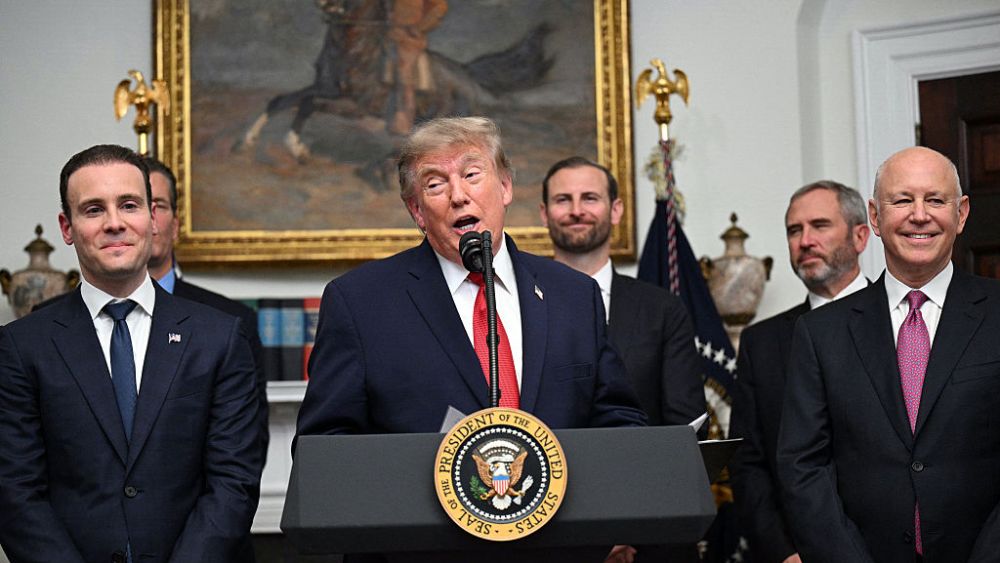
President Donald Trump called for an “economic D-Day” against Iran in a social media post Wednesday evening, warning the Islamic republic that the U.S. will impose the “most crushing economic operation ever taken against any country” if it doesn’t abandon its nuclear ambitions.
The president extended the threat to Iran’s trading partners.
“I am also announcing that ANY country that allows its financial institutions, businesses, airports, or government entities to provide any type of lifeline to Iran will itself face TREMENDOUS Economic Consequences,” said the president. “Oil smuggling, swap lines, cash transfers, exchange houses, ship registries, front companies—It all needs to stop NOW.”
Trump did not provide specific details, timelines or explicit penalty structures for non-compliant nations or foreign entities. At the time of the announcement, neither the White House nor the Treasury Department had issued new executive orders or sanctions designations.
The U.A.E. said Wednesday it would sever all trade and financial transactions with Iran after the Gulf state reported it had come under fire from two ballistic missiles. Both missiles fell into the water and caused no damage or casualties, country representatives said.
That action followed weeks of escalating tensions, including what Emirati officials say were Iranian attacks on seven of its ships in August alone. The U.A.E. is Iran’s second largest trading partner behind China and largest source of imported goods.
In an interview with CNBC Tuesday morning, Treasury Secretary Scott Bessent said the prospect of “maximum economic pressure” means that there will likely not be a large-scale restart of U.S. military operations in Iran.
Bessent will hold a press conference on Monday providing more details of the economic campaign.
“We have the blockade [of the Strait of Hormuz], and we are going to have the toughest sanctions in history,” said Bessent. “It is time for our allies and the rest of the world to make a decision. And we are going to squash the economy of this murderous regime, which that will curtail their ability to project power through their proxies. It will, it will mean that they cannot pay the military.”
When asked if the sanctions will include China, Bessent said “many conversations are best to have in private.” He said that the Chinese import 50 percent of their energy from inside the Persian Gulf, “so it would do them a big service to get with the program.”
In a press conference, Chinese foreign ministry spokesperson Lin Jian told reporters sanctions and pressure “will not solve the problem. China calls on all parties concerned to take responsible measures to resolve the issue through political and diplomatic means.”
As the U.S. preps to take economic action, Bessent insisted on the shipping front that the U.S. has “control” of the Strait of Hormuz, echoing recent comments from President Trump.
Observed ship traffic through the oil corridor remains low due to security concerns for vessels. A Liberia-flagged bulk carrier came under attack while exiting the strait’s southern corridor on Tuesday, leaving one crew member dead.
At least 17 mariners have been killed in 65 attacks on commercial vessels since the war in Iran began on Feb. 28, the International Maritime Organization says.
According to data from commodity market intelligence firm Kpler, the five-day average for ship transits as of Monday is about 10, the lowest level since May 11. Prior to the war in Iran, roughly 130 vessels crossed the Hormuz strait daily.
On Wednesday, nine commercial vessels with active Automatic Identification System (AIS) transponders transited the waterway, unchanged from Tuesday, data from Kpler showed.
According to a report from Axios, the U.S. military has been able to transport millions of barrels of oil each day across the southern route along the coast of Oman.
Under the stealth operation, which has been underway for the last several weeks, an estimated 15 to 20 tankers have entered and exited the strait each night through the channel, the report said.
Energy Secretary Chris Wright said on Aug. 11 that oil exports through the Strait of Hormuz had reached a seven-day average of nearly 9 million barrels per day,
Crude oil exports through the waterway totaled roughly 5 million barrels per day, according to maritime intelligence firm Windward.