
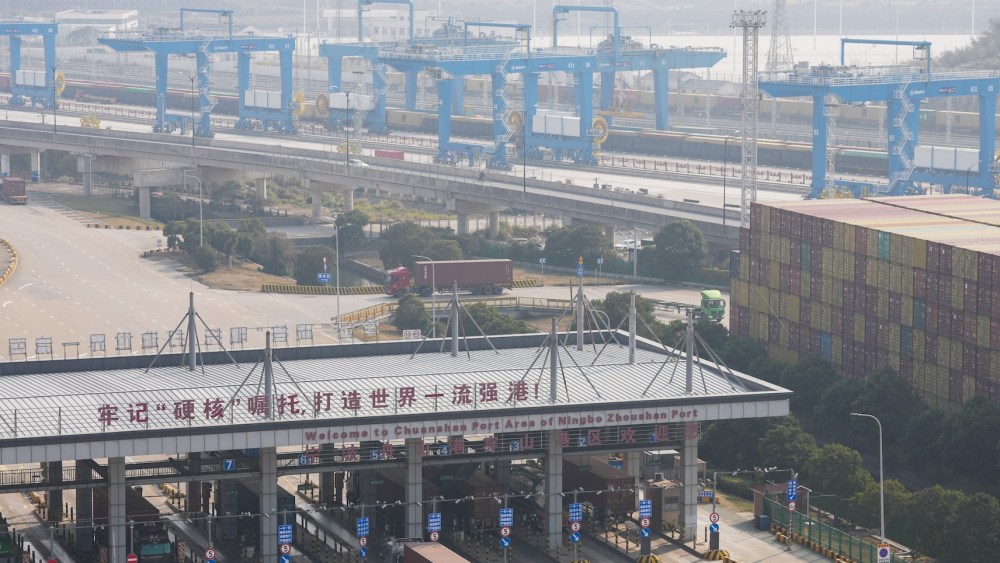
An active typhoon season continues to slam China’s east coast, again disrupting operations at two of the world’s largest container gateways.
The Port of Ningbo-Zhoushan has effectively shut down, while the Port of Shanghai’s Yangshan and Waigaoqiao terminals are suspending operations as Typhoon Saudel nears landfall in China.
The typhoon is tracking west-northwest across the East China Sea at “Force 15” winds, which reach sustained speeds of roughly 104 to 114 mph. Landfall is forecast between central-southern Zhejiang and northern Fujian on Friday morning local time.
Congestion off the coast of China has strained logistics networks in the wake of storms including Typhoon Bavi and Typhoon Dolphin, both of which caused major port terminals to close for multiple days in July and August and interrupted berth sequencing in the surrounding weeks.
Container shipping research firm Linerlytica estimated Monday that the east Asian berthing delays are primarily responsible for 4.3 million 20-foot equivalent units (TEUs) worldwide being stranded, accounting for 12.6 percent of global fleet capacity.
As Typhoon Saudel approached the coast, movement in and out of the Port of Shanghai began to subside. According to MarineTraffic data released Thursday morning, Shanghai recorded 1,506 port-call movements in a 24-hour stretch, around 70 percent fewer than the 5,039 movements recorded during the preceding day.
The latest total comprised 673 arrivals and 833 departures, reflecting a sharp slowdown as operators adjust schedules around the storm.
On Wednesday, German ocean carrier giant Hapag-Lloyd said both the Ports of Shanghai and Ningbo-Zhoushan were expected to close through Saturday because of the typhoon, with the company warning of elevated waiting times at both ports.
The Port of Ningbo was the first major gateway to officially shut down. Empty container operations were suspended at 4 p.m. local time Wednesday, followed by a halt to all terminal operations at 8 p.m., according to Kuehne+Nagel. By Thursday, the port had escalated its emergency response to Level I, the highest tier, with container yards suspended from 6 a.m. and warehouses from 2 p.m.
In the hours ahead of the closing, 41 container ships longer than 820 feet were arranged to enter the port and discharge cargo to limit disruption.
Terminals in Shanghai followed suit Thursday. Yangshan halted empty container operations at 4 a.m. and all operations at 6 a.m., while Waigaoqiao suspended empty container operations from 2 p.m.
While terminal and vessel operations have been suspended, Shanghai’s container yards, trucking services and warehouses remained operational as of Thursday, according to Kuehne+Nagel.
No new berthing windows will be granted during the clearance period, compounding berthing delays across all alliances, said Seko Logistics in a customer advisory.
Resumption of gate activity will be announced post-storm following structural safety inspections.
Hapag-Lloyd said Shanghai’s Yangshan terminal was already averaging waits of five to seven days for Gemini Cooperation vessels longer than 1,200 feet, eight to 10 days for smaller Gemini vessels and seven to 11 days for non-Gemini vessels. More than 139 container vessels resided in the port’s outer anchorages as of Thursday morning, Seko said.
At Ningbo, Gemini services were waiting an average of four to five days, while non-Gemini vessels were facing waits of three to six days, according to Hapag-Lloyd.
The immediate impact for shippers is likely to be a combination of vessel delays, rolled cargo and schedule changes as carriers work through the existing backlog while waiting for terminals to reopen.
Seko is advising shippers to build seven- to 10-day-plus buffers into east China bookings and prepare for potential port omissions, blank sailings and cargo diversions to alternative gateways including Qingdao, Busan and Hong Kong.
The congestion at the major ports is a catalyst for recent increases in container prices for intra-Asia trade.
Since July 30, when it cost $956 to transport an average 40-foot container from one major Asian port to another, ocean spot freight rates have increased 25 percent to $1,199, according to data from maritime advisory Drewry.
On a one-week basis, these rates have increased 10 percent, pushing the company’s Intra-Asia Container Index to its highest level in three years. Drewry expects freight rates to increase further in the coming weeks, supported by the persistent weather-related disruptions and port congestion.
Some of the biggest individual spikes have come in southeast Asia.
Rates from Shanghai to Thailand’s Port of Laem Chabang surged 27 percent to $1,024 per 40-foot container, while those on the path from Shanghai to the Port of Manila in the Philippines spiked 24 percent to $691 on average.