
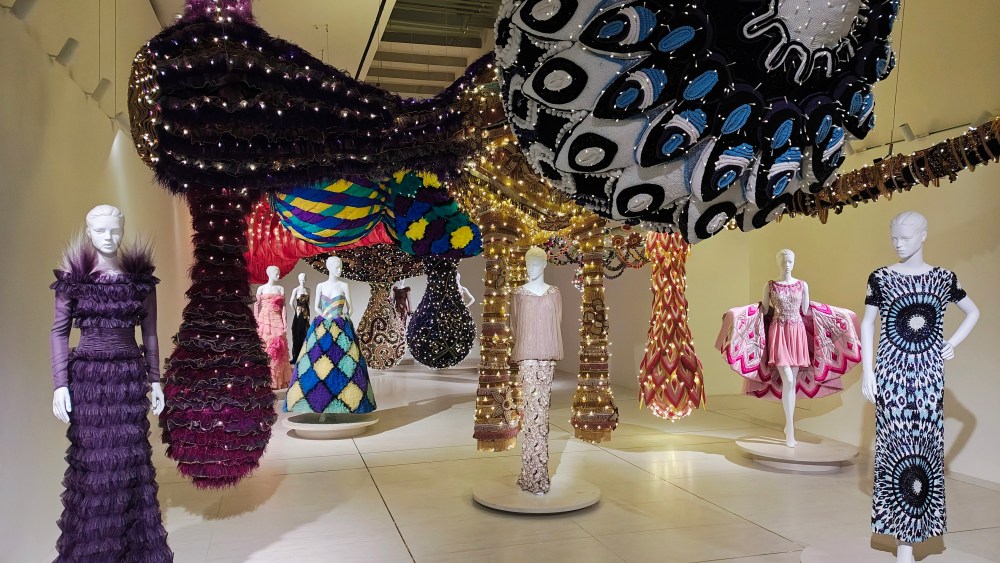
ROME — Venus and Rome are deeply interconnected, as the deity — one of the most widely referenced in mythology as the embodiment of love, beauty and prosperity — was also considered the ancestor of the Roman people through her son Aeneas. Now there is another Venus in the Italian capital thanks to the Valentino Garavani e Giancarlo Giammetti Foundation.
Debuting Sunday and running until May 31 at the foundation’s space PM23, the exhibition “Venus — Valentino Garavani through the eyes of Joana Vasconcelos” is unmissable, as the Portuguese artist reinterpreted the couturier’s creative universe through her own vision across more than 10,800 square feet.
The exhibition displays 12 works by Vasconcelos — including major existing installations and new site-specific pieces — together with 33 creations by Garavani, selected from the archive and curated by Pamela Golbin.
You May Also Like
Symbolic of the exhibition is the monumental “Valkyrie Venus,” named after the female warrior deities of Norse mythology, and conceived by Vasconcelos in direct relation to the space, as an extension of eight dresses unfolding through its arms, representing also an abstraction of the multiple facets of contemporary female identities.
“Every dress receives even more strength and beauty from the installations surrounding it,” said Giammetti. “With her sculptures, Joana magnified some details of the dresses and the artisanal work that could be missed in a photo or even on the catwalk. There is no need to explain the crochet rounds that reflect the tulle work on this dress, a guest can easily see it,” he added, pointing to one of the couture gowns displayed and to the arm of the Valkyrie.

The concept behind this second exhibition is entirely different from the first, “Orizzonti/Rosso [Horizons/Red],” staged last May, continued Giammetti.
“In the first, color was the only contact between fashion and art, and we saw how red is a very important color not only for Valentino but for many artists, a group of artists that was exceptional, since the value of their work totaled 1.3 billion euros. It’s one that an art expert or anyone interested in art would be shocked to see because of its assembly of masterpieces. This is more engaging and strikes an emotional chord and can be seen as more popular, anyone can understand it. I think this is a good direction [for PM23], although there will be more artworks in the future,” said Giammetti, who is already mulling several ideas for the next exhibition.
Golbin concurred, saying that the first exhibition “was much more conceptual, it was about the purity of the line and around the color red, and so art and fashion spoke about red, but not to each other, while here it’s more about texture and sculptural feel,” as Vasconcelos explored Garavani’s legacy “in a direct conversation with it, a first for her, who had carte blanche, took direct inspiration from a fashion designer and played tribute to Rome and to all of the facets of women today.”
Vasconcelos’ made-to-measure sculptures are “inflated balloons that are then dressed with zippers and crocheted pieces that she makes. And so when we started working together, she gave me a color palette and we worked around the colors,” said Golbin.
“It’s a 14-meter long sculpture with two tentacles on either side. And what’s exceptional is that with these tentacles, all of the crocheted pieces that you see come from 756 hours of workshops that were done with nine associations here in Rome that we partnered with that allowed us not only to bring them joy personally, but now to be seen within an artist’s sculpture,” explained Golbin.

Giammetti praised Golbin — a longtime collaborator of the brand, who also curated the first exhibition — for the choice of the dresses, and Vasconcelos for her “consistency, how she is inspired by the female world.” He sees plenty of similarities between her work and Garavani’s, who “never used a sewing machine or anything technological, it was all made by hand. Joana in her atelier is the same; more than 200 people helped her put together these works with their hands.”
Golbin added that crocheting for Vasconcelos “is a language of its own. You don’t need a translator, and anyone can do it and come together in a connection, not with words, but with action.”
Vasconcelos also underscored “the direct connection, it’s kind of an inspiration that drives into a larger work, into a sculpture. So the origin is the fashion, but it ends up in the sculpture with an artwork.”

Asked to comment on this experience, she said she learned “that the level of the detail and of commitment” were similar. “I also work in craft, and everything is done by hand in my studio, and I understood how Valentino did the same, how deep he would go into the detail. And that’s really impressive, because in sculpture, I cannot go as deep as you can go in couture because in couture you have a small area. Understanding where it comes from was really interesting, the hours of dedication — it’s really a poetic thing.”
Vasconcelos recalled a visit from Garavani to her studio in Lisbon years ago and how he thought it was like a couture studio, “because we go into details and are organized as a couturier and it was the first time the two connected in my mind. Before, I was just doing sculpture so I thought maybe I’m more related to fashion than I think that I am.”

Transforming everyday objects into monumental works of art, she used shiny stainless steel pots, pans and lids celebrating the often invisible labor of women, to create super-sized shoes, including the “Marilyn” high heels, here juxtaposed with three couture dresses from the late 1990s in silk, satin, organza, taffeta and sequins in multiple shades of silver.
“Full Steam Ahead” is a surprising mechanical lotus flower made of 76 Bosch irons, symbolizing resilience and transformation, and the ambiguity of women’s lives as it is paired with a beautiful evening gown in tulle and sequins with a long train from the fall 2001 season. “I think this was probably the hardest dress for me to find, one that could never be ironed,” said Golbin with a smile.
The galleries present key works by Vasconcelos, including “Venus, The Painting” from the Crochet Paintings series, which was inspired by Josef Hoffmann’s motif featured in Valentino’s couture fall 1989/1990 collection.
“The Garden of Eden” is a really sensorial experience, a black room with 1,000 LED-lit fiber optic flowers inspired by an 18th century French garden — “obviously Mr. Valentino loves gardens,” said Golbin.
“I think he created magic in people’s lives and with these dresses, you enter in a magical life, in a magical world, in another dimension,” said Vasconcelos, walking by a black gown embroidered with a gold snake running through the front and the back and seven other standout total-black dresses in silk, georgette and lace, embellished with sequins, crystals, glass beads and intricate tulle work.
Three artworks were also displayed around Rome, and one in particular outside PM23 — Instagrammable opportunities for tourists and locals alike.

Giammetti underscored the social and philanthropic mission of the foundation, reflected by the initiatives set in motion for this exhibition.
“The Valkyrie Venus,” produced by Vasconcelos’ atelier in Lisbon — was enriched by an ambitious and large-scale social project: 756 hours of workshops, more than 200 participants of all ages, and over 200 kilograms of crochet modules created across Rome, from the historic center to the outskirts, and sent to the artist.
Students, patients, detainees and members of nine partner organizations actively took part in the work, empowering the city’s most fragile communities.
“This project offers a collective narrative on the value of working together, the transmission of knowledge, beauty as a tool for transformation, and creativity as care and empowerment, strengthening communities and leaving a lasting mark on future generations,” said Giammetti.
Higher education institutions – MAM Maiani Accademia Moda, Accademia di Costume & Moda, and NABA Nuova Accademia di Belle Arti Roma — involved students in workshops, community encounters and visual communication activities, and social and health care partners included the women’s prison Casa Circondariale Femminile di Rebibbia with Fondazione Severino; the Bambino Gesù Paediatric Hospital; Gemelli Medical Center; Differenza Donna, committed to women’s empowerment and the fight against gender-based violence, and Intersos, an international humanitarian organization.