Vietnam plans to raise its minimum wage by 7.8 percent across the country’s four regions in 2027, pending final prime ministerial sign-off.
If approved, the Southeast Asian nation’s monthly wage floor will range from 4.04 million to 5.70 million Vietnamese dong ($153.52 to $216.61), depending on the region, the government said in a statement. Workers currently receive 3.70 million to 5.31 million dong ($140.60 to $201.70) per month. The minimum wage sets the baseline employers use to negotiate pay with workers.
Ngo Duy Hieu, permanent vice president of the Vietnam General Confederation of Labor, the country’s sole trade union federation, said in a statement that the wage increase would “both take good care of workers’ lives and promote production development to achieve double-digit growth targets.”
“This confirms the shared desire of all parties involved, who met in a spirit of sharing and harmony, to both take good care of workers’ lives and promote production development to achieve double-digit growth targets,” Ngo said. “This is a result that we are all very satisfied with in the current context.”
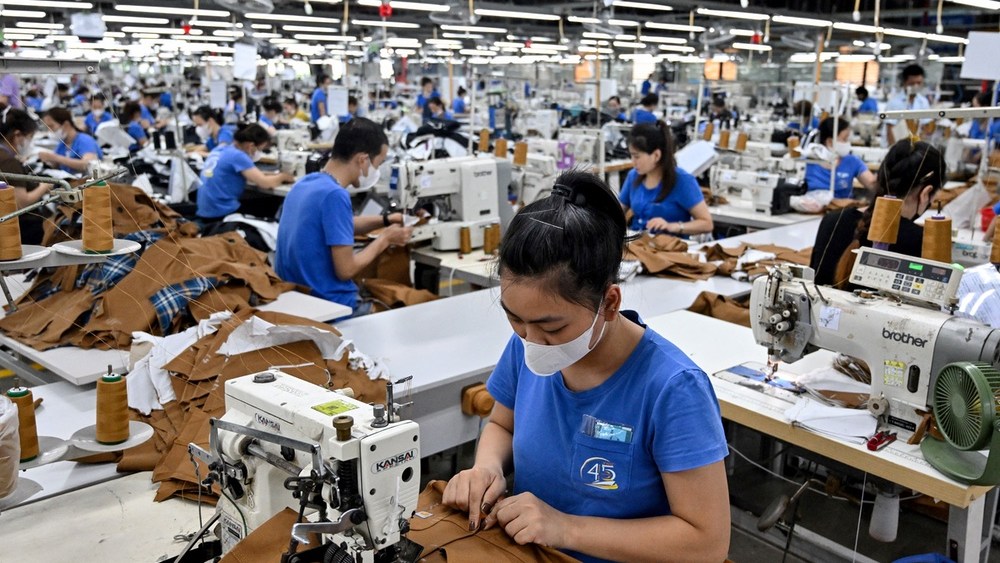
He added that he believed most workers would be satisfied with the outcome. The key question, however, is whether the increase will meaningfully offset rising living costs or simply keep pace with inflation. According to a WageIndicator benchmark, a 64 percent wage gap persists for garment workers in Vietnam.
The wage increase also comes amid strong trade headwinds, with Vietnamese goods entering the United States facing a 12.5 percent Section 301 duty under the 1974 Trade Act after the Office of the U.S. Trade Representative found that Vietnam failed to adequately ban imports made with forced labor.
Bangladesh, Cambodia, Indonesia and Malaysia stand to benefit from a so-called “textile mechanism” that could exempt part of their apparel exports to the United States from the tariffs if they use U.S.-produced raw materials. Vietnam, by contrast, gets no comparable carve-out.
That could push Vietnam to lean more heavily on its major trade pacts in Europe, especially the EU-Vietnam Free Trade Agreement and the U.K.-Vietnam Free Trade Agreement. The United States remains its largest export market, accounting for roughly 30 percent of total export turnover, with apparel and textiles totaling more than $40 billion and footwear topping $25 billion annually in overall production value.
Hanoi has rejected the USTR’s findings as inaccurate, pointing to its strict anti-forced-labor policies and compliance with International Labour Organization rules. It has also moved to tighten its customs rules by banning imports of goods produced wholly or partly by forced labor, including apparel, textiles and footwear. Signed Wednesday, the decree takes effect on Sept. 5.
“The USTR’s decision fails to fully reflect the realities on the ground and Vietnam’s efforts to prevent, reduce and eliminate forced labour, including its ban on imports of goods produced with forced labor,” Pham Thu Hang, a spokesperson for Vietnam’s Ministry of Foreign Affairs, said last week. “Vietnam will continue working with the U.S. in a constructive and cooperative spirit, while urging the U.S. side to fully take into account the measures Vietnam has adopted when adjusting tariffs on Vietnamese goods, consistent with the actual situation and Vietnam’s ongoing legislative and enforcement push.”