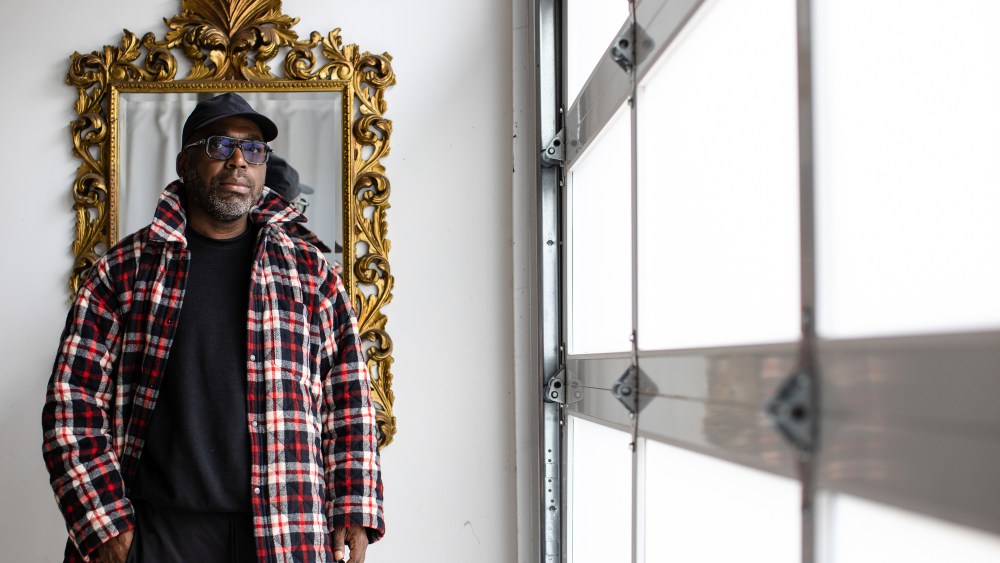
Derrick Adams’ studio, like many artist studios, is tucked on an otherwise nondescript city street. Depending which direction you take to get there, you may walk by a bodega, catch some music blaring from a car with its windows down, or pass someone rushing toward the subway, tote bag slung over their shoulder. A routine New York City stroll.
But for those who pay close attention, there’s a lot to capture. The act of looking outside of his studio is a central element of Adams’ routine and work: observing people’s mannerisms, personal style, and products being sold in the store windows.
Inside his Brooklyn studio, Adams projects what he’s gathered back out into the world through painting, sculpture, performance, and public installations that invite active participation.
You May Also Like
”A lot of my work is about what I want to see when I come into my studio,” says the artist, who’s in the process of preparing for his first midcareer museum survey. “I like to look at things in my studio that are empowering, reflective, and also revealing. And not always linear.”
Recently, that inclination materialized in a large, glittering painting of Beyoncé, created from a photo that Adams took while attending her recent “Renaissance” tour in St. Louis. The singer, rendered in Adams’ signature geometric construction, leans back atop a horse, moments before being lifted and suspended midair. “I felt there was something about that moment that was mystical,” he says of his choice to render it in paint.

In mid-March, the majority of his studio is filled with archival works that Adams has created over the last 20-plus years. “Derrick Adams: View Master,” on view at the Institute of Contemporary Art Boston, follows the publication of his monograph last fall, which traces his career through the current moment. The book became a blueprint for the museum show, highlighting three dominant themes within Adams’ work: Channeling, Signaling and Mirroring.
“ I started off my career as an artist making mostly performance and sculpture installations and video,” he says. “It was very experimental and process-focused, about material and making things that have more of a theatrical and performative presence — even the sculptural objects.”
In the middle of the studio, Adams has set up one of his earliest sculptural installations, and adds that the show includes works that he hasn’t revisited since he first made them.
The tabletop piece features a collection of wooden figures dressed in doll clothing, which populate a rug printed with a colorful 2D neighborhood cityscape. Created when he was getting his MFA in New Genres from Columbia University in the early 2000s, the work encapsulates many of the ideas that he’s continued to explore throughout his career, including representation, agency, and the influence of media and consumption on the creation of group identity.
“These objects, called ‘Play Things,’ were really talking about how commercialism and objects that you can purchase, are also representations of aspirational interests that people have,” he says. “And how those things sometimes become the representation of yourself or a group of people.”
During studio visits, Adams would sit on the rug with his guests and they would change the figures’ outfits while they talked. The interactions were rooted in an exploration of play, the politics of play, and audience participation — themes that Adams has continued to explore in the years since. In 2022, he introduced “Funtime Unicorns,” a public installation of rideable playground sculptures presented in collaboration with Art Production Fund, and shortly after installed a public playground in Washington, D.C.
Adams turns his attention to a series of sculptural works hanging on the wall nearby, geometric objects adorned with jackets that he originally showed in 2012. Created a decade after “Play Things,” these also explore the role of clothing in establishing — and accessing — identity, with the added dimension of implied autonomy.
“Most people look at sculptures as this stagnant object that you walk around and you look at. But I wanted to give the sense that the sculptures also had a presence and a consciousness,” he says. “They’re looking outward.”
The titular painting of the exhibition, “View Master,” depicts a red stereoscope, with a bespectacled man’s face depicted in both of the eyeholes. Although not instantly recognizable to most, the man is late industrial designer Charles Harrison, who redesigned the View-Master into a popular kids toy in the late 1950s. He also made his mark on many utilitarian items that, although lacking the flashiness of luxury design, bring dimension to day-to-day life.

“I think that not saying his name and putting him in the glasses is really saying to the viewer: look,” says Adams, who first encountered the breadth of Harrison’s legacy while working on an exhibition in Chicago. “I feel like it’s better to show you than tell you. And I think that my work does that,” he adds, with a caveat: “When you do that, you do risk people missing things and flattening out work sometimes.”
Although not currently displayed in his studio, Adams nods to his popular “Floater” series, vibrant paintings that depict Black figures lounging on whimsical pool floaties.
“When people look at my ‘Floater’ series, they think of this idea of Black joy…but it’s really more about multidimensionality,” he says. “It’s about the idea that there’s some people who are given opportunities to show their humanity through their moments of relaxation or repose,” he adds.
“It could be a happy moment, it could be kind of a neutral moment. It doesn’t have to be any particular sensation that’s exaggerated. It could just be a moment where the subject is in this space of self-actualization,” he adds. “The ‘Floater’ work was really about the subjects having their own fun, determining their own space and time.”
“View Master” is being presented at ICA within one large room, with a series of floating walls that “guide” visitors through the space and encourage them to discover different vantage points and relationships among the works. “ I like people to more rummage through my work than to be directed what to look at,” he says.
Several of his works will be installed outside of the museum, including his interactive “Funtime Unicorns” sculptures, rendered in black with rainbow-colored manes and tails. He’ll also wrap the exterior of the museum with a piece that extends from his works inspired by the color bars used for TV calibration, a hallmark of his childhood in the 1970s. For Adams, the bars signal: stay tuned for more.
Many people who encounter Adams’ public installations might just experience the pieces as a moment of brief joy or play, while others might then look deeper and discover his wider body of work and the ideas behind them. His D.C. playground featured a lively photo of children at play, taken shortly after the Supreme Court’s 1954 ruling against school segregation in the capital. One side of the playground is rendered in rainbow hues; the other side, an exact replica, is monochrome gray.
“ I think my success as an artist has been mainly because of my ability to shift audience through my work,” he says. “Working with the public and doing exhibitions that are outside, where people can engage with it — people who may have never gone to a museum, people who feel maybe not as welcomed in certain spaces.”

Broadening the accessibility of his work has also helped push back against the sense of elitism that often surrounds blue-chip gallery spaces like Gagosian, which represents Adams.
“You can make work about your culture and about people who occupy spaces that you feel are not highlighted — but you also can create work that isolates them from even understanding why you made what you made,” he says. “I believe that the people that you say are the inspiration for your work through observation, are the people who should be able to look at that work and see the essence of themselves projected.”
This fall, Adams is bringing “View Master” back to New York audiences, when it travels from the ICA Boston to the Queens Museum. “I love the community aspect of the museum. I feel like it’s a really good match for my aesthetic and what I do,” says Adams. While he’s called New York home for the past few decades, since attending Pratt as an undergrad, he’s also maintained intimate ties to Baltimore, his hometown. In 2022, Adams founded Charm City Cultural Cultivation, a nonprofit that cultivates local creativity, and continues to champion other initiatives and artists within the Baltimore community.
It makes sense, then, to imagine that there could be a third stop for “View Master” down the road.
“ That’s my dream,” says Adams. “Coming home.”