
New technologies often replace old ones. It’s what happened with the phone. Over time, the tool changes and parts of it disappear—the long antennas, the hard keypads, the tangled cords—until everything gave way to the small screen you’re probably holding now to read this article.
The popularity of AI in fashion is raising similar questions about the use of 3D designs. Sandra Gagnon, senior director for 3D digital product creation at Target, said it does not have to be an either-or scenario. On the contrary, her advice is to use both.
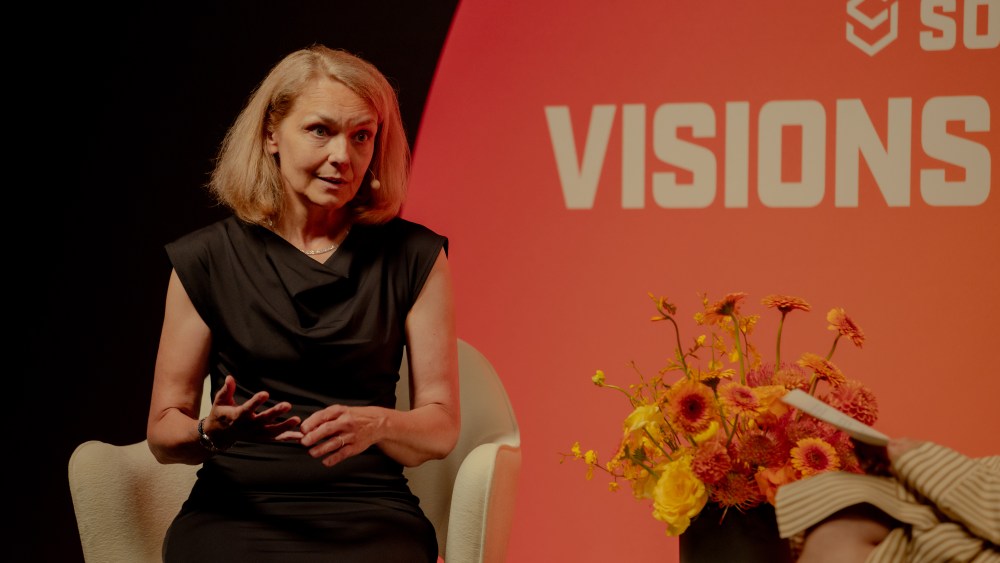
“AI and 3D are really solving different issues currently, and that’s why they complement each other so well,” Gagnon said during the Sourcing Journal’s inaugural Visions of Tomorrow in New York earlier this week. “Together, the two are a one plus one equals to three kind of moment in my mind.”
Gagnon, who has nearly three decades of experience in the industry, said AI is about iterating new ideas, while 3D design is about grounding those ideas to reality so they can also be translated into actual products on the factory floor. “It’s not an either-or [scenario]. It’s a big ‘and.’ The companies that are able to bring the ‘and’ to life sooner are the ones that are going to be the most successful in harnessing the two of them together.”
This, however, assumes companies are already good at harnessing either one of them. Gagnon acknowledged that it is difficult to get value out of a new asset, but that is partly because of how siloed teams have become within companies.
“What will it do for design? Or what will it do for development? When, really, they should probably be saying is: How does that one asset move throughout the entire organization to create value for everyone?” Gagnon said.
“Because once you have that asset, it can be for marketing, it can be for merchandising, sourcing, e-commerce, and ultimately your customer,” she said. “I think that’s where Target has really had its biggest success—when we’ve unlocked that entire value chain.”
Gagnon, who also co-founded an industry group called 3D Retail Coalition, underscored the importance of having the entire company on the same page especially when the ecosystem of technology is changing yet again.
“I think if I were to give advice, I would say before you take a step forward, take a step back,” she said, stressing how easy it is for fast-moving companies to rush the process and just add a new tool when what the situation calls for is a moment of slow and deliberate consideration. “We’ve all done that from time to time.”
Like how retailers take physical inventory to check if stocks are running short, Gagnon said there needs to be a digital inventory to think about what works and what doesn’t in the company’s day-to-day operations. In doing so, she recommended focusing on three things: the foundation of the basic data structure, the relationships needed to keep things working, and the decisions required to make sure they’re heading to the right direction.
“It’s not always just adding a new technology, right? It’s really thinking about how people work with it and how they evolve, and that’s where I think the biggest win is if you want to bring great products to your customers,” she said.