
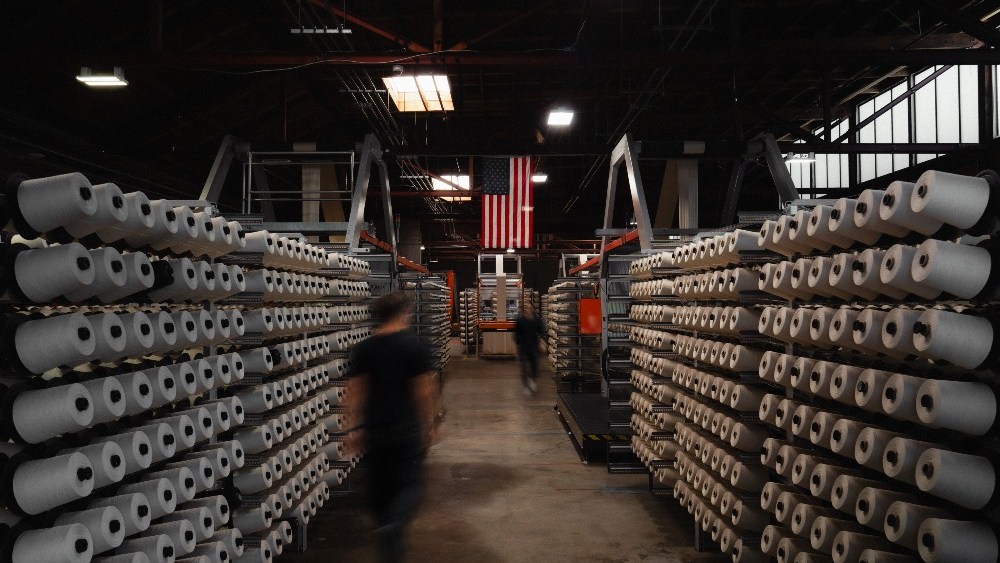
San Francisco 3-D weaving innovator Unspun has garnered the support of some of the nation’s foremost retail stalwarts as it moves to scale domestic manufacturing capacity and the use of its proprietary, AI-enabled technology.
This week, the group announced that Walmart, REI and other major supply chain partners have backed Unspun’s mission through letters of support as it works to establish 3D-weaving hubs across the United States. The retailers underscored the widespread industry demand for onshore options that facilitate next-generation apparel manufacturing.
Unspun, for its part, has equipment at the ready for deployment, and is presently engaged in assessing sites across multiple states for the project. The machines can produce garments directly from yarns using a highly automated process.
“We are not exploring whether domestic apparel manufacturing can work. We are building it,” said Arne Arens, CEO of unspun and former global brand president of The North Face. “Our clients are looking for a new production model because they see the economics: manufacturing closer to the customer, responding to demand within the same season, and creating skilled American jobs in the process.”
In just minutes, Unspun’s weaving tech can churn out semi-finished garments, negating the need for dozens of traditional cut-and-sew steps and consolidating them into a single process. The company’s value proposition parallels the growing concerns of modern U.S. industry—it enables brands to produce closer to home and to demand, allowing them to reorder within the same season, and allows them to hold less excess inventory.
Shortening production timelines from months to days can drastically improve margins—by up to 400-500 basis points—the company asserted, as on-demand production means less write-offs and markdowns.
There’s a growing demand for domestically produced products that Walmart is eager to tap into, according to its vice president of apparel production development, Avisnash Bhasker. The company has believed in the mission for several years, having partnered with Unspun in 2024 to produce a line of workwear pants for one of its private label brands.
“Our customers are proud to buy apparel made in America, and the demand keeps growing,” Bhasker said. “We are excited about Unspun’s commitment and effort in helping rebuild domestic manufacturing capability that is faster, smarter, and designed for how customers actually shop.”
The next stage is the evaluation of potential locations and their infrastructure requirements, Unspun said. It must also establish workforce training programs to lend manpower to the production hubs.
The development is a long time coming for Unspun, which put down roots in the Bay Area as a hopeful tech-fashion startup in 2017. The certified B-Corp aimed to develop a more sustainable and resilient apparel supply chain centered around regional production hubs, initially focused on denim.
Founder Beth Esponette believed that a technology boost could help the fashion sector break its toxic cycle of overproduction and its dependencies on low-cost offshore manufacturing. “The next five years will really be about setting up more of these micro-factories, to get the supply as close to demand as possible and try to localize production,” Esponette told SJ Denim in 2024.