
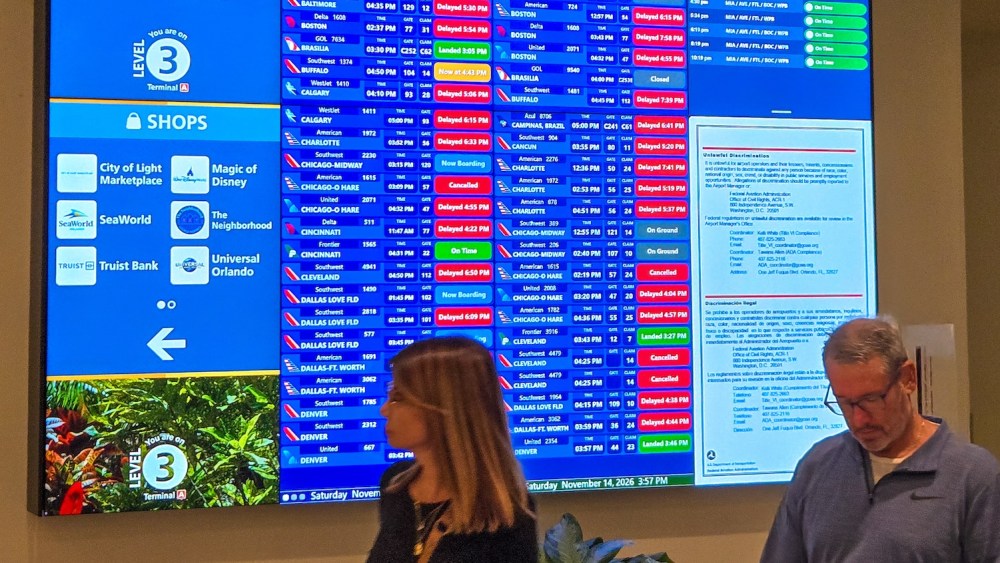
A string of major technical outages over the past few days has sent shockwaves through a number of key U.S. industries and federal agencies, grounding thousands of flights, locking customers out of their bank accounts and temporarily taking the classified intelligence network offline.
Public concern has spiked along with calls from members of Congress for immediate briefings at Capitol Hill. Officials at the federal level have repeatedly stated the various incidents are not related and there is no indication of a coordinated cyberattack.
The dominoes started falling on Thursday, Nov. 12, with a global outage of Microsoft 365 services (Outlook and Teams in particular) impacting businesses, schools and organizations across the globe. Microsoft confirmed the disruption was due to a network capacity change rather than anything malicious.
On Friday, Nov. 13, the critical national infrastructure was under attack when the FAA issued a nationwide ground stop on all departing flights for over four hours. The ground stop was initiated as a result of a router that had just been installed malfunctioning and overloading the old air traffic control communications systems. It resulted in over 9,000 flight cancellations and nearly 25,000 delays on Friday alone, with the effects continuing into Saturday.
The FBI has now joined a technical review of the router overload.
And it didn’t end there. The wave of glitches carried into the start of the new workweek in the financial and aviation sectors. On Monday, Nov. 16, customers at a number of the country’s largest banks (JPMorgan Chase, Bank of America, Wells Fargo, U.S. Bank and Capital One) were reportedly unable to log into their online accounts or were having transactions delayed. JPMorgan Chase attributed the issue to a software bug in their on-premise hardware and services were back online later that day. The same day United Airlines had a system-wide outage that lasted for just under an hour and 40 minutes and affected hundreds of flights across the country.
By Tuesday, Nov. 17, technical issues had hit both the national security systems and major consumer tech platforms. A highly classified internal comms network at the NSA had a temporary outage during what they described as normal maintenance and scheduled upgrades (the core operational systems were unaffected).
A few hours later Apple had a short disruption to iCloud, Apple Pay and the App Store as a result of an internal system update. Marriott reported a short-lived sign-in issue on their website and mobile app on Tuesday, and outage trackers saw a small spike in Gmail error reports.
When asked how these disruptions can impact consumers, Omair Tariq, CEO and co-founder of Cart.com, said he doubts if anyone is going “to scrap their online holiday shopping plans and drive to the mall instead just because Apple Pay went down for a few hours.”
“By Black Friday, most shoppers won’t remember which bank had problems this month,” Tariq told Sourcing Journal. “Online shopping is too baked into how people live now. They’re still going to spend.”
Tariq said what these outages do expose is how little patience shoppers have left. “They’re stretched thin and extremely selective this year. They’ll forgive Apple for one bad afternoon, but a retailer whose checkout freezes on Cyber Monday gets one shot. The shopper won’t hesitate to open another tab and buy from whoever’s site is working. That sale is gone, and probably the customer with it.”
The CEO said this exposes a much bigger problem this holiday shopping season. “A lot of retailers ordered cautiously and are counting on Cyber Week to make their year,” he said. “For some of them, an hour of downtime on the wrong afternoon could be the difference between a decent quarter and a tough conversation with their lender.”
Tariq said the question for every retailer right now isn’t whether something will break this holiday season. “It’s whether they’ve stress-tested what happens when it does,” he explained. “The big players have spent years building redundancy into their tech, their warehouses and their carrier networks. Mid-market brands need the same protection, and they shouldn’t have to build it from scratch to get it. They need access to infrastructure that was built at that scale.”
Tariq said the shopper always has a backup plan. “Plenty of retailers don’t.”
These disruptions also have a psychological dimension to them. And while media coverage of major technology disruptions typically focuses on financial losses and downtime, experts at Montclair State University said in recent research reports that these events also trigger severe psychological fallout. High-profile outages and suspected cyberattacks erode fundamental digital trust, stripping away users’ sense of safety and control. This creates chronic anxiety, hypervigilance or even platform avoidance.
Antony Karabus, independent retail advisor and formerly of Accenture, said consumers may tolerate disruptions caused by routine legacy system upgrades, but a growing consensus is that these recent incidents are cyberattacks that rattle confidence. The government and many of the companies involved have denied that these outages are cyberattacks, but investigations are continuing.
Karabus said the widespread, near-daily outages this past week leave shoppers questioning whether retail websites have adequate security to protect their email addresses, payment details and personal identifying information.
“There’s no doubt that if people think it’s hacking, it’ll make them nervous,” Karabus told Sourcing Journal. “If consumers believe it’s just old equipment being updated, they may not react as strongly—but there’s a growing consensus that this is hacking. It’s either cyberattacks, or there’s a massive amount of AI being layered on top of very old legacy systems, and the old and the new aren’t playing nicely together. Still, it’s hard to imagine this isn’t hacking because it’s too widespread, happening almost once a day.”
There are other issues too. “The fact that the biggest, most profitable, most successful companies are the ones getting impacted almost makes people ask, ‘Is anybody safe?’” Karabus said. “These aren’t secondary companies—we’re talking about Apple, JPMorgan, Microsoft. These are huge, critical organizations.”
Meanwhile, the string of failures across key sectors in the run-up to the busy Thanksgiving travel period as well as the kick-off of the holiday shopping season has drawn serious attention in Washington. House Minority Leader Hakeem Jeffries called on the administration to provide a briefing to Congress on the failures and to detail the steps being taken to safeguard critical infrastructure. Sen. Mark Warner (D-VA), Chair of the Senate Intelligence Committee, has suggested that the rapid patching of software vulnerabilities identified by AI tools may be increasing the risk of inadvertent system bugs.
Still, the intelligence community was keen to allay concerns about foreign interference. DNI Jay Clayton said on Tuesday that there was no evidence of state-sponsored activity or a coordinated attack at all.
The conclusion they’ve come to is that the incidents are simply the result of a confluence of routine maintenance, system updates and the fact that the systems are old and in need of it.


