PARIS — French heritage label Weill is targeting double-digit growth over the next three years as it accelerates international expansion across the U.S., Middle East and Asia, betting that a more cautious luxury consumer will respond to what chief executive officer Elie Weill calls its “fair price” positioning.
The 134-year-old, family-owned brand has spent the past two years overhauling its retail concept and sharpening its product offer, laying the groundwork for a wholesale-led push abroad.
Retail sales in France rose 15 percent last year on a comparable store basis, while e-commerce grew 40 percent in 2025 following a website revamp and updated creative direction, said Weill.
You May Also Like
“We are targeting 50 percent [cumulative growth] because we have a lot of potential regarding retail, and we believe we can continue to grow by 10 to 15 percent every year even in a challenging market,” Weill told WWD.
In a market defined by volatility at both the high end and the mass tier, Weill is betting that disciplined distribution and a strong price proposition can deliver growth — even as the broader luxury cycle cools.
The growth plan relies on three pillars: strengthening the domestic retail network in key midsize cities; accelerating international wholesale distribution, particularly in the U.S., and expanding selectively through franchise partnerships in higher-growth markets, including Hong Kong, Taiwan and the United Arab Emirates.

In the Middle East, Weill will open two monobrand franchise stores — one in Abu Dhabi and one in Dubai — through a new partnership with Prime Elegant.
The brand already operates franchise stores in Kuwait and Qatar. Weill described the Gulf as “dynamic” and said that its product mix of bright colors and natural fabrics resonates with local consumers.
“Even in our stores in Paris, we have a huge customer base from the region and especially Abu Dhabi and Dubai,” said Weill. “So they will be happy to find the brand again in their country, directly. Kuwait and Qatar are huge markets for us, and I think Dubai will be even more successful.”
For the Hong Kong and Taiwan expansions, Weill is entering carefully selected retail centers with stand-alone stores, alongside new franchise partner Queenix Asia.
In Hong Kong, the brand will open a store at Times Square mall, a high-traffic shopping hub in Causeway Bay. In Taiwan, Weill is opening in Bellavita Mall, a destination known for high-end fashion, design and lifestyle brands, as a traditional luxury environment that aligns with the brand’s heritage positioning.
This approach allows the label to introduce its “Made in France” and “Made in Italy” storytelling to Asian customers while adapting to the nuances of each market — high foot traffic and aspirational shopping in Hong Kong, and a curated luxury setting in Taiwan.
The CEO acknowledged the broader regional slowdown in Asia, but believes Weill is very well positioned to gain a foothold there.
“Yes, the market is struggling, but it is still a very big market,” he said. The executive said that the brand’s family history and artisanal approach distinguish it from “affordable luxury” competitors — even if he is not fond of the phrase that groups Weill with some contemporary and mass-produced high street brands.
“They really love the storytelling, and ‘family business’ is something they really value. We have a lot of Made in France and Made in Italy products with French and Italian fabrics. That’s something that really differentiates us from other brands — even European ones that don’t have these kinds of fabrics or craftsmanship,” he said.
Still, Weill is stepping into Hong Kong and Taiwan selectively, and does not have plans to expand into mainland China, where foreign luxury demand has yet to bounce back.

Weill considers the U.S. the brand’s biggest opportunity. But rather than opening stand-alone stores, the brand has partnered with New York showroom Stylistico to rebuild its wholesale distribution after taking a step back from the market.
In its first week of sales, held ahead of New York Fashion Week, the label secured 12 new retail doors, Weill said.
“We have not been working aggressively in the U.S. market for a long time,” Weill said, noting that the company exited department store distribution roughly a decade ago.
A return to major U.S. department stores remains under consideration but is not central to his near-term plan. “I would like that to happen over the next seasons, but it is not a priority to be honest because I know they are struggling too,” he said.
Instead, the focus is on independent boutiques that cater to what he describes as a niche but underserved customer — women in their 40s and 50s seeking polished, French-inspired tailoring and cocktail dresses at a lower price point than established American luxury brands.
A stand-alone U.S. boutique is not out of the question, but only “hypothetical” for the near future.
Despite department stores’ struggles, particularly following restructurings and financial pressure at major U.S. chains, Weill sees opportunity in the current luxury environment. Customers are still craving quality products, but their reassessment of price and value has shifted.
“The slowdown of luxury is offering us an opportunity, because people are still looking for beautiful, nice products, but with a fair price, and that’s something that we can offer,” he said.
He avoids the term “affordable luxury,” instead describing the brand’s positioning as “pret-a-couture” — a portmanteau for high-end fabrics sourced from France and Italy with ready-to-wear production.
“The States is really important in terms of wholesale, and honestly speaking, our biggest potential, because I really believe the product is relevant for the market,” Weill said.
The brand has no immediate plans to expand into fragrance or beauty — or launch an array of handbag styles to drive sales. And while tariffs are something that Weill “constantly monitors,” the brand’s pricing keeps it competitive with its peers in the U.S., even if there are additional levies or costs before it hits the retail floor.

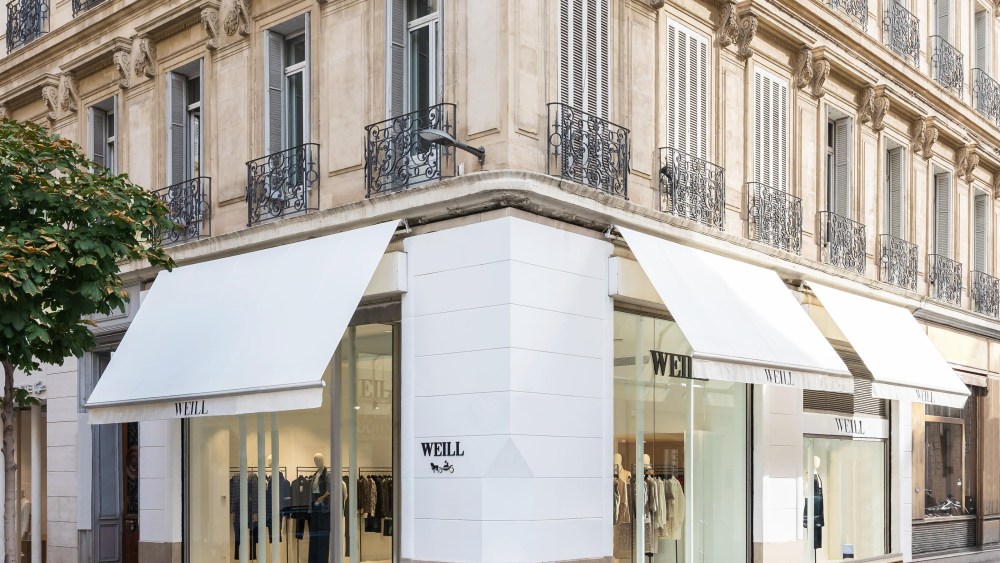
The international expansion drive follows an extensive refresh of the brand’s French store network. Nearly all the domestic boutiques have been renovated over the past two years around a new concept inspired by a minimalist Parisian apartment, designed to showcase what Weill describes as increasingly sophisticated collections.
The brand currently has 25 boutiques. Three additional stores are scheduled to open in France by midsummer — in Lille, Lyon and Nantes — reinforcing the company’s home-market base before further international rollout.
The company is privately held and fully owned by Weill, the great-great-grandson of the founder. That independence removes pressure for rapid growth but also means expansion must be financed internally — something he positioned as a competitive advantage at a time of industry consolidation. He’s the fifth generation of the family to run the business and he hopes to pass it on to the sixth.