Fine jewelry has been luxury’s shock absorber in a difficult market, and it is expected to continue to withstand the pressure in the coming months.
According to Bain & Company and Altagamma, growth of jewelry is set to fall between 4 and 6 percent in fiscal 2025, and gain market share compared to other segments such as luxury cars. According to Grand View Research, luxury jewelry is expected to have an 8.7 percent compound annual growth rate in the years to 2030.
Growth will come from three main factors: Jewelry’s precious metal content, its creative value and the aura of the brands making the designs.
You May Also Like
“Branded jewelry will continue to be the fastest growing product segment in personal luxury,” said Mario Ortelli, managing partner of advisory firm Ortelli & Co., in an interview. “People are looking at branded jewelry for its superior design and its ability to retain value and price over time.”
Those factors are pushing established jewelry brands to develop new designs, and luxury fashion and lifestyle companies to step up their efforts in the space. “It is a fantastic category because it adds cachet to a brand and not dilution,” Ortelli added. “And in jewelry, you can sometimes play at lower price points.”

Although the market is ready to absorb these new offerings, there are challenges ahead in the shape of precious metal prices, and gold in particular.
Central banks, investment funds and yoyo-ing U.S. tariffs drove up the value of gold in 2025, with prices hitting a record high of $4,524.40 an ounce on Dec. 24.
Gold, long viewed as a safe haven, isn’t the only metal on the rise, however. On Dec. 24, silver also hit a high, trading at $71.66 an ounce, compared with less than $30 at the start of the year. The price of gold has since come down, with gold trading at $4,369.81 on Jan. 2. Silver’s ascent has continued, with the metal trading at $73.84 on Jan. 2.
According to J.P. Morgan, gold has not finished its bull run. “While this rally in gold has not, and will not, be linear, we believe the trends driving this rebasing higher in gold prices are not exhausted,” said Natasha Kaneva, head of global commodities strategy at J.P. Morgan, in a recent report.
“The long-term trend of official reserve and investor diversification into gold has further to run. We expect gold demand to push prices toward $5,000 per ounce by year-end 2026,” she added.
J.P. Morgan is forecasting prices to average $5,055 per ounce by the final quarter of 2026, rising toward $5,400 per ounce by the end of 2027.
Soaring gold prices have left jewelry designers stunned and forced them to get even more creative with their designs.

They’re pressing platinum and silver into action, reducing the weight of their solid gold pieces and changing production methods in order to control the amount of gold they use. In most cases they’re also taking stock of their professional values, and finding ways to stay true to their aesthetic and to the desires of their clients.
In his many decades as a jeweler, Stephen Webster said he’s never seen gold prices spike like they did in 2025. As a result, he’s been trying to “shift” clients from white gold to platinum, while all of his new bridal designs are in the latter metal, which is around half the price of gold right now.
Diamonds, by contrast, have been on an altogether different trajectory. Prices have plummeted by up to 40 percent since 2021 due to the rise of less-expensive lab-grown gems; concerns around traceability; sanctions against rough diamond giant Russia, and a slowdown in luxury consumption in China.
In response, De Beers Group shut its Lightbox brand of jewelry made from lab-grown gems (which have also fallen sharply in price) in order to double down on its core business of mined rocks.
In May, the diamond giant said the decline in lab-grown diamond values underpins its core belief in “rare, high-value, natural diamond jewelry as a separate category from low-cost, mass-produced lab-grown diamond jewelry.”

Be they mined or man-made, diamonds are in trouble. In 2020, Rio Tinto shut its Argyle diamond mine in Australia, which produced distinctive pink, red and violet stones. It plans to close its only remaining diamond mine, Diavik in Canada, in early 2026.
The Diavik closure will mark the end of an era for Rio Tinto, which will focus instead on mining metals and minerals such as iron ore, copper, aluminum and lithium to feed growing demand for smartphones, laptops and electric cars.
With precious metals and rocks on a roller-coaster ride, jewelers are hoping that creativity will keep customers interested, and coming back for more.
“When you’re a jeweler, you want to sell a design, [not] gold or stones, because you cannot differentiate yourself so much in that. You also don’t want customers to reverse-engineer how many grams of gold — or whatever — is in a piece of jewelry,” said Ortelli.
“When you buy a Loro Piana jumper, a Louis Vuitton bag or a Gucci T-shirt, you are not asking how many grams of cashmere or square centimeters of leather or cotton they contain,” he added.
Still, while the jewelry sector may be positioned for further growth, Western brands in particular will face challenges from competitors in Asia.
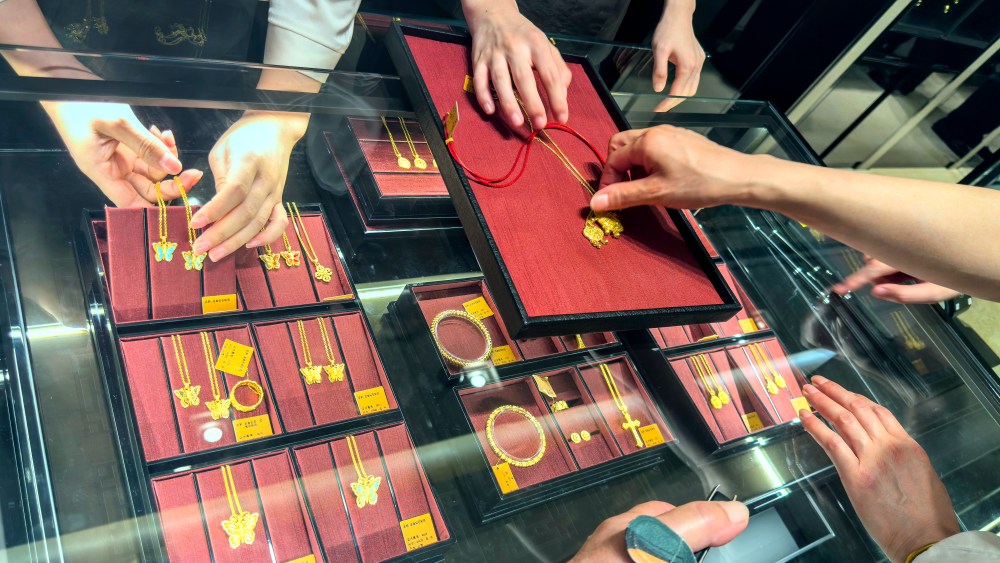
Laopu Gold, the breakout star of the Chinese jewelry market, has caught the eye of luxury titan Bernard Arnault of LVMH Moët Hennessy Louis Vuitton, while Borland, a Chinese filigree specialist, revealed in December it had received an investment from Kering Ventures.

Both offer 24-karat gold items, and styles that resonate in particular with younger consumer cohorts.
“If Chinese brands are able to build up this narrative that [references] traditions of craftsmanship, a certain design and so on, they can be relevant, not only to the Chinese consumer but also to the international one,” Ortelli said.
He pointed to the infusion of Chinese motifs and materials in pieces created over the years by Cartier and Van Cleef & Arpels that have been worn by Europe’s grandest customers.
“We can remember that many fine pieces of jewelry with Chinese design inspirations went on the wrists and necks of European aristocracy [while] traditional motifs and materials such as dragons and jade influenced the creations of brands like Cartier and Van Cleef & Arpels,” Ortelli continued. “There is a lot of opportunity there.”