
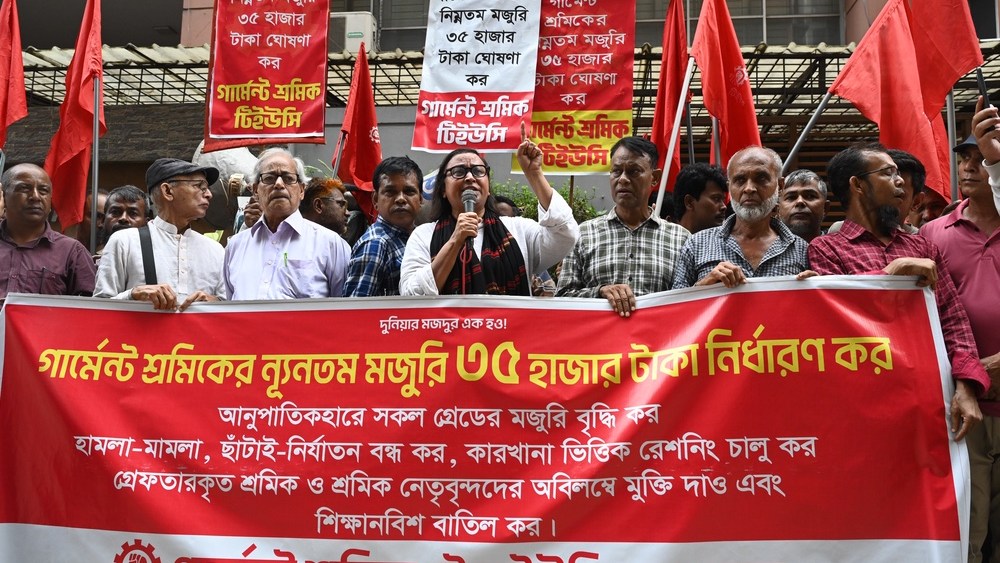
Negotiations on a new minimum wage for Bangladesh’s garment workers hit an impasse Monday after nine-and-a-half hours of bargaining failed to produce consensus between employers and workers’ representatives on a revised pay structure.
Speaking to the media afterward, Syed Azad Subhani of the six-member minimum wage board expressed optimism that a decision could be reached when discussions resume at an “extended session” Tuesday.
Both sides have been invited to submit fresh proposals after factory owners called workers’ demand excessive and union leaders rebuffed the employers’ counterproposal as inadequate. Subhani said the board decided not to disclose the employers’ offer to avoid further escalating the ongoing unrest, though he told reporters that it was higher than 14,500 taka ($116).
Workers have pleaded hardship, saying that persistent inflation has driven up the cost of food, rent, healthcare, transport and children’s education since the 2023 wage review, leaving them struggling to cover basic expenses without taking on heavy amounts of debt. Their representatives are calling for a new minimum wage of 32,000 Bangladeshi taka ($257), up 156 percent from the current 12,500 taka ($100).
Factory owners argue, however, that such a steep wage hike would be financially untenable, especially for smaller operations whose razor-thin margins are less able to cope with rising production expenses, gas and electricity shortages and weakened consumer demand in key export markets. They also say that such an increase could hurt Bangladesh’s competitiveness against rivals such as Cambodia and Vietnam.
Advocates for a substantially higher minimum wage note that the current minimum wage sits more than 51 percent below the Global Living Wage Coalition’s 2022 living wage estimate for Dhaka. Last week, the Centre for Policy Dialogue, a Dhaka-based think tank, said workers need 16,351 taka ($132) to maintain the purchasing power of the current minimum wage, and 18,578 taka ($149) to keep a four-member family above the upper poverty line. The Bangladesh Garment Manufacturers and Exporters Association, the trade group also known as the BGMEA, has rejected those numbers, questioning the methodology behind them.
Anger over the wage dispute has erupted into mass protests across Bangladesh’s industrial enclaves, including Ashulia, Gazipur and Savar, shuttering or suspending hundreds of factories and disrupting production over the past month. Overlapping demonstrations by former prime minister Sheikh Hasina’s supporters have compounded and complicated the situation, with Tarique Rahman’s Bangladesh Nationalist Party-led government accusing the now-banned Awami League and outside instigators “across the border” of stoking already inflamed tensions.
On Sunday, the BGMEA said an increasing number of Bangladeshi garment exporters are resorting to airfreight to meet delivery deadlines. Even so, international buyers have transferred confirmed orders for 59 million garments, worth $254 million, to other countries as a result of the turmoil. A preliminary survey of 317 factories that halted production for 1 to 16 days this month put losses at $428 million in free-on-board value. Actual losses, the BGMEA added, could be higher.
“It is imperative to overcome this critical situation as soon as possible, in the interest of the country’s economy and the livelihoods of millions of workers,” Md. Shahedul Islam, the organization’s secretary-general, said in a statement. “The extent of the damage cannot be measured solely in terms of immediate financial losses. The unrest has also seriously affected the long-term image, reliability and future prospects of Bangladesh’s garment industry in the global market.”
A crackdown on the protests has also led to the arrests of at least 60 people, including union leaders and workers. After police detained Sultana Begum and Md. Elias, president and general secretary of the Green Bangla Garments Workers Federation, respectively, following a webinar on garment workers’ minimum wage demands, multi-stakeholder organizations such as the American Apparel & Footwear Association and the Fair Labor Association published statements calling their detention “unacceptable” and urging the government to “respect the right of workers and trade unions to freedom of association and their calls for a fair wage that allows garment workers to support themselves and their families.”
Members of the groups include some of Bangladesh’s biggest apparel buyers, including H&M Group, Gap Inc., Primark, Levi Strauss & Co., Uniqlo owner Fast Retailing and Zara parent Inditex. The Clean Clothes Campaign, the garment industry’s largest consortium of trade unions and civil society organizations, has called on brands to support the 32,000 taka figure and commit to responsible purchasing practices that make room for the higher labor costs. Of them, however, only Oberalp Group, an Italian outdoor apparel purveyor, has publicly done so.
More than 100 labor and human rights organizations across Asia, including the Asia Floor Wage Alliance, Amnesty International Indonesia, the Cambodian Alliance of Trade Unions and HomeNet Pakistan, also signed an open letter Friday, calling for the release of Begum, Elias and “every garment worker and trade union leader detained for exercising their right to organize—immediately and unconditionally.”
“These leaders committed no offense,” the letter said. “They were seized for nothing other than representing workers demanding a meaningful revision of the minimum wage. This is not an isolated act. It is part of an escalating campaign of arrests, fabricated criminal cases, surveillance, intimidation, and violence against garment workers and trade union leaders engaged in the ongoing minimum wage struggle—a struggle rooted in a just demand, and one that calls for dialogue and resolution, not repression.”
The organizations also pressed more brands to come forward as Oberalp did.
“To the brands that profit from Bangladeshi workers’ labor: silence is complicity,” they said. “You cannot build sustainability reports on the backs of workers whose union leaders sit in police custody. Speak up, intervene with the government of Bangladesh, the BGMEA and the [Bangladesh Knitwear Manufacturers and Exporters Association] and back your commitments with action.”


