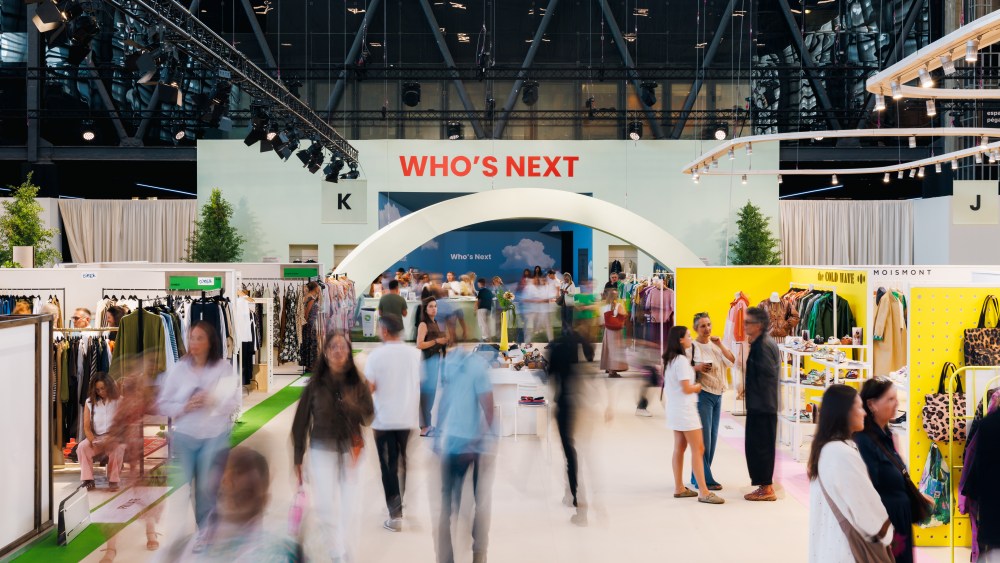
PARIS — Visitors to Porte de Versailles the first weekend of September were welcomed into a universe that was more curated than ever, with a scenography that set the tone for the multitude of product universes Who’s Next has made it its business to bring under one roof to help retailers navigate market shifts.
Overall, there were 1,300 exhibitors at the event, which Frédéric Maus, organizer WSN’s chief executive officer who has been in charge of the event since 2018, described as “my biggest ever.” As WSN leans further into design, the Shoppe Object area welcomed 100 exhibitors, twice as many as when it debuted a year ago, to help multibrand retailers cultivate demand for lifestyle assortments and stronger curation.
You May Also Like
The event saw a 3 percent uptick in visitor traffic year-over-year, according to WSN, with half of traffic representing independent retailers and concept stores, up 7.7 percent year-over-year.
The increase coincides with renewed interest in wholesale, Maus noted, given the recent challenges faced by department stores and the spiraling costs of direct-to-consumer.
“The past two years have been tough for everyone, with decelerating consumption, the rise of secondhand, and government-backed loans [in France] from the COVID-19 period reaching their terms, as well as inflation and tariffs,” he summed up. “Exhibitors are being proactive and trying to do things differently, and ultimately wholesale remains the segment where they do the majority of their business.”
As such, he sees the trade show as a facilitator for both brands and retailers, and WSN has been focused on enhancing services accordingly. “Wholesale is a model that makes sense as long as each player in the value chain is good at what they do…I’m convinced that it’s a business that is much more stable [for brands] for the long term.”
Ready-to-wear and accessories at Who’s Next, jewelry event Bijorhca and Interfilière, for lingerie sourcing, and Shoppe Object had a revamped layout to shake up visitor journeys, with categories increasingly mixed together to enhance discovery, a strategy praised by exhibitors.

As the show continues to gain traction with international visitors, who represented 56 percent of traffic — historically Who’s Next in September had been more of a draw to French retailers — a number of bigger brands were back for the first time in several years as they court business among multibrand retailers, especially internationally.
Breton brand Armor-Lux, known for its striped marine jerseys, was a first-timer, leaning into a broader offer with its Terre et Mer ready-to-wear capsule and expanding geographically beyond its coastal roots.
“Our aim is to grow our footprint through wholesale where it’s not viable to have our own stores or franchises,” Armor-Lux sales director Guillaume Thouvenot explained. “We’ve added a lot of new accounts over the past year. At the show, we’ve seen a lot of international prospects, far more than we anticipated,” he added.
Von Dutch made its return as it pursues its repositioning following its purchase by WSG Brands in 2024, seeking to bring the label to new generations of consumers and tap into the Y2K revival trend. “We’re on fire in the U.S., it’s exponential … We multiplied the business by a factor of 10 in the first year, in the U.S. at least, because the demographic is very responsive,” said operating company DNAM Brands’ sales account manager Elias Belhouane. “In Europe it’s just starting to pick up.” The revamp involves activations including a summer party in Ibiza and a collaboration with U.K. music duo Prospa, as well as a consolidation of the brand’s European e-commerce platform starting next January.
As well as helping retailers improve curation, WSN is seeking to enhance services with the addition of one-on-one sessions with buyers for personalized advice as part of the WSN Academy knowledge consultancy.
Digital and AI concepts were also a key aspect of the show. Shopping platform WhatNot hosted live sessions from the event, aiming to tap into strong growth for fashion on the marketplace in Europe. “For 12 months now, we’ve seen huge growth in the fashion vertical and we’ve started to see brands take interest in going directly and using WhatNot as a channel,” said WhatNot head of fashion for Europe Pierre Tettart. “We see WhatNot as being the perfect solution [for brands and retailers] to complement their regular activity [and] offer them the infrastructure to help them do that.”
South Korea’s StyleAI, meanwhile, showcased its pre-sampling fashion design platform, intended to improve speed to market, costs and sustainability for fashion brands, while Cabine.AI, a French start-up offering online fitting rooms, presented its first IRL prototype, a virtual try-on solution for use at retail, featuring designs from exhibitors’ collections.
Among trends seen at the show, buyers highlighted graphic prints and more elevated silhouettes when it came to ready-to-wear, and overall, a strong shift toward bolder looks. Value-for-money was also high on shopping lists.
“Walking down the aisles at market, one trend did come to mind — maximalism,” said Chris Goins, general manager of retail for The Museum of Fine Arts in Houston. “Surprisingly, it can be done with elegance and at accessible price points.”
In line with her observation, for jewelry at Bijorhca, larger styles were the name of the game, with materials like horn, ceramic and wood offering alternatives to the inflation in precious metal prices.
“There are a lot of big resin pieces and big beads, there’s a real return of big jewelry,” noted Printemps fashion jewelry buyer Marion Durel. “I liked LoveLab’s bracelets, which are a good alternative for people who have a restricted budget.”
Highlights From Who’s Next

Stella Forest
Category: Ready-to-wear
French fashion house Stella Forest, founded in 1998, was one of a number of larger players back at the show after sitting out several seasons as it looks to grow its wholesale footprint after several years focusing more on direct-to-consumer. The brand currently has 11 boutiques in France and is also strong in the rest of Europe, but is looking to expand geographically, including in the U.S., where it forged a new partnership last year. As it seeks to navigate this shift, the brand, best known for its exclusive prints and embroideries and its contemporary bohemian aesthetic, has been focusing on reinforcing its image and assortment to help buyers easily navigate their selection. At this edition of Who’s Next, “80 percent of our visitors have been potential new customers,” said director of operations Geoffroy Boniface.
Retail pricing: 130 to 250 euros

Flotte
Category: Outerwear
This fun, sustainable French brand created in 2020 by Mickaël Pan and Lyly Wu, who dub themselves “pluviophiles,” has made it its mission to put the fun back into rainwear. Their sporty silhouettes made from recycled plastic bottles have a contemporary streetwise feel, and the spring 2027 collection featured a range of fun scarf and polka-dot prints rarely seen in the outdoor-wear universe. The brand has three boutiques and is soon to open its fourth, in Lille, and recently raised 3 million euros in a funding round.
Retail pricing: 100 to 200 euros

Lorna Murray
Category: Hats and bags
Hailing from Australia, designer Lorna Murray started out as a visual artist and arts teacher before setting up her sustainable luxury lifestyle brand. Centered on innovative and distinctive collapsible straw hats handcrafted in Indonesia, she has recently built out the collection to feature bags and homewares as well as partnering with Kathy Hilton on a capsule collection. Exhibiting for the first time at Who’s Next, the brand is looking to build its European business.
Retail pricing: 180 to 210 euros

LoveLab Antwerp
Category: Jewelry
The story of LoveLab Antwerp began in the diamond district of Belgium’s gem capital, where the brand’s founding partners had the aim of making lab-grown diamonds accessible to all. The 18-month-old brand offers IGI-certified diamonds set in silver on colorful thread bracelets, and is already available in around 500 sales points across 40 countries as retailers seek out accessibly priced jewelry. Recent introductions included more elaborate designs in the shape of flowers or set with numerous stones.
Retail pricing: From 75 euros to 1,500 euros

Les Berlingots
Category: Jewelry
This three-year-old brand based near Toulouse, a first-time exhibitor, is the brainchild of entrepreneur Marion Legent, who wanted to valorize dormant stock and vintage beads and offer consumers accessories that could bring new life to existing items in their jewelry box. Named after colorful French traditional candies, Les Berlingots designs, all one-of-a-kind, combine beads interspersed with brass rings set with rhinestones. They can be worn on hoop earrings or a chain, and are available individually or as matching pairs.
Retail pricing: From 36 euros per pair

Golden Monstera
Category: Jewelry
Avid travelers Daniel Alfara and Jenn Fernandez met in the Philippines and were inspired by its heritage, landscapes and craftsmanship to create their contemporary jewelry label, which launched in 2016 and is based on Siargao Island, a surfing hot spot. Their sculptural jewelry aims to elevate brass as a noble material and integrate local elements like wood, mother-of-pearl and sand resin, working with local artisans. The brand has its own concept store in Siargao as well as a pop-up in Manila, and was opening up to international wholesale with its first showing at Bijorhca.
Retail pricing: From 45 euro to 200 euros

Raw Bhoomi
Category: Jewelry
Hailing from Bangalore, India, Ritu Rawat creates handmade porcelain jewelry that she hopes appeals to businesswomen who need to dress conservatively but want to add an easy touch of whimsy. She launched the brand just six months ago, and presses each petal on her chunky yet delicate floral designs, combined with gold-plated stainless steel or brass hardware, by hand.
Pricing: From 60 to 190 euros wholesale, including shipping

Tung Chueh
Category: Jewelry
Tung Chueh was created in 2022 in Beijing by designer Tung Chueh Wei, whose ambition is to help fill the gap between Chinese classical aesthetics and contemporary design language. The collection is centered on fine jewelry, especially for the fingertips. Crafted from gold-plated silver, gemstones, shells and plant lacquer, the selection ranges from minimalist creations to elaborate designs evoking Chinese symbolism. The distinctive collection in a largely untapped category, showing for the first time internationally, included false nails to be held on with stickers and knuckle rings featuring extensions that cover the nails.
Retail pricing: From 897 to 1,680 euros

Stangrecki Sztuka
Category: Jewelry
Polish sculptor and visual artist Tomazs Stangrecki’s stand was a perfect illustration of the maximalist trend on show. With his monumental silver and amber jewelry, Stangrecki transcends traditional notions of wearability, combining polished or corroded and patinated metal with rough-cut resin in abstract explorations of Slavic cultural heritage.
Retail pricing: From 1,000 to 10,000 euros

Ryvdoll
Category: Gifts and homewares
Showing in the Shoppe Object area, Ryvdoll is the brainchild of business school graduate and fashion enthusiast Ryvka Adda, who has created a playful world inspired by paper dolls and analog objects with the aim of transcending social media and encouraging play. Her magnetic dolls, clothing and room setups are handcrafted in France and available as a range of kits exploring different themes. Since founding the brand four years ago, Adda has collaborated with brands including Sacai, Miu Miu and Claudie Pierlot, as well as participating in pop-ups at Le Bon Marché and Isetan.
Wholesale pricing: From 14 euros to 31 euros

Asca
Category: Homewares
Founded in 1971 but unknown outside Japan, Asca creates high-end, lifelike synthetic flowers and floral arrangements inspired by Japanese craftsmanship and aesthetics. For its first trade show outside Japan, the brand was presenting a range of designs including cherry blossom, dahlias, tulips, lilies and orchids. The brand has more than 8,000 skus in its catalogue.
Pricing: From 10 to 20 euros per stem