
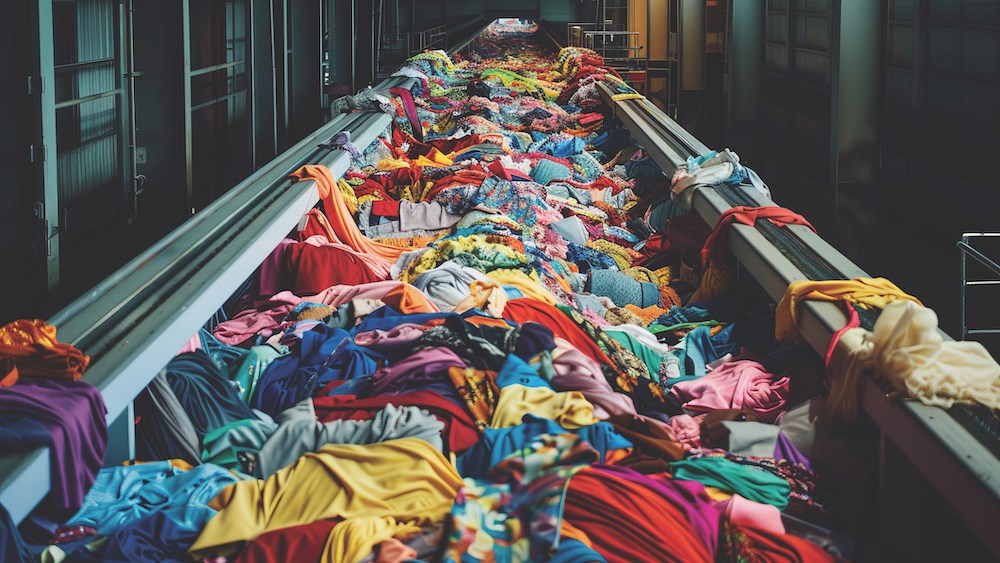
For years, sustainability in fashion has meant adopting the circular economy. But Fashion for Good’s latest report makes it clear: resale and repair alone won’t solve the industry’s overproduction issue.
The Amsterdam-based innovation platform’s “Sorting for Circularity: Project Rewear” report digs into what really happens to used clothing in Europe, Ghana and Pakistan. Working with global impact organization Circle Economy and other partners, the group looked at the condition, resale potential and downstream impact of discarded garments—just as brands and policymakers are pouring money into circular fashion.
This is all happening against the backdrop of fashion’s mounting waste crisis.
“Without parallel efforts to slow production, Rewear risks becoming either a greenwashing tactic or a parallel market that leaves the industry’s core environmental harms untouched,” the resulting 70-page report reads.
In this context, “rewear” encompasses everything that keeps clothes in use longer: secondhand and vintage shopping, rentals, swaps, repairs and upcycling. Rewear’s ecosystem is a sprawling globalized network of actors—collectors, sorters, traders, retailers, repairers—all operating across jagged geographies and their distinctive economic and social realities.
“Rewear can only be transformative if paired with measures that constrain overproduction and promote global equity,” the report contends. “Scaling rewear alone, without reducing new clothing production, will have limited to no impact.”
Project Rewear analyzed 8,280 garments across sorting facilities in the Netherlands, Spain, Lithuania and Poland. Researchers found that most discarded garments were still functionally wearable: 37 percent showed no damage, while another 41 percent carried only minor flaws such as stains, pilling or discoloration.
But most of those clothes never make it back into resale because the odds frequently do work in their favor. On one hand, cleaning, repair and sorting costs remain high. On the other hand, low-cost new fashion keeps pushing secondhand prices down.
The numbers are somewhat staggering. Since 2000, the EU’s textile exports have tripled, hitting almost 1.7 million metric tons in 2023. That said, high export volumes don’t necessarily equate to high quality.
In Ghana’s Kantamanto Market, where roughly 15 million garments arrive weekly, researchers found that many items imported for resale were already damaged by the time they reached vendors. One case study found that 86.5 percent of garments imported as “rewearable” showed some form of defect—arriving stained, faded or torn.
Traders, repairers and upcyclers do what they can by mending, altering and reselling. However, the report points out that importing countries are shouldering more of the environmental and operational fallout from overproduction. Pakistan, for example, is now a major hub for sorting, recycling and re-exporting used clothes, reportedly importing over 800,000 metric tons of secondhand textiles each year.
The report also spotlights pilot projects aimed at breaking down the barriers that keep repair, reuse and resale from scaling.
Save Your Wardrobe developed an open-source Aftersales Diagnostics Tool to help brands identify opportunities in garment care and repair services. United Repair Center, in partnership with Kringloopwinkel and ModaRe, redirected 164 garments from lower-value export channels into European secondhand markets through repair and creative restoration work. Berlin-based startup Reverse.fashion tested AI-supported sorting tools intended to help operators identify garments with stronger resale potential more efficiently at the sorting stage.
Still, the report makes one thing clear: technology and resale growth alone won’t fix the system.
“This type of transformation requires economy and society-wide changes: the changes and outcomes desired will not be achieved with tweaks and interventions at the margins of the existing system,” the report states. “An overhaul of existing norms around what is valued, incentivized and prioritized is needed—the extent of this change requires deep cultural shifts as well as economic ones.”
Fashion for Good‘s view is that the rewear ecosystem is already in place, but it is challenged by economics and incentives. Operating under this perspective, the bottleneck isn’t about getting consumers on board—it’s about recovering value. It’s one of the reasons why Project Rewear positions reuse and repair as more impactful than any future downstream recycling strategies.
That distinction matters. More resale doesn’t automatically mean less consumption, especially when production keeps climbing.
Project partners include Artdiction, The Revival, Knowtex and the National Textile University in Pakistan. Implementation partners include Circle Economy, Erdotex, ModaRe, Humana People to People Baltic, Wtorpol, Valvan Baling Systems and Refashion. Advisory partners comprise the Denmark-based consulting firm Revaluate and Oslo Metropolitan University, the third largest public research campus in Norway.
In January 2024, the Netherlands-based organization launched an 18-month initiative with Circle Economy, as well as brands such as Adidas, Inditex, Levi Strauss and Zalando, to enhance textile sorting using AI technologies.
Last month, Fashion for Good rolled out Project FAE—Feedstock Activation Europe. The goal: upgrade Europe’s sorting and pre-processing systems so that non-rewearable clothes can actually feed large-scale textile-to-textile recycling. It’s a direct shot at one of circularity’s biggest hurdles: turning waste into value.