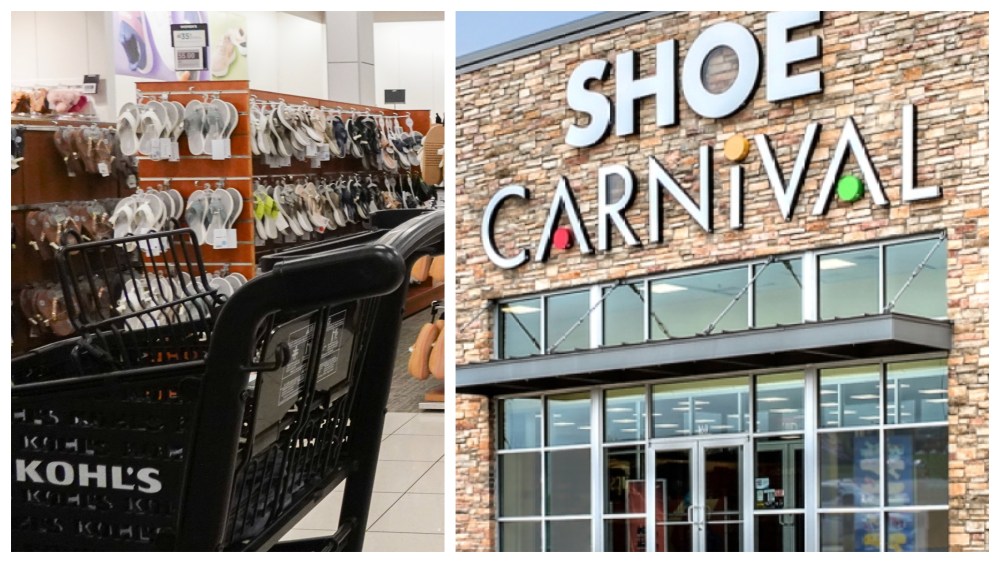
Kohl’s Corp. kept its eye on the consumer, while Shoe Station Group Inc. could have done a better job.
Both Kohl’s and Shoe Carnival target consumers on the hunt for moderately-priced fashion apparel and footwear.
For Kohl’s, footwear in the third quarter represented a big turnaround category for the retailer. The department store’s strategy to elevate product relevance served it well, particularly in shoe sales.
Michael J. Bender, Kohl’s chief executive officer, told investors Tuesday during the company’s earnings conference call that priority brands continued to resonate with customers as they play an important role in the overall brand portfolio and value proposition.
“As we anticipated, our footwear busines returned to growth in the third quarter, generating a 4 percent positive comp. This marks over a 700 basis point improvement from just the second quarter,” Bender said. “Highlights include improved newness and depth in key brands like Nike, Adidas, and Skechers, all delivering positive comparable sales.”
You May Also Like
Bender described the 700-point improvement as a “big, big change,” adding that the business began to turn in the back-to-school timeframe. That was when the retailer also began to see strength in its kids’ footwear business, which he noted in the second quarter conference call. Moreover, as growth in the footwear category began to build in the second quarter, Kohl’s brought in both fresh inventory and additional depth in its core active brands that include Nike and Adidas.
Separately, Telsey Advisory Group‘s chief investment officer noted in September the “renewed momentum in footwear,” noting that when Kohls’ is able to offer value, newness and innovation, consumers are still shopping.
Bender in Tuesday’s conference call was also upbeat about the performance in the retailer’s boots business, which he said was heavily impacted by tariffs last fall. “In the third quarter, boots grew over 20 percent versus prior year, and we expect positive momentum in boots to continue into the fourth quarter,” he said.
Bender also said that the focus for the past year has been on “curating this balance of proprietary brands and national brands [in the portfolio], complete with Nike, Levi’s, et cetera.” Bender emphasized that the team has been “supremely focused on value” and making sure that value is being defined by more than just by price — meaning by a mix of “price, quality, convenience, style and making sure that the combination of those elements bring forward an inspiring experience for the customer.”
When Shoe Station posted third quarter results on Tuesday, the big news was that it has dramatically halted its ambitious store conversion plan and will revert most locations to their original banner.
“We currently operate 131 rebannered stores,” interim president and CEO Cliff Sifford said. “Of those, 27 are Shoe Station at Rogan’s locations, and they will return to operating solely under the Rogan’s name. We are evaluating the remaining 104 stores now and will determine the exact number over the next few weeks. We currently estimate that 75 percent or more of them will return to the Shoe Carnival banner.”
Some changes, particularly for signage, are expected in the first quarter of fiscal 2027. The retailer operates three nameplates, Shoe Station for the better branded shoe and accessory business, Shoe Carnival for moderately-priced footwear for the entire family, and Rogan’s that services the blue-collar worker through its stores and trucks.
Shoe Station continues to offer the retailer the best opportunity for long-term growth, but now that will come from new doors located in higher-income demographic areas of cities where there is already a Shoe Carnival banner or in new cities where there is not yet a Shoe Carnival banner.
Loyal Shoe Carnival customers didn’t like the change to Shoe Station and its correspondingly higher price points.
“She came in, she looked, she couldn’t afford,” Sifford told investors about what happened at the Shoe Station stores converted from the Shoe Carnival banner. Essentially, Sifford said that store conversion was good in that customers who walked into a store bought, but what declined was foot traffic.
“Traffic was weakest in our rebannered stores,” Sifford said, adding that the company began studying in August how customers viewed the Shoe Station and Shoe Carnival banners. The decline in footfall was compounded by lower sales in men’s and women’s athletic styles, as well as men’s and women’s nonathletic shoes.
Sifford also noted that its stores need assortments localized to the customer who shops in those doors. He noted that much of the work has already been done, although more is needed to differentiate the two banners, such as different shelving and angled aisle layout in certain rebannered locations.
The rebannering and the change in the shoe retailer’s corporate name from Shoe Carnival to Shoe Station Group began a year ago under the helm of former CEO Mark Worden, who left the company this past February.