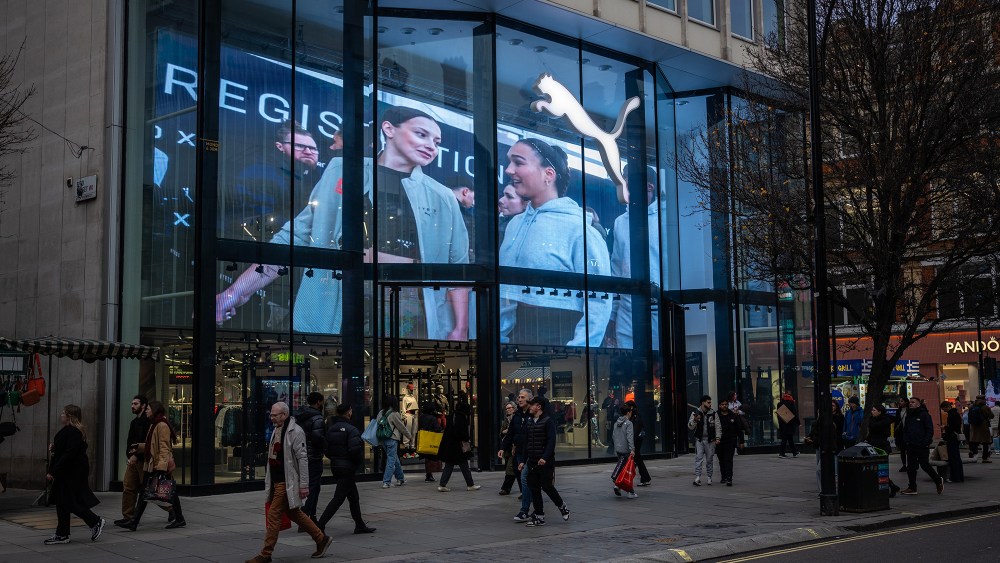
Just hours after Anta Sports confirmed a deal to acquire a 29.06 percent stake in Puma SE for $1.8 billion — a move that will make it the brand’s largest shareholder — market watchers began to speculate about the road ahead.
One analyst suspects Puma could get a much-needed amplification in the market under Anta’s guidance.
“Following this deal, consumers can expect high-profile marketing campaigns for Puma, with new endorsements, as the brand is set to accelerate its revamp around key lifestyle and performance products,” Marguerite LeRolland, senior global insight manager for fashion at Euromonitor International, wrote in a note on Tuesday. “We are also likely to see the opening of more stores in key markets.”
LeRolland also speculated that Puma will move to become more premium around the globe by borrowing from the strategy that Salomon has followed in recent years. (Anta Sports holds a controlling stake in Amer Sports, the parent of Salomon.)
You May Also Like
“Building on its reputation in the ski market, [Salomon] has recently expanded its offering across mountain sports and lifestyle, promoted its expertise and product development through new flagship stores in prime shopping locations e.g., Champs-Élysées in Paris,” LeRolland wrote.
This idea makes sense as Salomon has grown steadily in recent years, driven by new funds from Anta’s acquisition of Amer Sports in 2019 and then Amer’s subsequent IPO on the New York Stock Exchange in 2024.
In November, Amer Sports said its net income in the third quarter was $143.1 million, or 25 cents a diluted share, versus net income of $55.8 million, 11 cents, in the year-ago quarter. Revenue rose 29.7 percent to $1.76 billion from $1.35 billion in the third quarter.
Amer Sports chief executive officer James Zheng told analysts on the company’s third-quarter earnings call that Salomon’s “footwear momentum continues across all regions, especially Asia with strong demand for both sports style and the performance products. In addition to sneakers, bags and socks are also growing strongly across regions.”
As for Puma, LeRolland said that this new transaction will allow Puma extra financial resources to turn around the business, as the German player was undergoing a “reset program” to remediate its high inventory levels across markets and rethink its distribution strategy in key markets including Europe, Middle East and Africa; China, and U.S.
Deutsche Bank research analyst Adam Cochrane seems to agree. In a separate note issued on Tuesday, Cochrane wrote that Anta has a track record of developing brands, and the financial firm expects the Chinese sports brand to be “a more active partner” than Groupe Artémis, the investment company of the Pinault family which sold its stake to Anta.
“For Puma, this should give them more support for their strategy as 2026 is a rebuild year and this will allow management to fully focus on the operations over this timeframe,” Cochrane wrote. “For shareholders this does potentially create a better risk/reward on a longer-term view as either the strategy works with a profit uplift, and the downside is protected by a potential offer for the remaining shares at some stage.”