The 2026 Black Footwear Forum returned to Pensole Lewis College of Business and Design in Detroit this month, gathering icons of the fashion industry and students alike for a series of conversations which offered gems related to this year’s conference theme: Rooted in CommUNITY.
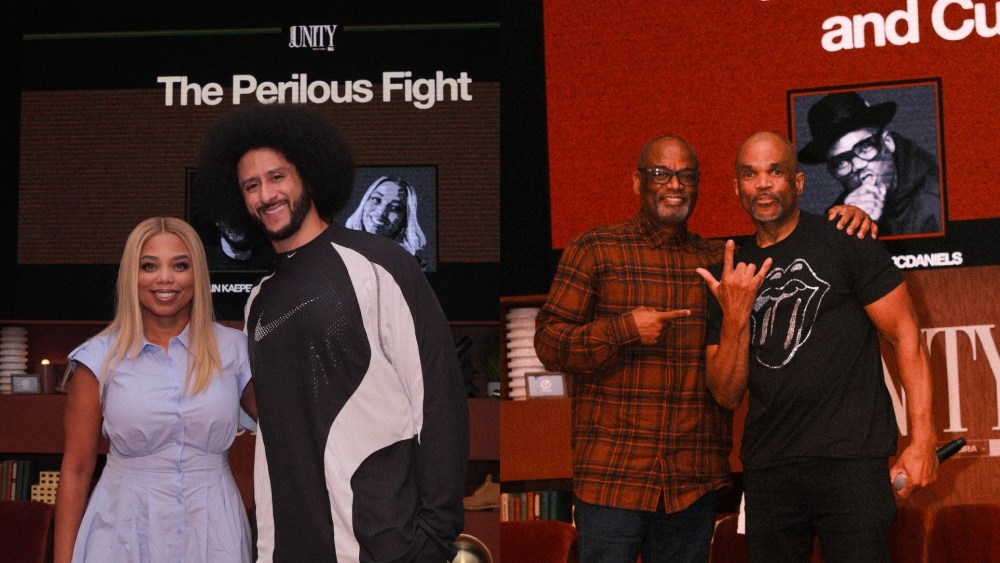
The two days of programming culminated with a talk featuring Colin Kaepernick and Jamele Hill, the first stop on Kaepernick’s book tour for “The Perilous Fight.” Ten years after the former NFL player took a knee to protest racial injustice, he wants his story to help build community and effect change — and he’s also ready to return to the NFL.
You May Also Like
Kaepernick said, “I don’t think anyone should ever have their career taken from them for fighting for us, first and foremost.”
“Second,” he continued, “I know the message that the NFL was trying to send. They were trying to send very explicitly, ‘Hey, if you try to fight for Black folks, we’ll take your career from you.’ And that message has traveled. I had a young man in one of our Know Your Rights camps in Vegas come up to me and ask, ‘I love playing football and I want to go professional there. I also want to fight for my community. Which one do you think I should choose?’”
That shouldn’t have to be a choice for anyone, Kaepernick believes.

Investing in community is paramount for James Whitner, founder of The Whitaker Group, who sat down for a conversation with Dominique Debnam, vice president of global footwear at Jordan Brand, and Dr. D’Wayne Edwards, president of PLC Detroit.
Debnam spoke on what Whitner has taught Jordan Brand about having community and retail presence in multiple places, saying that The Whitaker Group shows up authentically across its banners.
“One of the things that he’s had the courage to do is to go into communities where you kind of before didn’t see retailers,” Debnam said. “Whether it be Social Status or À Ma Manière with respect to where he is located — connected to HBCUs or connected to communities that we would exist in. So I think what he’s taught not only us, but all brands is how do we go to where the consumer is, show up for them, and then also make sure that those retail destinations and those places are beautiful, that they expose the consumer to something new as well.”

Whitner spoke more about his community-focused approach to retail with FN at the conference, saying, “The human experience now is more important than the product. It needs to be so nuanced that you now know your relationship with the consumer is all about the connection and experience, and less about what you can do for them with product, and now learning what are all the unique ways that we connect to them? We do it with food, we do it with hospitality, we do it with tons and tons and tons of events, and we’re doing it by building an ecosystem of places for people to show up in.”
Brands belonging to the VF Corporation are thinking beyond product as well.
Darren McKoy, vice president of product design and creative direction at Timberland, said in a different main stage conversation, “We’re going around, we’re supporting local libraries, we’re going and building trails, we are repurposing parks, but that’s all with the intent of making better, doing better as an organization. And this is something that’s critical to authentically connecting with people.”
Ricardo Lajoie, Vans global chief merchant, said in the same conversation, “I think it’s important not to mistake activating with a community as being the same as investing in it. We have to make sure where we’re doing activations, where we’re doing product exclusives for whoever it is within the communities, that we don’t think that that’s enough. The responsibility that we have goes much further than that. I think the challenge for any of us is how to create something that opens up the level of opportunity where ownership and agency become significant.”

Streetwear pioneer April Walker, founder of Walker Wear, also discussed the concept of ownership in a talk and Q&A in which she teased her upcoming 2027 book which coincides with the 40th anniversary of her entrepreneurial journey. While pointing out that there are Black legacy brands, she broached a “hard conversation.”
“The reason there is no $100 million-plus Black business that’s a brand right now in fashion is because we need support, and I think that we have the mindset that their ice is colder every time. And when we change that thinking, the world will change because we have all the magic. They take it, they regurgitate it, rebrand it, and sell it back to us, and we stand in line. So when we get off that train, the world changes.”

Sidney Baptista, founder of Pynrs streetwear — which has collaborated with Brooks Running — brought up ownership in fashion as well in conversation with Brooks athlete and pro marathoner Erika Kemp. Baptista said of his brand’s origin, “It was less about ‘I want to create an apparel brand.’ It was like, ‘We need to create something that we can own in the space,’ and it just happened to be apparel.”

The forum also touched on the importance of representation. D.M.C., aka Darryl McDaniels, of Run-D.M.C. sat down for a conversation with Dr. Edwards in which he reflected on his journey and how Run-D.M.C.’s fashion and way of being was empowering to audiences.
The rapper said, “When people saw Run-D.M.C. and [Jam Master] Jay’s look that we acquired as our stage attire or our wardrobe…People didn’t see celebrity. They saw themselves…It wasn’t just the music, it was the style.”
He added, “When Run-D.M.C. hit album covers and TV, it was the game changer for the culture because now you don’t have to change the way you look, the way you act, the way you speak, the way you think, just to please the world. We said it on the song ‘[My] Adidas.’ Our secret to success is ‘We took the beat from the street and put it on TV.’ We didn’t invent it…We didn’t say it was Run D.M.C.’s. We said it was all of ours together.”
Ahead of the 2026 Black Footwear Forum, FN spoke to Dr. Edwards about the conference highlights and the current state of DEI, emphasizing that he believes DEI has a marketing problem. He noted that while some think DEI is for Black people, they are not historically the first demographic to benefit from such initiatives.
He also had a clear message for brands: “If you’re a footwear company and you’re selling product to a Black community, you have an obligation to help that Black community.”