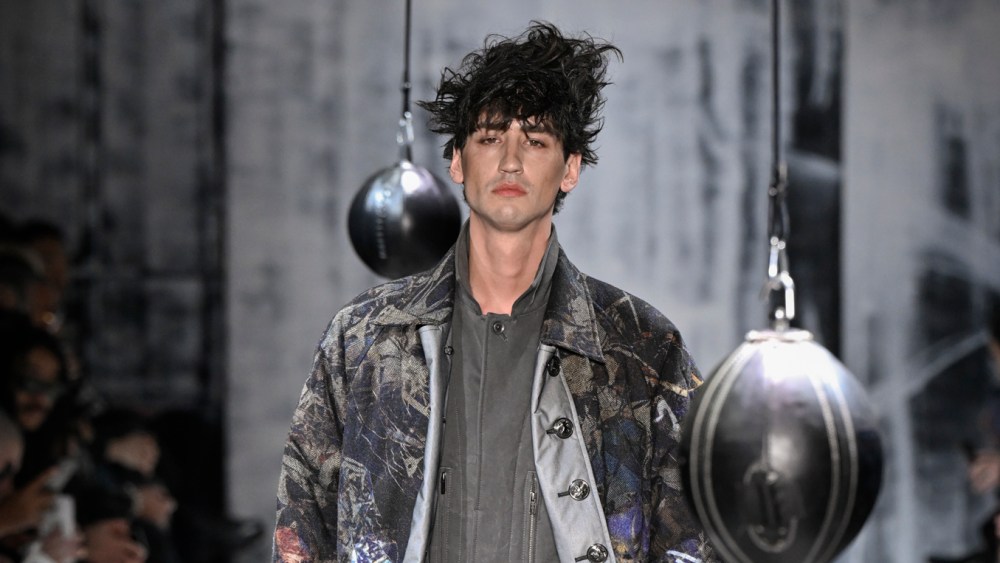
Got something on your mind? Let it out in whatever way you need. At Yohji Yamamoto’s fall show, models met double-end boxing balls on their path with a punch, a caress or a respectful bow.
The hanging orbs represented “emotion,” Yamamoto said backstage. He’s no proponent of using fists to address feelings — just last season, he opined that humans should find other ways than war to interact, lest we bring on the end of the world prematurely. But the veteran designer is certainly onto something by suggesting the world might be a tad less complicated if people just addressed how they felt instead of keeping it all in.
That might be messy work, a run-on thought prompted by the fact that “everything was inspired by the army and working in the dirt,” not for style or as a metaphor on purpose but because such garments are protective, he said.
You May Also Like
His fall collection certainly left no part of the body exposed and bore traces of having faced whatever was thrown at you.
Ever an erudite when it comes to the history of fashion, Yamamoto mined a wide range of eras, sampling 18th-century frock coats; navy peacoats and duffle coats from the 19th century; 20th-century suiting and field jackets, and workwear staples made timeless by virtue of their evergreen utility. A handful of looks even skewed futuristic, reading like spacesuits thanks to the high-gloss liquid finish of their material.
Thick coveralls came in mottled prints that evoked splatters in a multitude of colors or accidental bleaching. Heavy-duty trousers featured reinforced kneepads or had chaps-like panels zippered or laced at the shin for added protection. Outerwear had light padding or was cut from the hardiest possible fabric option for its genre.
There were even suits — another type of armor, if you will. Throughout, there was scant flourish, save for discrete tone-on-tone stitching that evoked long-healed scars or near-misses.
If the ensemble read rather on the classic side in terms of cuts — “we don’t need a crazy cut,” deadpanned Yamamoto — surface treatments and textile manipulation sang.
Take overcoats and jackets that looked like they’d caught major spillage. Upon closer inspection, the effect was achieved with intricate felting, feathering at the edge like a dye effect.
Along with a final trio, walking proud in coats patchworked so heavily they looked more pieces than pattern, they suggested that nothing could keep Yamamoto or the men he designs for down.