
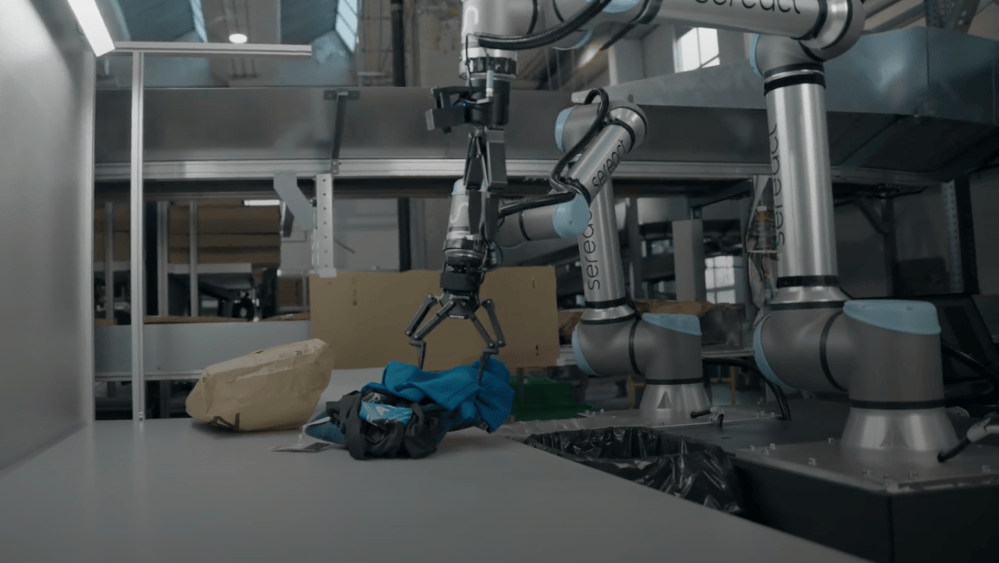
Zalando is turning to artificial intelligence and robotics to tackle one of the most demanding parts of its massive European logistics operation: processing the millions of fashion items customers send back to the retailer.
The German fashion e-commerce giant has begun using AI-powered robotic systems from Sereact to handle returned merchandise at logistics facilities operated by Ceva Logistics in Greven, Germany and Świebodzin, Poland.
The dual-arm robots use Sereact’s physical AI platform Cortex to identify, grasp and sort returned fashion items without requiring individual training for each product or a predetermined list of SKUs.
The systems are now operating in live production, with Zalando, Ceva and Sereact describing the deployments as the first phase of a broader effort to automate returns across Europe. The robots are being deployed through a robotics-as-a-service model.
For Zalando, the project adds another piece to an increasingly automated logistics network and addresses what is historically a difficult problem for conventional warehouse robotics. Unlike outbound fulfillment, where products generally arrive in predictable configurations and are picked from known inventory locations, returns can arrive in almost any condition.
The Sereact project is designed to be more adaptable to these upredictable environments, with the Cortex platform enabling the robots to recognize and manipulate objects they have not encountered previously. Rather than relying on article-specific programming, the system uses AI to dynamically identify the items, allowing the robots to deal with the variability inherent in returned merchandise.
“Returns are the hardest manipulation problem in fashion logistics. If a system only works on articles it has seen before, it does not work in a returns operation at all,” said Ralf Gulde, CEO and co-founder of Sereact, in a statement. “Running this in production with Ceva at Zalando volumes is the strongest proof point we have.”
The system is also intended to reduce manual touchpoints and handle repetitive physical work, allowing employees to move toward station supervision, exception management and quality control.
Zalando has plenty of experience dealing with the reverse logistics problem. The company has built a European network of about 20 specialized return centers, where returned merchandise is inspected, sorted and, when necessary, cleaned, ironed or repaired before being put back into inventory. The company uses predictive analytics to determine where returned items should ultimately be stored, considering factors including recent sales and inventory levels at different sites.
The online retailer estimates about 50 percent of items ordered across its markets are returned. More than 96 percent of returned items are classified as being in “ideal condition” during the company’s inspection process, while about 98 percent of returned fashion items can ultimately be offered again through Zalando or its Lounge shopping platform.
The e-commerce seller has been steadily implementing automation elsewhere throughout its network.
In March, Zalando announced plans to deploy as many as 50 AI-powered robots from Nomagic across its fulfillment centers. The systems handle item-level picking, scanning and induction into automated sorting systems, with specialized technology developed to address the difficult task of picking shoeboxes.
The rollout followed a pilot in which Zalando deployed 10 robots across three locations in Germany and Italy. Combined, the robots can handle 100,000 picks per day. Additional systems were planned for facilities in the Netherlands, Sweden, France and Germany.
According to Zalando, as of early May, robots across its fulfillment network had handled about 2 million picks per month.
Zalando has a financial stake in Sereact’s success. In July, the company participated as a strategic investor in the robotics company’s $116 million Series B financing round.
That same month, the fashion firm extended its partnership with Ceva Logistics, which has partnered with Zalando on supply chain initiatives since 2009. Both companies extended several logistics agreements through 2030 covering fulfillment, returns and inbound operations in Germany, the Netherlands and Poland.
Ceva operates returns infrastructure for Zalando, including facilities where employees inspect and prepare returned merchandise for resale.
Zalando highlighted a Ceva-operated facility in a previous look at its returns operation, describing a standardized process in which workers inspect every returned item before determining whether it can immediately return to inventory or requires refurbishment.
The third-party logistics (3PL) provider has also developed extensive expertise in high-volume fashion returns outside the current Sereact deployment. The CMA CGM-owned company says it processes as many as 450,000 returned items per week during normal operations for another European fashion player with a returns facility in Poland. This number increases to 700,000 during peak periods. The operation processes about 1.3 million returns per month and has achieved a 92 percent salvage recovery rate.


