“I feel like I am a custodian of the Zegna family wardrobe,” said artistic director Alessandro Sartori.
To wit, the concept of a family closet infused his fall collection for the brand and was telegraphed by the set of the fashion show, starting from the entrance of the venue — the transformed and unrecognizable Milan ice skating rink. Strategically lit stood the first jacket dating back to 1930 that belonged to founder Ermenegildo Zegna, Su Misura, and entirely in Australian wool, set in a glass display opposite his desk. Show guests then entered an imaginary supersized closet built around the oval catwalk. Here personal pieces from the wardrobes of executive chairman Gildo Zegna and his cousin Paolo, both members of the third generation of the family, hung alongside other brand garments.
The models walked out of the closet onto the floor, which was peppered with rugs in different sizes, patterns and styles, and, as usual with Sartori, the casting was carefully diverse in terms of age and ethnicities, including a few women, showing the versatility of the designer’s lineup.
You May Also Like
“When I talk to our clients, I see how they mix the old and the new, and how this timelessness adds sentimental value to the clothes, almost like watches for collectors,” said Sartori. “These are clothes that can be passed on from father to son.” The fact that the quality is impeccable and that classic wardrobe builders and their fit are reinterpreted for today is a given, in Sartori’s mind.
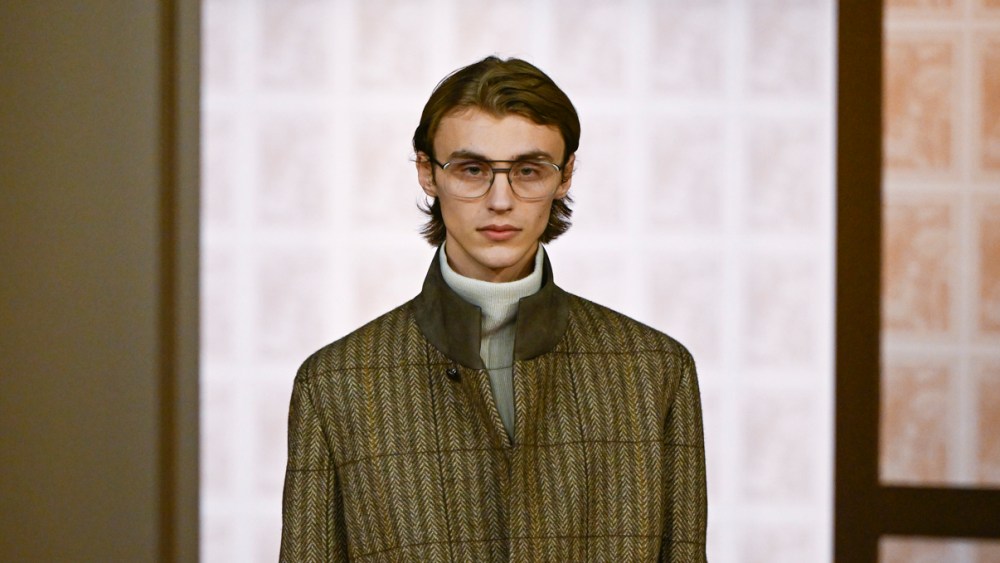
For example, Zegna’s staple Conte jacket was shown slightly longer, the pockets and the buttons lower, and while still structured, with high and peak lapels, the look remained relaxed.
Sartori was pleased with a “little trick” that could add a third horizontal button to a jacket. In fact, he succeeded in turning the familiar into novelty with his extensive research into materials. What appeared to be classic pied-de-poule or tweed patterns were actually new graphic motifs on a cashmere and recycled paper jacquard that was feather-light. A fashion show is always a spectacle, but it’s unfortunate the audience couldn’t feel the weightless quality of the fabrics, even though Zegna’s customers will. Even the overshirts were made lighter, with no pockets, allowing Sartori to indulge in his taste for layering.
Zegna’s classic Trofeo worsted fabric made in superfine Australian wool, created in 1965, was central to the collection. Leather details and the beautiful suede jackets with high collars, the padded cashmere cardigans that reprised some of the patterns of the shirts — more numerous this season — and the cozy knits in delectable sage green or mustard were all part of a cohesive message — keeping clothes for life, you can mix and match to your heart’s content.