The work boot category is the proverbial reliable workhorse of the shoe industry. After all, it was built by established players that have, in some cases, more than a century under their belts.
Nevertheless, there is fresh energy in the market, illustrated by a surge of brand newcomers and increased investments among retailers. And enthusiasm for all things Americana has boosted interest in domestic manufacturing, as well as sales of Western-inspired work gear.
Adam Beck, chief executive officer of California-based retail chain Beck’s Shoes, said the work category is broader than a decade ago. “There is a large, consistent customer base that needs work footwear, and we’re seeing more brands realize there is an opportunity to bring better styling, technology and comfort into the category,” he said. “At the same time, retailers are recognizing that work customers can be extremely loyal and represent a meaningful recurring business.”
The market’s evolution has been driven, in part, by younger generations entering the trades with different expectations for comfort and style. And America’s industrial landscape is ever changing. For instance, the warehousing and distribution boom several years ago gave birth to more safety footwear for indoor workers.
You May Also Like
And while the U.S. labor market overall is experiencing volatility from economic stressors, trade industries such as construction and manufacturing have been bright spots in 2027.
Here, FN dives into some of the big stories happening in the work shoe market right now.
1. New Players Jumped In
This year marked notable brand additions to the market.
For starters, SCL Footwear Group announced a deal with worksite equipment maker Bobcat Company to design, manufacture and distribute Bobcat-branded work boots and shoes. The line launched in April with Walmart Inc. and aims to expand distribution over time.

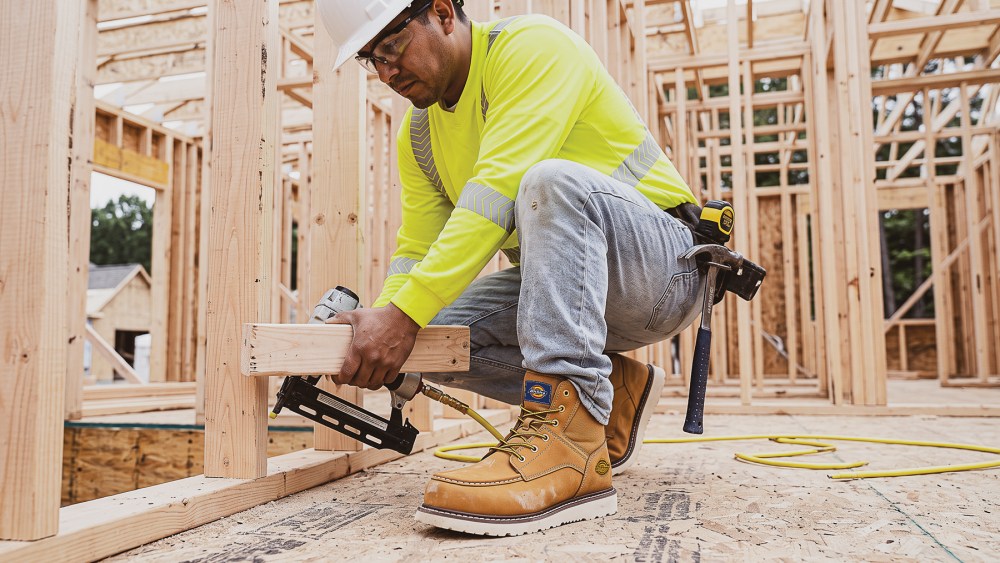
This fall, Dickies — the more than 100-year-old workwear brand — debuted its first footwear collection with partner SureWerx, which also produces safety shoes under license with New Balance and Airwalk, plus its own Avenger label.
Their initial Dickies lineup includes heritage-inspired wedge boots, waterproof work boots, Western styles, Chelsea boots and lightweight occupational footwear. The line is wholesaling to independent work stores, farm and ranch accounts, safety distributors and strong online partners.
Alex Cantu, director of brand management at SureWerx, said the early response from retailers has been encouraging. “Dickies already has credibility with people who work in the trades, so the conversation quickly moves beyond the name to how the boots fit, feel and perform,” he said. “Retailers see an opportunity for footwear that carries the brand’s workwear heritage while meeting the comfort and protection needs of today’s jobsites.”
Also, this fall, HandsFree Labs, the parent company behind Kizik, launched a footwear brand called Blue Ox, which brings hands-free step-in technologies to two safety boot styles. The brand is selling now via its direct-to-consumer site.

And in August, athletic giant Adidas officially got into the safety shoe business with the debut of its Adidas Pro Work line of protective footwear. The collection, produced under license by Dutch firm GLO Brands B.V., features several men’s (and two women’s) athletic-inspired styles, but is currently available only in the U.K. and European markets.
2. Retailers Upped Their Game
Aside from brands, retailers are also putting a bigger focus on workwear — and for good reason. At Beck’s Shoes, the work category makes up 30 percent of its overall business. “We see firsthand how important the category is,” said Beck.
Academy Sports + Outdoors agrees. “Workwear continues to be a strong category for us, with products available across our apparel and footwear divisions,” said Matt McCabe, executive vice president and chief merchandising officer. “This includes an assortment of work boots and warehouse work footwear, which have been some of our top-performing footwear categories this year.”
In response to that demand, Academy announced in August it would launch 200 Ariat in-store shops this fall. They will stock Ariat’s Western and work collections of apparel, accessories and footwear, with assortments tailored to each store.

McCabe noted that the growth in the work category is being driven by consumers, who are wearing the gear during off-hours. “Workwear isn’t only being worn on the job anymore — customers are incorporating Western and work-inspired products into their everyday wardrobes,” he said.
Brands like Ariat and Carhartt are well positioned in this scenario because their collections translate well beyond the workday, according to McCabe. And among footwear-only brands, he said Wolverine and Justin are top performers, as well as Academy’s Brazos private label.
At Boot Barn, meanwhile, it’s leaning into the category through customer service.
Stephen Loscko, vice president of marketing and media, explained that the company recently revamped its business-to-business work boot and workwear supply program, Boot Barn Workforce.
“The updated program leverages Boot Barn’s nationwide reach of 575-plus stores and broad assortment of boots and workwear to supply businesses across the country with crucial safety gear,” said Loscko. “It’s powered by a new, custom-developed digital experience that brings workforce management, product ordering and spend tracking together in one seamless platform.”

While Boot Barn’s B2B program has a long history of working with crew leaders and safety professionals to fulfill bulk orders, Loscko said this upgrade is part of a “larger ongoing initiative to better serve our work customers across every key industry” and across the U.S.
“As our country’s infrastructure keeps growing, that naturally brings new opportunities for us,” he said.
3. All Eyes Were on America
American pride and nostalgia blossomed this year as the country celebrated its 250th anniversary, and in that moment, domestically produced work footwear had a chance to shine.
For some, like Red Wing, America 250 was an opportunity to share their story in a larger way with marketing campaigns that highlighted their long histories in the U.S.
For others, it was a chance to showcase their growing capabilities in manufacturing. For instance, in June, Weinbrenner Shoe Co., the parent company of Thorogood, celebrated the opening of a new $14.5 million manufacturing facility and debuted its first Thorogood retail store, in Marshfield, Wis.

Keen Inc. continues to ramp up production at its footwear factory in Shepherdsville, Ky., where it relocated two years ago with the aim of expanding its American Built offerings.
Meanwhile, Twisted X launched U.S. manufacturing for the first time in 2026. However, Jud Taylor, vice president of sales, said the timing was purely coincidental with America 250.
“We really wanted to diversify our manufacturing around the world,” he explained. “We were heavy in China in the past, and then we had Mexico, and now we’re building product in five different countries. We always wanted to [build in the U.S.], and this opportunity came up, so we jumped on it.”
Twisted X released its first nine Built in the USA boots in July and, based on the positive response, fast-tracked a second collection of six more styles that will deliver in December.

Taylor said the brand is optimistic that interest in U.S.-made product will remain strong beyond the anniversary year. “Our customer is very pro-America, so for us, it really makes sense for our demographic,” he said.
Beck agreed that made-in-America is more than a one-year trend. “Our work customer has always cared about quality, durability and where a product is made,” said the retailer. “When you combine that with the current interest in buying American, I think there is still plenty of runway.”
But he noted brands are still challenged to justify price differences between U.S.-made and imported boots.
For Twisted X, it used its sourcing capabilities to keep prices comparable to the rest of its collection, with the line topping out at $260.
The Americana movement has also translated to aesthetics, with strong demand for Western-inspired work boots. At Dickies, for instance, Cantu noted that the brand’s Amarillo Western boot is among its early standouts.
Some credit the strength of the trend to ongoing pop culture influences like the “Yellowstone” shows and to big country music crossovers.
“Customers are responding to the styling, but I also think Western has benefited from becoming more mainstream beyond the traditional Western customer,” explained Beck.
All of that has contributed to a geographically diverse opportunity. Taylor explained that Twisted X has traditionally been strong in the South and Southeast, but now its biggest growth area is the Northeast.
And he believes the Western look is here to stay. “Maybe it was a trend, but we feel like now it’s just a way of life,” he said.