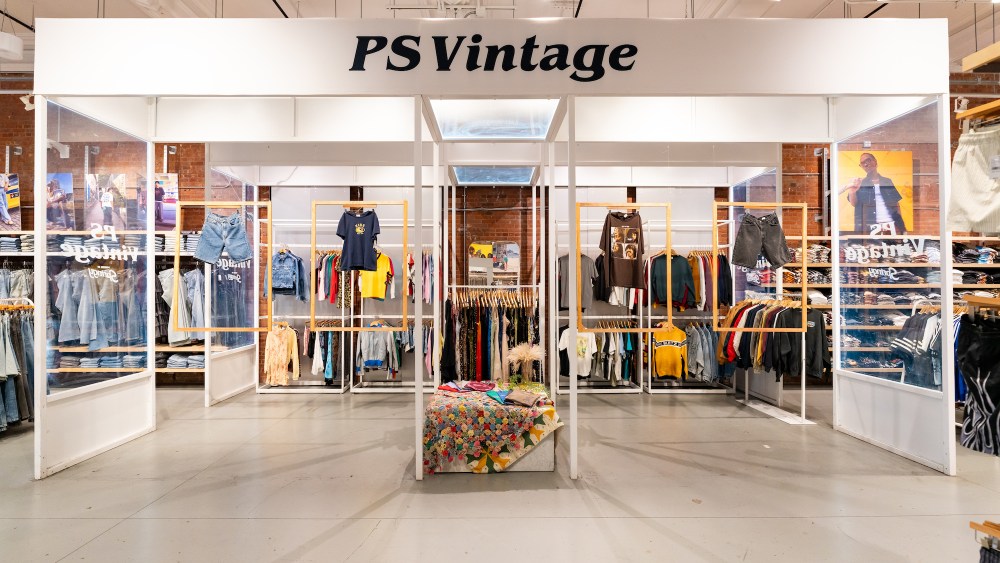
PS Vintage, the secondhand platform Pacsun launched online in December in partnership with Springy, is expanding to 16 Pacsun stores nationwide.
Initial locations include Bellevue, Murray, New York, Los Angeles, Roseville, White Plains, Frisco, Houston, Garden City, Boise, Newport Beach, Tigard, Tacoma, and Euguene. Each store will carry approximately 150 vintage pieces at any given time.
Abbie Hutzler, Pacsun’s divisional merchandise manager, said this initial rollout is intentionally focused, allowing the Southern Californian retailer to test, learn and refine the experience before scaling more broadly.
“PS Vintage represents an evolution of the Pacsun retail experience, introducing a new layer of discovery that complements the existing assortment,” she said. “By bringing resale into stores, the concept bridges digital and physical shopping behaviors while tapping into a broader cultural shift toward more intentional and individualized consumption.”

Here, Hutzler speaks with SJ Denim about what PS Vintage means for Pacsun customers—and how it shapes the retailer’s future with younger generations.
SJ Denim: PS Vintage launched online in December. How is the category performing?
Abbie Hutzler: PS Vintage has seen strong early momentum online, reflecting a growing appetite for one-of-a-kind product. The experience leans into a more discovery-driven way of shopping, encouraging customers to spend time exploring and engaging with the assortment. It resonates because it offers something inherently differentiated. Each piece feels personal, limited, and culturally relevant in a way that mass-produced product often cannot.
SJ Denim: What are PS Vintage’s best-selling items? Have any trends emerged?
AH: Denim continues to be a core driver, alongside vintage workwear jackets, particularly recognizable heritage brands like Carhartt, which align with the broader shift toward utility-inspired dressing.
There is also strong and consistent demand for culturally iconic product, including vintage Harley-Davidson pieces across tees, fleece, and outerwear. Graphic tees more broadly remain a key entry point, especially those tied to music, motorsports, and legacy brands.
In addition, categories like camo and sportswear-driven fleece and sweatshirts are performing well, reflecting continued interest in relaxed silhouettes and nostalgic athletic influences.
Taken together, the throughline is clear. Customers are gravitating toward pieces with authenticity and recognizable cultural references, items that feel both personal and rooted in a specific moment or aesthetic.
SJ Denim: Are you seeing customers purchase both PS Vintage and new products within the same order, or do they typically come specifically for vintage items?
AH: We are seeing both behaviors. There is a clear customer segment engaging with PS Vintage as a destination for resale, while another is incorporating vintage into their broader Pacsun purchase.
That crossover is particularly notable, as it reflects how customers are actually building outfits today. They are mixing vintage with new to create a more layered and individualized look.
SJ Denim: How will the in-store PS Vintage experience differ from the traditional Pacsun shopping experience?
AH: The in-store PS Vintage experience is designed to feel more curated and discovery-driven than the traditional retail floor. Rather than being organized by standard merchandising categories, the assortment is presented through the lens of era, size, and style, encouraging a more exploratory way of shopping.
Compared to the online assortment, which offers greater breadth, the in-store edit is intentionally tighter and more curated. The goal is to create a distinct experience that feels tactile, immersive, and rooted in the thrill of finding something truly one-of-a-kind.
SJ Denim: How frequently will inventory rotate, given the uniqueness of resale items?
AH: Inventory will be refreshed on a rolling basis, though the exact cadence will evolve as the concept scales. With this being the first in-store launch, the focus is on learning. The team is working to understand customer appetite, purchase behavior, and the optimal frequency for newness.
Longer term, the goal is to establish an evergreen vintage presence in-store that continuously services demand while maintaining a sense of freshness and discovery.
SJ Denim: Is the selection for each store curated for the region and customer trends?
AH: Yes, with an added layer of variability inherent to resale. While the assortment is guided by overarching customer insights and brand point of view, each piece is unique, meaning no two stores will carry the exact same product. This ensures that every location feels distinct while still maintaining consistency in the types of categories and styles customers can expect to find.
SJ Denim: How does resale fit into Pacsun’s broader long-term brand strategy?
AH: Resale is a natural extension of Pacsun’s focus on youth culture and the evolving expectations of its customer. As younger consumers place increasing value on sustainability, individuality, and circularity, PS Vintage allows the brand to participate in that shift in a way that feels both relevant and authentic.
It also expands the role of Pacsun beyond traditional retail, positioning the brand as a platform for both new and pre-owned product, and reinforcing its place within a more dynamic, culturally driven fashion ecosystem.