
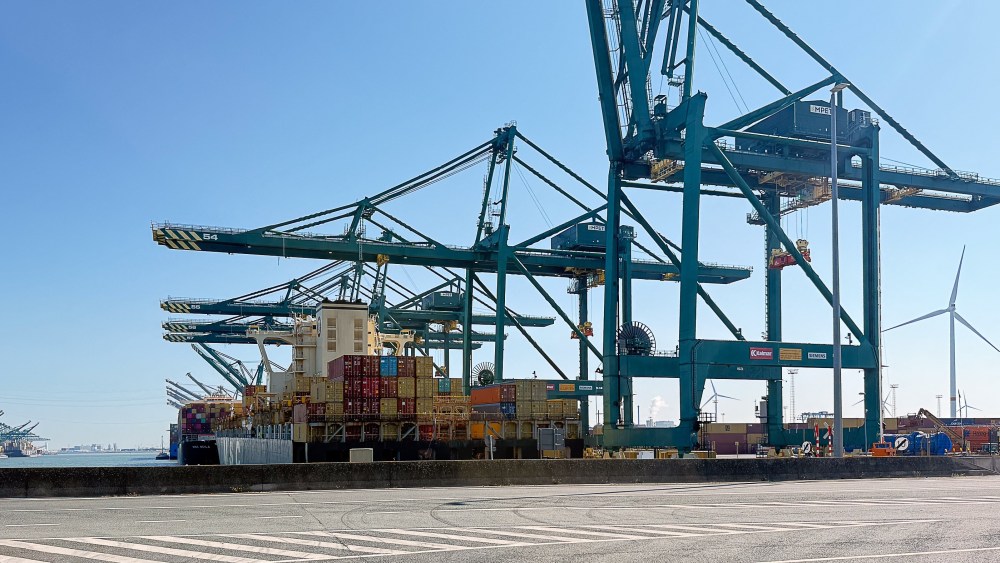
The Port of Antwerp-Bruges closed two terminals Tuesday night after a shipping container leaked toxic chemicals on a vessel docked at the gateway, hospitalizing dozens of workers.
A container of hydrofluoric acid was damaged and began leaking aboard the Mediterranean Shipping Company (MSC) cargo ship MSC Mia Summer II at the port’s Deurganck Dock. As a result, shipping traffic was temporarily suspended at DP World’s Antwerp Gateway and MSC-PSA European Terminal (MPET).
Authorities also closed the bridges over the nearby Kieldrecht Lock, which is one of two locks that give vessels access to the docks from the Scheldt River, and urged people to avoid the area around MPET’s Quay 1742.
Emergency services evacuated everyone from the vessel and the surrounding quay after the leak was detected and carried out air quality measurements.
As of 3:30 p.m. local time Wednesday, the port confirmed that DP World Antwerp Gateway terminal had been reopened, but the MPET remained closed.
Local authorities in nearby Beveren-Kruibeke-Zwijndrech indicated that 155 people were taken to the hospital. While most were discharged, 28 exhibiting more serious symptoms remained under observation in hospital as of Wednesday morning local time. One person was receiving intensive care.
No local residents were affected by the fumes, Beveren-Kruibeke-Zwijndrecht mayor Marc Van de Vijver said.
Specialist teams were on standby to remove the container from the vessel, according to the port.
Belgium’s federal prosecutor’s office, the Openbaar Ministerie, launched a criminal investigation into the incident Wednesday. According to the office, the incident occurred during container loading and unloading operations, although the investigation has yet to determine the exact cause.
This is the second such incident involving a leak at the Belgian port in recent months. In April, an oil spill occurred at the dock when the MSC Denmark VI vessel attempted to refuel. That spillage ended up blocking the access route from the port to the North Sea, forcing the temporary closure of the Deurganck Dock and the MPET.
These backlogs are impactful to the flow of cargo in and out of western Europe. Antwerp-Bruges is the second-busiest port on the continent behind the Netherlands’ Port of Rotterdam, handling 13.6 million 20-foot equivalent units (TEUs) in 2025.
Its tonnage surpasses the largest port in the U.S., the Port of Los Angeles, which saw roughly 10.2 million TEUs flow through its terminals last year.
The brief closure at Antwerp came just days after operations at two of the most pivotal ports worldwide were forced to shutter temporarily due to Typhoon Bavi. Container handling operations at China’s Ports of Shanghai and Ningbo were halted over the weekend amid the torrential rainfall and heavy winds.
Operations at those gateways largely resumed by Monday. But the storm resulted in more than 2 million TEUs of vessel capacity waiting at berth in north Asian waters outside the two ports, according to a report from container shipping market research firm Linerlytica.
The report estimates that vessel backlog will take “several weeks” to clear.
Antwerp had already seen congestion of its own in recent weeks, with Kuehne + Nagel reporting Monday that the seven-day average vessel waiting time to dock at the port is 2.02 days.
In early June, Belgian maritime harbor pilots went on strike stemming from a longstanding dispute with lawmakers over federal pension reforms. The pilots, who help captains guide cargo ships into the port, have conducted various labor actions since last fall.
Vessels had more difficulty berthing at docks during the latest strike, which led to operational challenges even after their conclusion such as irregular peaks in container volumes and a longer queue of vessels entering and leaving the port.
Compounding these matters, Belgium’s annual construction holiday period from July 13-31 will reduce staff availability across all terminals.
“Vessel backlogs continue to affect the lineup and are expected to persist through this week,” said Kuehne + Nagel in an update Tuesday. “Labor availability has also been reduced by the start of the school holiday period. The yard density remains at a critical level.”