
It’s taken a while, but Ellen Gudwin, CEO of VisionSpring, finally has the hard numbers to persuade factories that their workers may need vision correction.
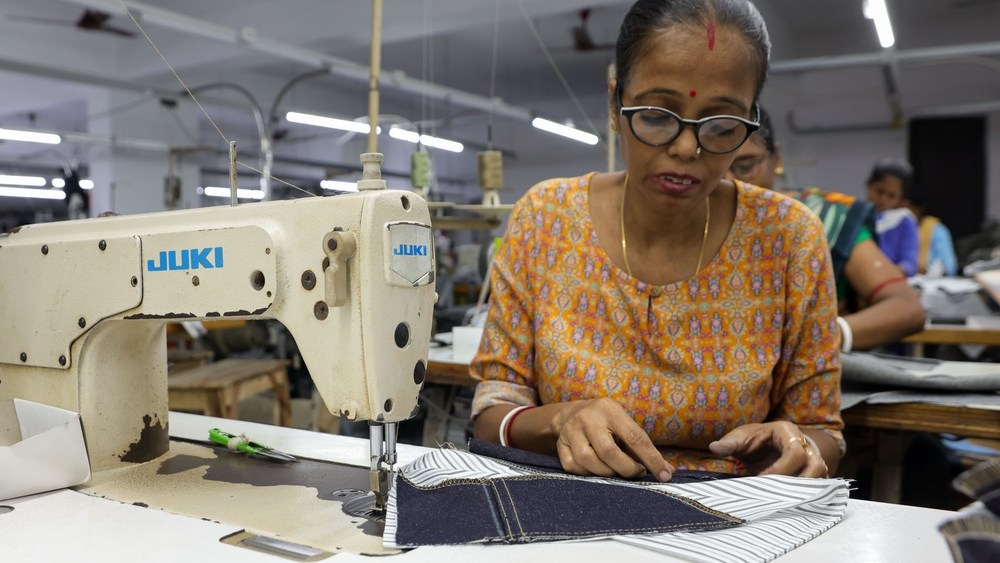
A randomized controlled trial by Good Business Lab at Shahi Exports, India’s largest manufacturer, published in the British Journal of Ophthalmology, found that correcting garment workers’ near vision with glasses boosted productivity by 6 percent. The intervention also delivered a 337 percent return on investment over the three-month trial period.
Gudwin said the idea for VisionSpring’s factory program took shape after she met a garment worker in Bangladesh in 2016 who had lost her job after struggling to see. VisionSpring launched the initiative in 2018 as an expansion of its work providing affordable eyewear to people living in poverty.
This was a labor issue, to be sure, Gudwin said. But for garment workers in the global South, who are predominantly women, it was a gender one, too.
“Imagine you’re in a garment factory, you’re a senior sewing machine operator at the top of your game, and then you fall out of the workforce after coming through every barrier as a woman in employment for lack of a $1.50 pair of glasses,” she said. “It’s a failure of feminism.”
Rolling out the program wasn’t easy. Factory managers were often on the defensive, since raising vision problems could sound like a critique of their management. VisionSpring relied on persuasion and pilot schemes and built a hyper-efficient 15-minute screening protocol to keep production lines moving. Early brand partners like Levi Strauss & Co. also helped show buyers were interested in worker welfare.
Still, convincing factories operating on razor-thin margins that spending money on eye screenings and glasses was more than a nice-to-have corporate social responsibility expense remained an uphill battle. That may change now that the findings show a return of up to $23 for every dollar invested over the typical two-year life of a pair of eyeglasses.
Presbyopia is a normal part of aging that causes blurry close-up vision and typically emerges around age 40, though it can come a little earlier for garment workers who spend long stretches doing close-up work, Gudwin said. It’s no coincidence, she added, that workers start dropping out after age 35.
“Catching people early in their presbyopia journey can extend their income-earning years and income potential, while the factory benefits from higher productivity,” she said. “We often hear stories of workers being downgraded. They start on a sewing machine line and end up in the packaging department or hanging garments because they can no longer handle that fine, precision work.”
In the study at Shahi Exports factories in Karnataka, one in four sewing machine operators—roughly 27 percent of the 3,600 workers who underwent comprehensive eye examinations—had uncorrected vision impairment. VisionSpring found the same ratio in Bangladesh. In Vietnam, where the workforce skews older, it was one in three.
“When individuals receive vision correction, they increase their functioning, productivity and income,” Gudwin said. “They also see well-being benefits—fewer headaches, the ability to help children with homework, all that good stuff. But the real question is, how do we get factories, employers and global brands to think about the well-being of their workers, the longevity of this very skilled workforce and introduce vision correction as a workplace norm?”
VisionSpring conducted the study alongside Good Business Lab, a nonprofit labor innovation and research organization incubated within Shahi Exports and co-founded by Anant Ahuja, who is head of ESG and sustainability at Shahi Exports. The manufacturer had other vision-correction interventions before, but they weren’t structured like VisionSpring’s or organized as a programmatic workplace benefit, let alone evaluated for impact.
The nearly 690 workers in the trial saw measurable benefits after receiving glasses, including significantly better visual function scores within 12 weeks. They were also more likely to keep wearing them over time, with adherence rising from 41 percent in week 4 to 65 percent in week 12, suggesting that workers who felt the benefits were more likely to stick with the glasses.
Getting workers to actually wear their glasses was the crucial part, Ahuja said. It also proved harder than screening them or giving them away for free because of the social stigma.
“It’s very normal to wear glasses in white-collar work or in the West, but if you visit a garment factory in India, and I’m sure the same is true across South Asia, you won’t see many people wearing glasses,” he said. “Part of it is access. Doing screenings and getting glasses takes time and money. But even when you address access, there are social norms. Some women said wearing glasses makes them seem less desirable or less likely to get married. They almost see it as a kind of handicap.”
Vision problems don’t show up in social audits either, Ahuja noted. Because vision hasn’t been integrated into standard occupational health and safety guidelines, there isn’t a checkbox for whether you’re providing glasses to workers, he said.
Ahuja said the ROI was larger than he expected. The intervention itself cost less than $10 per worker to screen and provide glasses.
“It isn’t negligible, but it isn’t a super-high cost, either,” he said. “Going in, you never really know if workplace impacts will offset that expense. In our case, we found that every dollar spent, we got $3.37 back in business outcomes, whether that was attendance, retention or productivity. Part of what was surprising was understanding the deep social norms around wearing glasses, but it was equally surprising to see such a clear business return from a relatively low-cost intervention.”
Shahi Exports is now working on a comprehensive scale-up plan to conduct free vision screenings across all 50 of its factories, covering more than 100,000 workers. It’s also planning similar structured, evidence-based approaches to tackle other hidden workplace health issues, including mental health, nutrition and reproductive care. These are upfront investments, Ahuja said, but ones that will pay off in the long term.
The 6 percent productivity gain, in particular, was a big finding, Gudwin said, especially because it was limited to the sewing line.
“So then you can imagine what if you could extend it to the cutting department and patterning and the rest of the operation?” she said. “But we did it on the sewing machine line because that is obviously where you need the most precision and skill. From a study-protocol point of view, it was also very measurable, because you have to go through quality checkpoints with every piece.”
What this means, Gudwin said, is that vision care should be a scalable, systemic standard for global supply chains, one that brands should support through programs like the Clear Vision Workplace alliance, a global initiative led by VisionSpring and the U.S. Agency for International Development that includes household names like Levi’s, Calvin Klein owner VF Corp. and Warby Parker.
“Brands are buying high quality and reliability, and the relationship between the factory and the brand hinges on the delivery of quality goods,” she said. “We’ve all heard stories: If a factory can’t produce high-enough-quality items, orders get canceled. That’s why there’s an opportunity to say to brands, ‘You can invest in the quality of your supply chain and benefit workers at the same time.’ That’s a two-fer.”
This year, VisionSpring will screen its 1 millionth garment worker. The study estimates that if scaled across the estimated 53 million garment workers in Bangladesh, Cambodia, India and Vietnam universal vision correction could add billions of dollars in annual profits while enhancing workers’ quality of life. Globally, the study estimates a potential $27 billion annual productivity gain for the textile and garment sector.
But equally important is giving workers the dignity of choice so they can feel “good and confident” in what they wear.
“You can’t just hand out black glasses to everybody and say, ‘Hey, congratulations, here’s your black glasses,’” Gudwin said. “If I’m a garment worker, I’m going to want a gold-rimmed pair because it goes with my sari. Or I might want wine red, which is very popular with women. Men might want gunmetal gray. Some people want slightly cat-eye frames. We have to offer style.”
As far as interventions go, this one’s a shoo-in that should be a standard workplace benefit, perhaps supported by government and industry together as a private-public partnership that makes glasses both affordable and readily available, she added.
“Vision correction in factories is so easy and so infinitely doable,” Gudwin said. “There are lots of things that are hard. This is not one of them.”