With closing arguments in the murder trial against Lindsay Clancy murder trial expected to get underway Thursday, the color pink became an unexpected hue.
In an interview this week, Renee Kimball, the Maine resident who organized last week’s rally outside of the Plymouth Superior Court in support of the defendant, discussed the pink dress code at the event, her ties to a documentary and the cost of the gathering in Plymouth, Mass.
The 36-year-old Clancy is accused of killing her three young children, 5-year-old Cora, 3-year-old Dawson and 8-month-old Callan in their Duxbury, Mass. home in January 2023. She has pleaded not guilty by lack of criminal responsibility. Her legal team has argued that she was experiencing postpartum psychosis, a severe Perinatal Mental Health disorder. The prosecution has contested that the killings were premeditated.
Clancy is paralyzed from the waist down after jumping from a second-floor window in the family’s home.
You May Also Like
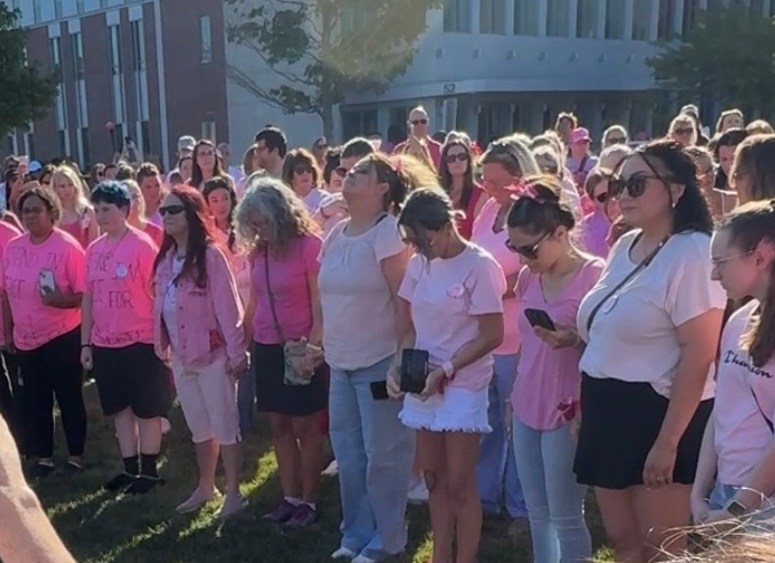
Some of Clancy’s supporters have been wearing pink shirts as a sign of solidarity. Pink was the predominant color worn by the 300 or so people who showed up outside of the courthouse on Aug. 20 for the “Stand in Peace With Lindsay” event that was organized by Kimball. The Maine resident said she first spread the word via TikTok, then others shared the details on Facebook and Instagram. The trial and last week’s gathering have prompted a public discussion about maternal mental health.
The dress code was pink in memory of Cora Clancy’s favorite color, according to Kimball. Attendees were also asked to don bows. One of the prosecutors, assistant district attorney Shanan Buckingham, spoke of Cora’s fondness for bows in her opening statement last month. Buckingham’s decision to wear bows, as a nod to the child, during the monthlong trial, has polarized some trial observers.
Kimball said she made ribbons from 21 yards of pink fabric for the bows for supporters to wear last week at a cost of $700, including $300 that others donated. She also had flags made for the 12 countries where supporters had indicated solidarity.
While some participants wore shirts with phrases like “Stand in Peace for Lindsay” or “She Needed Help,” the majority wore blank pink shirts, the organizers said. “For me, the purpose of [pink] for that gathering was to include Cora and her brothers in the stand,” Kimball said.
Kimball said the media attention was not something she expected. Having published her first book, “Two Happy Homes, One Happy Family, the Book on Coparenting,” Kimball said she is not currently working on a book about the trial. “If I ever was going to write about Lindsay’s story, I would want to work hand-in-hand with Lindsay. That is not something that I have thought about,” Kimball said. “I have not done any selling or any marketing, or made any money from any media.”
Kimball said she has been working with a production company for a documentary about the trial, but she declined to identify the company.
As for whether the pink-clad supporters may influence the jury, she said, “The jury is going to decide the verdict in this case. It’s important that everyone knows that we weren’t there to discuss the verdict in this case, or who we think did what. We were there for one reason, to bring attention to mental health and postpartum depression and postpartum psychosis, which people are trying to use interchangeably.”

Susan Scafidi, founder of Fordham University’s Fashion Law Institute, offered a different take. While the jury will “of course be instructed to consider only evidence admitted by the court and to view it objectively rather than through rose-colored glasses, judges and jurors are human,” Scafidi said. “At some level, the jury may be more sympathetic toward a defendant supported by a pink wall of well-wishers than one who appears to be shunned by society.”
If you or anyone you know is contemplating suicide, a list of suicide hotlines around the globe can be found at suicidestop.com. In addition, dialing, texting or chatting 988 in the U.S. will route people to the National Suicide Prevention Lifeline. The lifeline’s phone number, 800-273-8255, is also available to people experiencing emotional distress or suicidal crisis.