What comes after a designer’s sketch? In fashion, it’s the tech pack, a highly detailed instruction manual for a factory to follow, breaking down each part of a design into measurements, materials, and costs. Often stripping designs of their whimsy, these often complicated recipes for garments rely on technical notes.
Creating tech packs has long been a manual process that can take weeks or months depending on the nature of the design. A design typically goes from an office in the West to an Asian factory at the other side of the world, and on its journey, the tech pack becomes a living document that undergoes revisions that reflect what is doable within the confines of the supply chain at hand. Maybe a certain material is no longer available, for example, or the costing changed. These documents can also be hard to decipher because of language barriers.
“It’s not uncommon to send an English tech pack to a factory in Cambodia or Vietnam, and when you walk the floors there, someone’s hunched over translating that with a sharpie into their native language,” said Kathleen Chan, who founded Calico, a startup that wants to make the sourcing journey easier to manage with the help of AI. “Parts of the product creation process has always been incredibly manual, and that really stood out to me.”

“You’re looking at folks memorizing and remembering very minute and highly detailed things across their sourcing journey that they keep with them in emails and spreadsheets within their memory,” she told Sourcing Journal. “You’re looking at this insane back and forth between international manufacturers that translation could have solved.”
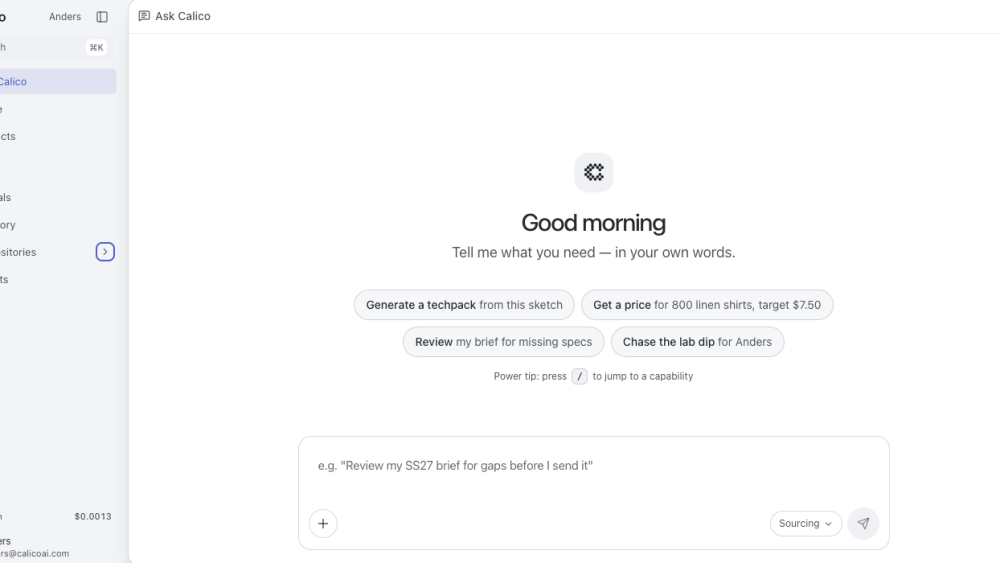
Unlike other AI companies in the fashion industry, Calico isn’t about generating beautiful designs. Its job starts after the styles are solidified, using industry-specific data to create tech packs in a matter of minutes. Calico is an AI-powered operating system for technical design, a learning intelligent software that can pull out any technical information needed from a brand’s own historical data and present it in 120 languages.
Earlier this year, the startup secured $15 million in Series A funding, which Chan said the company will use to “double down” on its product and market presence, which is currently concentrated in North America. Chan launched Calico in 2021 after leaving her job at Microsoft.
While Calico does not want to disclose its current roster of clients, Chan said the response has been promising, illuminating the need for a technical solution to a very common problem. “We’re not out here trying to build rocket ships,” she said. “It’s very tailored to the industry, so that’s why you’re seeing this fast adoption across brands.”