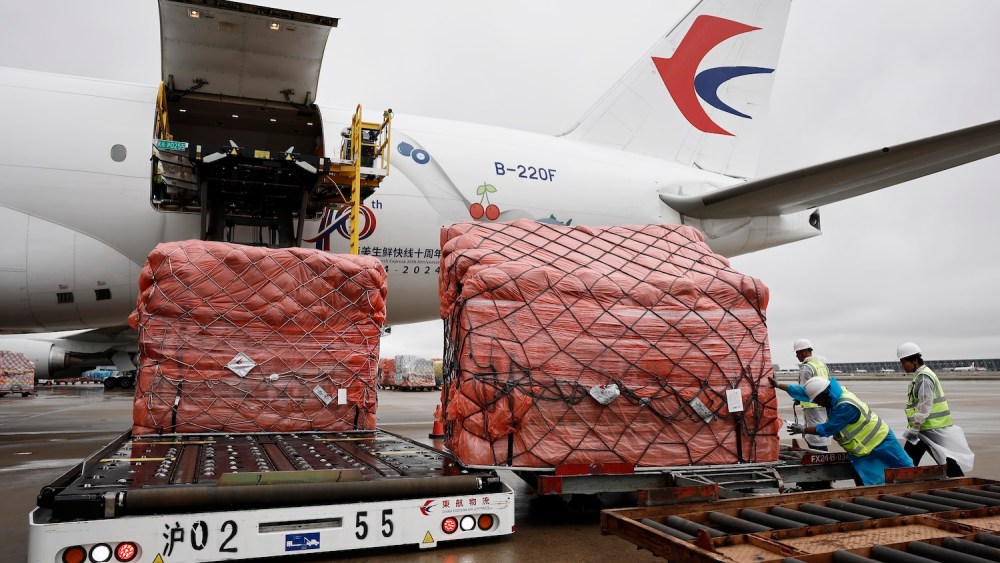
Air cargo demand between Asia and North America rose 17 percent year on year in September, extending the lane’s growth to eight consecutive months, according to the International Air Transport Association (IATA).
The figure marks the fourth time in a six-month span that air cargo demand increased at a double-digit pace on the trade lane. Every month since April has seen at least 8 percent demand growth between both markets.
Asia Pacific and North American carriers jointly accounted for 77 percent of the total year-over-year demand growth in September, adding 721.1 million and 678.2 million cargo tonne kilometers (CTKs), respectively.
The Asia-North America trade lane had the strongest air cargo demand growth pace across the seven global routes monitored by IATA, with intra-Asia flights coming in a distant second at 10.2 percent.
“Stronger global trade and manufacturing provided a supportive backdrop, while AI-related shipments helped drive another month of double-digit growth across the Pacific,” said Marie Owens Thomsen, IATA’s senior vice president of sustainability and chief economist in a statement.
Total air cargo demand grew 7.7 percent, with gains taking place across all carrier regions. For international operations, demand increased 8.6 percent.
Both figures well outpaced total air cargo capacity, which grew 2.7 percent. For international flights, capacity measured by available cargo tonne kilometers (ACTKs) increased 3.3 percent.
As traffic grew faster than available capacity, the demand-led tightening raised global utilization. The cargo load factor, which is the share of available cargo space filled, rose 2.2 percentage points to 47.9 percent. North American carriers recorded the largest improvement, with their load factor rising by 4.3 points to 43.9 percent of space filled.
Fuel costs and the higher load factors strengthened air cargo carriers’ pricing strategies, with yields increasing 2 percent on a sequential basis in September, the second consecutive monthly rise in rates. Yields were 25.9 percent higher year over year.
Jet fuel averaged $184.5 per barrel during the month, IATA said, an increase of 17.5 percent from August and up 103.4 percent from last September’s $90.7 per barrel. The spike extended an eight-month run of annual gains due to oil supply disruptions at the Persian Gulf and Strait of Hormuz, adding to the sustained pressure on airline operating costs.
“The challenge is cost. Jet fuel prices have more than doubled compared with a year ago, and yields have not kept pace,” Thomsen said. “There is no shortage of goods to ship, but doing that profitably in the face of persistently high fuel prices has become more challenging.”
That cost pressure did not fall evenly, because the capacity squeeze behind the higher load factors was sharpest in some regions and absent in others.
IATA said Asia Pacific demand rose 8.6 percent against capacity growth of 4.9 percent, lifting its load factor to 50.7 percent. European carriers withdrew capacity by 1.6 percent even as demand rose 4.5 percent, increasing their load factor to 54.6 percent.
That tightness has lingered through late October. According to data from air cargo market intelligence platform WorldACD, global tonnages declined 2 percent on a weekly basis from the week of Oct. 19-25, cancelling out a 2 percent rise the week prior.
The fallout from the European Union’s recent ending of its duty-free low-value imports threshold continues to impact air cargo flow into the bloc. On top of the 3-euro duty that was tacked onto low-value shipments on July 1, the EU imposed a new 2-euro handling fee on e-commerce imports from outside the bloc on Sunday. That fee applies to all packages regardless of the item’s financial value.
As of late October, the 3-euro duty was still affecting annual volumes into the EU. Chargeable weight of cargo shipped from Asia Pacific to the 27-member collective fell 16 percent year over year during week 43, while weight to the U.S. rose 9 percent annually.
Since the July de minimis change, EU-bound volumes from Hong Kong have fallen 33 percent. Chargeable weight from mainland China has declined 9 percent.
Spot rates rose on both lanes, with shipments to Europe up almost 30 percent year over year to $5.10 per kg. U.S.-bound cargo saw a bigger annual jump at 41 percent to $7.43 per kg.
WorldACD’s data, which is based on more than 500,000 weekly transactions, indicated that global spot rates rose 5 percent week-over-week to $3.80 per kg, up 4 percent from the week prior and 38 percent year over year.
Global capacity dipped 1 percent in the week of Oct. 19-25, and Middle East and South Asia capacity remained constrained.
Since late February, Gulf capacity is down 19 percent. King Khalid International Airport in Riyadh, Saudi Arabia was still only about 6 percent of normal capacity as of Oct. 29, according to air cargo consultancy Aevean. Houthi missile strikes forced the airport to close on Oct. 10, with a partial reopening still leaving most foreign carriers suspended into November.