
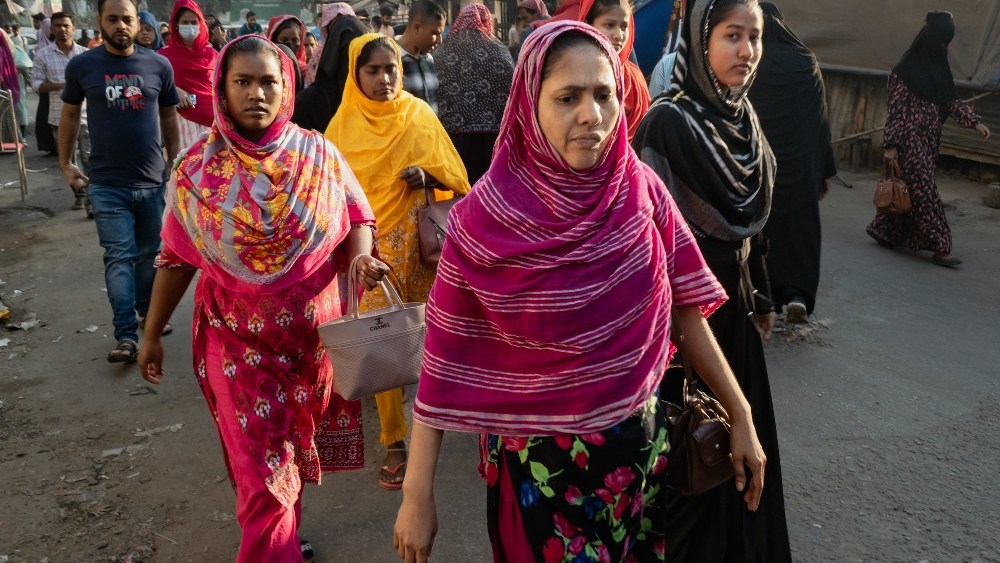
Since August 2026, garment workers in Bangladesh are protesting for a minimum wage of Tk 30,000 ($241.15) a month, more than double the Tk 12,500 ($100.48) floor in place since December 2023. Protests intensified in late October, and the government formed a new Minimum Wage Board on Nov. 1. The wage board’s meeting scheduled for Nov. 16 was postponed until Nov. 23.
The international brands or retailers that buy these garments have said remarkably little; Sourcing Journal contacted nearly 30 buyers and only a few responded with general statements about collective bargaining or monitoring developments.
A minimum wage is not a living wage
In 2024, governments, employers and workers meeting at the International Labor Organization (ILO) defined living wage as a pay sufficient for a decent standard of living for workers and their families, taking account of local circumstances and normal working hours. On the other hand, a minimum wage is a legal floor, not necessarily a measure of what a family needs to live decently. The Global Living Wage Coalition puts the 2025 living wage for Dhaka City at Tk 30,459 ($244.84) a month. The current legal minimum for garment workers is about 41 percent of that amount.
Buyers comply with local law when their suppliers pay the statutory minimum. But what responsibility do buyers have when that minimum falls far below the living wage? Do they have responsibility to pay purchasing prices which would allow suppliers to pay more? The Clean Clothes Campaign’s (CCC) 2026 Fashion Checker assessed 110 buyers and found that while 32 percent had made a living-wage commitment, only 4 percent reported tangible progress. Just 3 percent disclosed wages paid at their suppliers’ facilities. Workers surveyed in Bangladesh earned 73 percent below the CCC’s living-wage benchmark. Separate research by CCC and Public Eye found that inflation-adjusted sourcing prices for cotton T-shirts from Bangladesh had fallen by as much as 30 percent over roughly two decades. These findings raise questions about the buyers’ claims of responsible or ethical sourcing.
Buyers can help close the gap
Some brands are already committing living wages at their supply chain. The Dutch chocolate maker Tony’s Chocolonely pays cocoa farmers a premium on top of the market price and it recalculates that premium each year. In 2024-2025 it paid more than 3.7 million euros ($4 million) in premiums.
There are practical guidance and tools for calculating living wages, such as the Road Map to an Asia Floor Wage, Oxfam’s Getting to a Living Wage: Recommendations for Brands, A Sewing Kit for Living Wages, and the ETI’s Living Wages in Global Supply Chains. Thus, the problem is less a lack of policy statements than a lack of purchasing commitments that support them.
Poverty wages feed forced and child labor
A living wage is intricately connected to buyers’ responsible or ethical sourcing claims. It is one of the most effective protections against the abuses brands say they do not tolerate such as forced or child labor. In several jurisdictions, the brands are legally required to report their forced and child labor commitments, and the consequences of low wages are well documented. The Ethical Trading Initiative finds that without a living wage, workers may be compelled to work excessive overtime or several jobs, fall into bonded labor, and send their children to work instead of school. A wage far below living wages leads to coercive work and child labor. Walk Free cites Oxfam Australia research in which all 472 Bangladeshi garment workers interviewed earned below a living wage.
On the other hand, paying living wages improves productivity and labor retention. In a U.K. survey of accredited Living Wage employers, 86 percent said it improved their reputation as an employer, and among organizations with more than 500 staff, 76 percent reported better retention and 78 percent higher motivation.
Zero tolerance policy on forced labor and child labor needs a wage policy
Failing to pay a living wage is not the same as forced or child labor. However, nearly every buyer publishes a policy of “zero tolerance” for forced and child labor. While the inevitable link between poverty wages and forced and child labor is well documented, should the brands’ claims of zero tolerance for forced and child labor be questioned while they stay indifferent to wages that make those abuses highly likely.
Audits and risk assessments cannot make up for sourcing prices that leave suppliers little room to raise wages. Suppliers are responsible for paying workers, but buyers have the leverage to determine how much suppliers should pay. Brands claiming responsible or ethical sourcing need to tie their sourcing prices and policies to their suppliers’ obligation to pay a living wage. That means ring-fencing labor costs in the prices they pay, so a wage increase is passed through rather than squeezed out of the factory. It means committing to keep sourcing from Bangladesh after the new minimum takes effect. While the wage board is deliberating, the brands need to commit that they will absorb the cost of a wage that approaches the living-wage benchmark. H&M recently committed that its costing tool updates automatically once a new legal wage is set. This is a useful step, but paying for the legal minimum is not the same as committing to a living wage.
How we got here
The silence of the brands is a symptom of a liberalized market system with a globalized production system. While capital owners won the freedom to source from wherever labor and environmental rules and their enforcement were weakest, competitiveness came to mean cheap and flexible sourcing policies. In a labor-intensive production system, suppliers turn to low wages and low production costs to remain competitive.
Reflecting the liberal market system, international labor law also distinguished between the core and redistributive rights of labor. The 1998 ILO Declaration on Fundamental Principles and Rights at Work emphasizes the “core” standards. Freedom of association and collective bargaining were treated as enabling rights: they give workers the right to organize and bargain for fair wages and safe workplaces. Labor law scholars such as Philip Alston warned that this approach downgraded the redistributive rights that give the enabling rights their meaning. A safe and healthy working environment was added to the fundamental principles only in 2022, nine years after Rana Plaza. A living wage is still not on the list.
The globalized production system ignored the balance of power. Where international buyers can move their sourcing places and unions face repression, collective bargaining does not deliver a living wage. It delivers a race to the bottom in which workers underbid one another for jobs.
Legal and ethical accountability
The landscape of corporate accountability is shifting. The EU’s Corporate Sustainability Due Diligence Directive lists an adequate living wage among the rights that in-scope companies must address. However, the 2026 Omnibus amendments narrowed its scope, delayed application to July 2029 and removed the EU-wide civil liability regime, leaving liability to national law. Even so, the direction is clear. Although the directive does not require every brand to pay a particular wage, it makes wage adequacy a due-diligence concern for companies within its scope.
Under the U.S. Trafficking Victims Protection Reauthorization Act, a U.S.-based company can be sued if it knowingly benefits from a venture it knew or should have known engaged in forced labor. If a brand knows that its suppliers pay far below a living wage, and is aware about the link between poverty wages and forced and child labor, can the brand claim to have complied with adequate forced and child labor due diligence of its suppliers? Low wages alone do not establish forced labor or liability. However, when a buyer identifies signs of coercion, it cannot treat minimum-wage compliance as the end of its inquiry. How can robust due diligence claims justify a company’s silence on the payment of living wages? How would a company publicly report on its risk prevention measures, explaining what it did to prevent underpayment, and its risk assessment measures, explaining what it did to identify and prevent the potential risks of forced and child labor?
Claims about responsible or ethical sourcing are also facing legal scrutiny. A federal judge in Washington is weighing Starbucks’ bid to dismiss a class action over its “100 percent ethical” sourcing label, after a D.C. judge refused to dismiss similar claims in 2025. In April 2026, Clean Clothes Campaign sued Levi Strauss & Co. for misleading consumers about conditions in its supply chain, and a complaint in Washington, D.C. targets Nestlé’s “zero tolerance” claims on child labor. There has not been any finding of liability yet, but these claims make it clear that public claims about robust due diligence should be supported by evidence. A brand that advertises rigorous due diligence and responsible or ethical sourcing while knowingly buying from factories that pay poverty wages is most likely taking a legal risk and not just a reputational one.
Government action and brand commitments must go together
Living wage commitments from international buyers cannot reach every worker. Informal subcontractors and factories outside the main export supply chains will not receive the benefit of buyers’ responsible purchasing prices. While the lowest wages and worst exploitations are often found in informal sectors where no brand or retailer audits, it is necessary that the government sets a fair wage floor that reflects living wages.
However, if brands are serious about their public reports on due diligence, their claims of responsible or ethical sourcing, they should back living wages and include it into their purchasing terms and prices. As the wage board considers a new minimum, international buyers should publicly support the workers’ Tk 32,000 proposal, commit to continued sourcing from Bangladesh and reflect higher labor costs in the prices they pay. These measures will not solve every labor problem. They would, however, give substance to buyers’ public commitments and help workers benefit from a new wage.
Dr. Zobaida Khan has expertise in business, human rights, international trade, labor, and sustainable development law and policy.


