There is a widely held assumption about extra-wide shoes — that only a small percentage of people need them, the styles are boring and that it’s too expensive to manage the inventory.
All of that is changing, according to footwear insiders, starting with the size of the market.
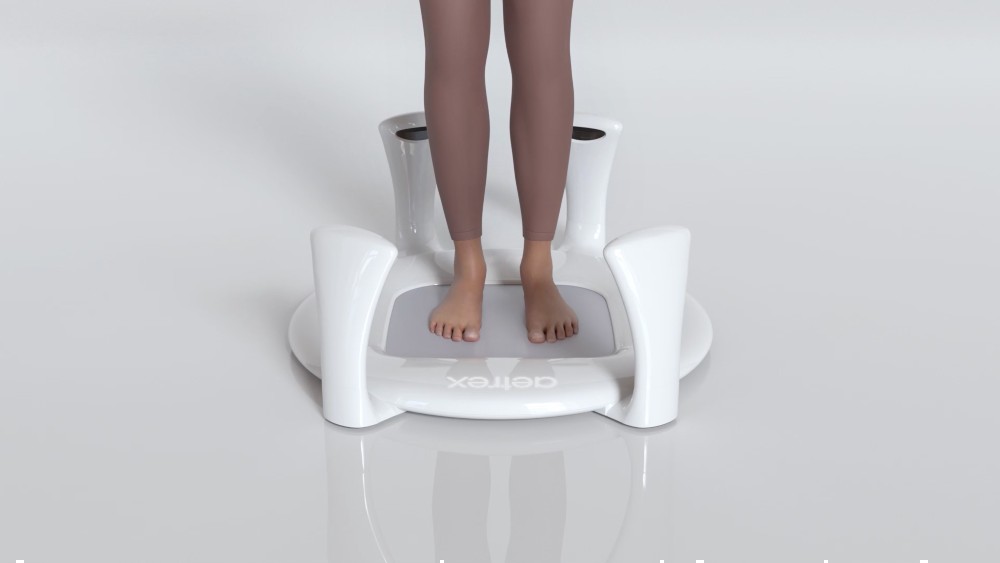
Aetrex Inc., creator of the Albert Pro foot scanning device, has collected more than 50 million scans since 2002 and made a surprising discovery this year while leveraging artificial intelligence to analyze the results. “We found that about 66 percent of the adults that are in our database are actually an E width. But the standard in the industry is a D width,” said Jason Israel, senior vice president of business development at Aetrex. “We’re seeing that there are more people that could benefit from a wide width.”
And it’s not just a U.S. story. “As you look toward Asia, we’re seeing a wider foot and a lower instep,” said Israel. And in Europe, the company found that, on average, both genders’ feet were greater than the medium width designation.
You May Also Like
Brands are increasingly recognizing the opportunity to serve those customers. For instance, a recent email promotion from Vida Group’s Jambu brand touted “Wide Width Wednesday” to showcase its options.
Newcomer 1587 Sneakers — founded by Adam King and Sam Hyun in 2023 — uses what it calls an AAPI Last, shaped to the contours of the Asian American foot anatomy. Actor Daniel Dae Kim signed on recently as an investor based on the strength of the concept.
Footwear veteran Rick Blackshaw cofounded Stoke Shoes this year to cater to an “average all-American guy” who is “powerfully built, he’s got wide feet, so we said let’s build a shoe specifically for him.” The brand offers a pair of sneakers in two options: “wide,” which fits an E or EE, and “wider” to fit a EEE or EEEE.
Blackshaw, whose background includes leadership roles at Converse, Keds, Sperry and Hey Dude, said “athletic footwear has generally been focused on containment and not on splay.” Stoke, by contrast, equips its sneakers with a wider toe box (cheekily trademarked as “Big Ball Girth”) and its midsole is not cupped to allow the foot to expand.

Indeed, creating a better-fitting shoe goes beyond simply addressing two-dimensional length and width, said Israel, who pointed out that Aetrex 3D scanners capture 16 foot measurements, including arch and instep height, heel shape and more.
Natelle Baddeley, chief design and product officer at Caleres, said a comprehensive development strategy is central to the nearly 100-year-old Naturalizer brand. “Naturalizer was founded on the belief that women’s shoes should be designed around the contours of a woman’s foot, and that principle still shapes our product development today,” she explained. “Fit isn’t determined by one element alone; it’s the orchestration of size, width, arch support, construction and style working together.”
Baddeley noted that more than 40 percent of Naturalizer’s business “comes from sizes, widths and boot shaft options outside the traditional size 6 to 10 medium range.” In response, the brand has committed to an inclusive size-and-width selection. Its Contour+ collection, for instance, comes in a range of styles and sizes, from 5M to 12XW, with extended boot calf sizing in narrow, medium, wide and extra wide.
Brands like Naturalizer have also helped prove the case that customers with wider feet don’t need to sacrifice on style.
Deborah Delisle is bringing that same mentality to longtime size-and-width player Propet. Since joining the brand as national sales director earlier this year, Delisle has been working to introduce more contemporary styling to the collection.
“We want to look as good as everyone else, so that when you walk by a retailer and you see our product, you’re drawn by the design but then you’re ecstatic because we offer sizes and widths, or we are A5500-approved for a diabetic,” she said.
While the brand won’t be chasing the fashion market, Delisle said it does want to incorporate more trend-right items. “We’re working with some great designers who see the vision and understand that the materials and the little bells and whistles of comfort are what separate us, and they’re incorporating those into these updated designs.”

One longtime challenge in offering wide widths is the inventory commitment. “It’s a lot of additional SKUs, and [big brands] don’t want to invest in that. They want to turn their product faster or they want to move on with trends faster,” said Delisle.
Retailers struggle with the issue as well, added Israel. “There’s only so much space in the back room to put these shoes, and they need to get a certain amount of SKU productivity out of as many as possible.”
But the Aetrex executive is optimistic that with the wealth of data available about customer sizing and purchasing — and with new AI tools emerging every day for processing that data — companies can make smarter decisions throughout the footwear journey, from more customized lasts to more effective merchandising.
“I think it’s the most exciting time going on,” he said, “because we have the data piece, we have great shoemakers, so now how do we marry these things together to benefit the consumer.”