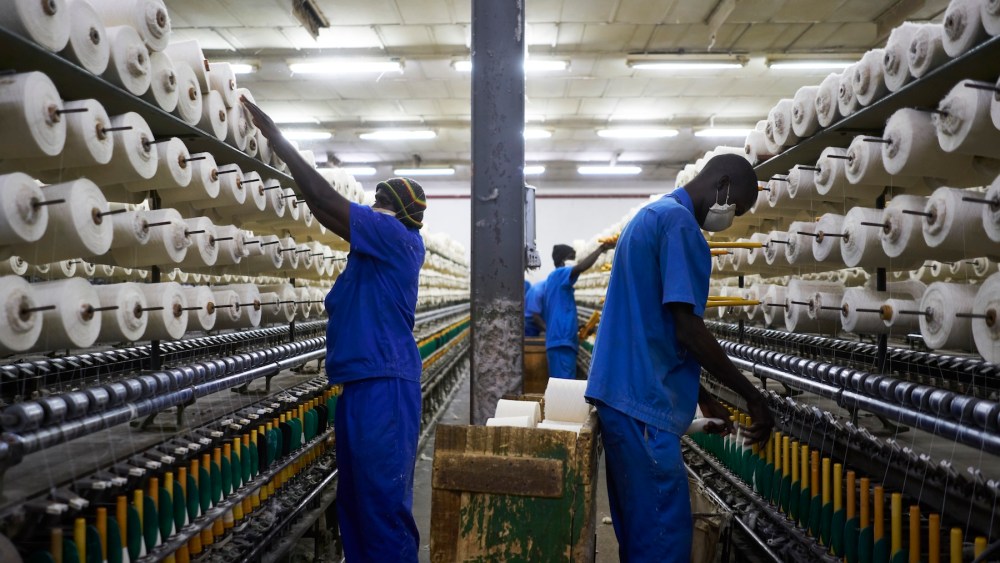
A coalition of African financial, research and media organizations is pushing to expand textile manufacturing across the continent, arguing that processing cotton domestically rather than exporting it as raw fiber could contribute $34 billion annually to Africa’s gross domestic product.
The initiative, called Africa Made It, launched its “Power, Protect and Purchase” campaign during the CANEX Weekend event in Lagos, Nigeria, with a strategy centered on lowering industrial energy costs, protecting domestic manufacturers from import competition and encouraging consumers to buy locally made clothing.
The campaign targets a longstanding imbalance in Africa’s textile supply chain: Cotton-producing countries export much of their fiber for processing elsewhere, then import finished textiles and apparel. Spinning, weaving, dyeing and garment manufacturing, the stages that create industrial jobs and generate much of the value between the farm and the finished garment, often take place outside the countries where the cotton is grown.
According to the World Trade Organization, roughly 98 percent of cotton produced in West and Central Africa is exported as raw fiber.
Africa Made It projects that expanding domestic spinning, weaving and garment production could support nearly 2 million permanent industrial jobs, generate approximately $33 billion in annual household income and contribute $34 billion to the continent’s gross domestic product each year.
The campaign’s strategy rests on three priorities: securing competitively priced electricity for textile mills, introducing trade measures to support emerging domestic manufacturers and increasing demand for African-made apparel. It also calls for $1.8 billion in investment to support infrastructure, cotton processing and garment production.
Africa Made It is coordinated by organizations including Africa Practice, Afreximbank, AllAfrica Media, Africa24, Africa No Filter, AKAS Consulting, Bird Story Agency, IC Publications and Research Alpha.
“African culture, design and storytelling influence global fashion, music and media like never before,” said Marie Wilke, editor-in-chief of Africa Made It magazine. “Yet, without domestic manufacturing infrastructure, Africa’s creative authority yields very little economic return.”
The campaign comes as international development institutions pursue related efforts to move African cotton producers into higher-value textile manufacturing.
On Oct. 29, the WTO and United Nations Industrial Development Organization launched an investment promotion drive focused on Benin, Burkina Faso, Chad, Mali and Côte d’Ivoire. The initiative, organized through the Partnership for Cotton, seeks to connect investors with spinning mills, textile factories and garment manufacturers across the five countries.
An assessment by UNIDO and the International Trade Centre identified $12 billion in potential investment commitments over the next decade, including $5 billion from private investors. If realized, those investments could create 500,000 direct jobs and another 1.5 million indirect jobs.
The WTO said the partnership has identified more than 10 bankable projects and secured financing commitments from financial institutions, although the total value of those commitments remains unclear.
Unlike the continent-wide Africa Made It campaign, the WTO-backed initiative focuses on a defined group of cotton-producing countries and a pipeline of prospective manufacturing projects. Afreximbank is involved in both efforts.
The challenge extends beyond attracting capital. Expanding cotton processing requires reliable electricity, industrial equipment, transportation networks and access to markets large enough to sustain production. Spinning, weaving, dyeing and finishing also introduce energy, water and chemical-management demands that raw cotton-exporting countries do not face at the same scale.
For African manufacturers, the test will be whether new processing capacity can compete with established textile supply chains in Asia and attract enough demand to keep factories operating.