The opening of a new century brought promise, experimentation and upheaval. In the early 20th century, more immigrants arrived on American shores, sustaining cheap labor as the backbone of the U.S. garment industry, while the founding of Women’s Wear Daily gave fashion its own trade voice.
In 1910, the industry staged its first trade fashion show as dress began to loosen and modern life started to move faster. Tragedy followed in 1911, when the Triangle Shirtwaist Factory fire exposed the deadly realities of industrial production and intensified demands for labor reform, workplace safety and union protection. World War I brought more women into the workforce — and a more suitable wardrobe — while suffragettes continued to fight for — and eventually won — the right to vote.

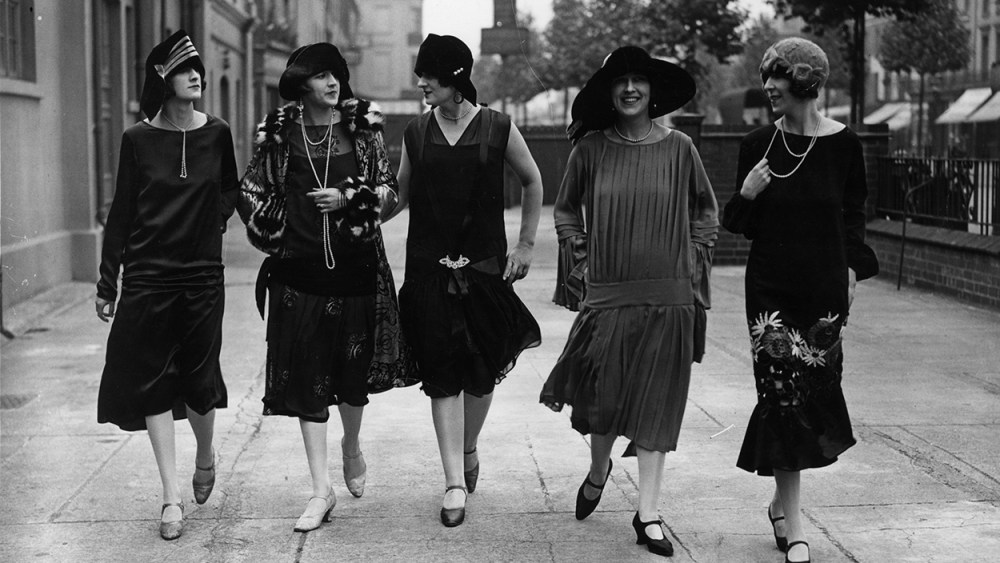
America introduced the flapper silhouette in the 1920s, its dropped waists, shorter hems and straighter lines reflecting movement, nightlife and leisure. Broadway, vaudeville, silent film, the Harlem Renaissance and resort culture shaped the look, alongside the rise of makeup, bobbed hair, sportswear, swimwear and rubber-soled sneakers like Keds and Converse, while the invention of the modern zipper eased everyone into comfort.
You May Also Like
In 1921, WWD covered the garment industry’s consolidation and moved to 498 and 500 Seventh Avenue, establishing the heartbeat of the industry in Midtown Manhattan. The garment industry was now in closer proximity to Macy’s new flagship that anchored Herald Square. In the same decade, Saks Fifth Avenue helped establish Upper Fifth Avenue as a luxury destination. And while the country still asked what defined American style, New York set the tone for fashion’s future.

Here a list of events converging around fashion from 1901 to 1925.
- 1903: The Wright Brothers make the first sustained airplane flight at Kitty Hawk, N.C.
- 1908: Henry Ford introduces the Model T, revolutionizing transportation and mass production.
- 1911: The Triangle Shirtwaist Factory fire broke out in Manhattan.
- 1915: Textile Color Association of the United States (CAUS) is founded.
- 1917: The U.S. joins World War I, which lasts until 1919.
- 1919: American Cloak and Suit Manufacturers Association represent contractors and subcontractors is formed.
- 1920: The 19th Amendment giving women the right to vote is approved.
Our Excuse for Being, WWD, 1910
With its lens focused on fashion, Women’s Wear from Fairchild Publications makes an early statement to readers in its first stand-alone issue of June 1910, declaring its “Excuse for Being.” Evolving with the business, it becomes Women’s Wear Daily by the 1930s and ultimately WWD. From the start, its distinction lies in reporting not only on the fashion industry, but on the people, places and things shaping its influence on American and global culture. And it still does, 116 years later.
The Rise of the Garment Industry
Women’s Wear has chronicled and witnessed the ups and downs of the global fashion system since its first issue hit newsstands in 1910. When the industry made its home on Seventh Avenue — then between 36th and 39th streets — in 1921, WWD gave its readers a summary of its progress. Then, as now, evolution was a continuum. Design, production and manufacturing were spread across boroughs, continents, states and towns, but for America, New York remained the city where fashion made its home. Here, a timeline of the New York garment industry’s earliest evolution.
- 1870: Origin along Lower Broadway on Canal, Worth, White, Thomas, Lispenard and Church streets.
- 1880: Along Broadway in the vicinity of Fourth and Eighth streets.
- 1890: Broadway and 12th Street, pressing toward Union Square.
- 1900: Fifth Avenue and 18th Street, as well as Broadway.
- 1910: Fifth Avenue and 23rd Street.
- 1915: Concentration in the northerly V made by Fifth Avenue and Broadway at 23rd Street.
- 1918: Growth along Madison Avenue and on side streets west of Broadway.
- 1921: Seventh Avenue development.