Nearly two decades after Eddie Borgo helped define a hard-edged, architectural strain of fashion jewelry, the designer is returning to some of the codes that made his name — with a different perspective on both design and the business around it.
After rapid expansion through the 2010s, Borgo shuttered his New York business in 2017 amid the pressures of growth and the wholesale model, later relocating operations to Los Angeles with a strategic partner before eventually regaining full ownership and rebuilding the brand on more deliberate terms.
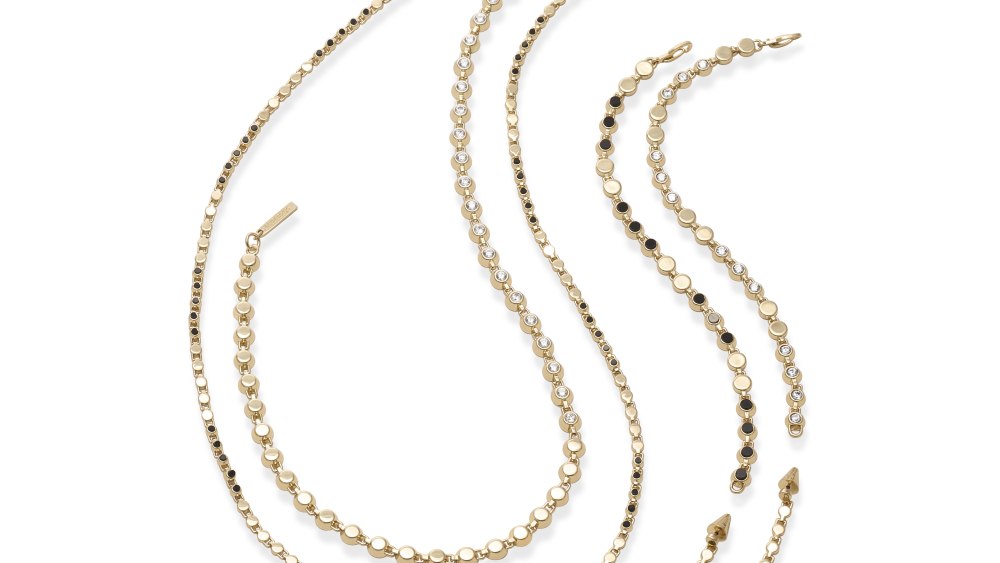
Now Borgo has launched Icons, a 27-piece collection exclusive to Nordstrom, available online and in 10 stores nationwide, including the retailer’s New York City flagship. Rather than reissue archival hits, he distilled their geometry into new forms, rendered in mirror-polished silver and 12-karat gold with pavé and hand-cut stones including tiger’s eye, labradorite, Baltic amber, lapis and onyx.
You May Also Like
The partnership, he said, has been two years in the making, developing as he slowly rebuilt the wholesale presence of the brand he founded in 2008.

“Humbly, we have seen design work that we created nearly two decades ago influence the jewelry space — both in the costume category and in the fine jewelry and high jewelry spaces,” Borgo said.
As conversations progressed, he said, Nordstrom became interested in examining why that early work resonated — and continues to reverberate through jewelry today.
“It was important to the team at Nordstrom that we recapture our rightful ownership of those ideations,” he said.
That reclamation begins with what Borgo calls the brand’s “Geometric Classicism”: clean metal surfaces, repetition and strict architectural shapes informed by modern art, particularly the work of Donald Judd and Sol LeWitt. While cataloguing nearly two decades of molds, samples and commissions for an archival project, Borgo began looking at those familiar forms differently.
Three-dimensional pyramids were flattened into square plates; cones became circular discs. Rather than mine the archive wholesale, Icons reduces recognizable Borgo signatures to their foundations, preserving the rigor while shifting their expression.
New York remains the connective tissue. Borgo sees the collection speaking not only to the customer who remembers the brand’s first ascent, but to one drawn to the city and the creative mythology around it.

“I think about a client who might not physically be in New York City, but romanticizes that environment and its sparkling skyline,” he said, recalling his own desire as a young person to get to the city. “I like to think that our client can take a piece of New York City with them and keep it with them every day.”
If Icons reconsiders the past aesthetically, its Nordstrom rollout also reflects what Borgo has learned from it commercially.
“It is an incredibly unique experience to build something twice,” he said.
This time, growth is less about ubiquity than alignment. Borgo described wholesale as “a dance,” one requiring compromise, understanding and respect for the creative process on both sides. Nordstrom, in his telling, offers not simply distribution but a platform for the work. And after experiencing the machinery of fashion once already, Borgo appears comfortable being selective about where the second chapter goes next.
“We have been approached by others who do not share in that philosophy of business,” he said. “Our answer will always be (a polite) ‘No, thank you.’”