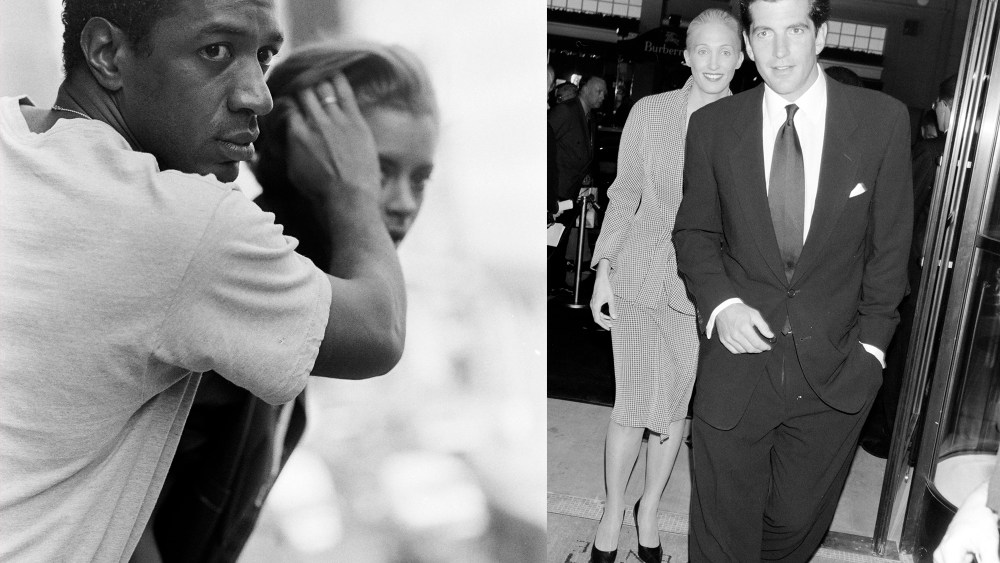
Gordon Henderson’s name may no longer be a prominent one in today’s fashion conversation, but the Parsons alum and former fashion star once shared close ties to Carolyn Bessette Kennedy and John F. Kennedy Jr., whose tabloid “love story” has reignited a nostalgic era in fashion. Henderson, who played a significant role in the real-life story and is portrayed in director Ryan Murphy’s version, was a notable figure in the fashion world during his time. While the television series has sparked widespread nostalgia for the era, each episode also questions new truths about what really happened
Henderson is introduced in the pilot episode; his story bears similarities to that of Anne Lowe — the designer behind Jacqueline Bouvier Kennedy’s iconic wedding gown — but unlike Lowe’s overlooked contributions, Henderson’s impact was well documented in Women’s Wear Daily’s coverage. After reconnecting with the designer for “WWD Black In Fashion: 100 Years of Style, Culture & Influence,” WWD reached back out to him about the series. From designing for Calvin Klein, starting his own brand, and playing an important role in his friend Carolyn’s wedding to JFK Jr., here’s what he said about the nostalgic timeline.
You May Also Like
When did you arrive at Calvin Klein?
I arrived at Calvin after graduating from Parsons in 1984. I did work for other brands as well before going out on my own. I was hired as an assistant for Calvin Klein Collection, arriving just as the designer Zack Carr was leaving. Back then, the designers didn’t want to see a portfolio; they were more interested in what you could actually produce. When I went to his office, with some of my work, he didn’t seem to believe I made what I showed him — he liked me, but thought leaving me with his studio team—seamstresses, tailors and patternmakers—while he went to Italy would be the quickest way for me to learn. My first silhouette accepted for collection was a cinched-waist pant and skirt, that in hindsight I should’ve kept, but it was adopted for the brand, so that was that. I stayed for less than a year working with Kelly Klein and other assistants on his team. By 1988, I was on my own building But Gordon which I produced under World Hong Kong, USA.
But Gordon was one of the most successful young contemporary designer brands in the late 1980s and early 1990s. WWD heralded Henderson in multiple features, including one titled “All the Rage” in 1989, the year he would receive and become the first Black designer of the CFDA Perry Ellis award for young talent.

In the series, you are shown in the studio/design offices with Narciso Rodriguez, whose iconic wedding dress for Carolyn also put him in the spotlight. Was that factual?
No. Narciso and I were not in the studio together. Many people weren’t in the studio, because Calvin was very protective of that space so, that part of the story is a bit over exaggerated.
How and when did you meet Carolyn?
I met her around 1988 on Broadway at a bookstore with another friend, Will Regan, who owned “Rex Bar” with David Rabin. It was a famous New York hotspot where the fashion crowd hung out. Will assumed I knew Carolyn, who was accompanying us on a trip to the horse stables in the Catskills. That’s where I first met her. Our friendship really started when we crossed paths again on 39th Street in the fashion industry near Calvin Klein’s offices. She was admiring my signature denim shirt, jeans and Frye boots, that’s when our friendship started and flourished. By the end of the decade I had established my own label. Carolyn, was [he chuckles] a wild lady, fun and spirited.
Since the film Carolyn’s style is getting renewed attention. How would you define her style?
At first, she wasn’t “that” girl. She was more brunette than platinum blond when we first started hanging out. Working at Calvin — at the store, is when her style began to turn around. And just a note, she didn’t like leather and never wore much makeup. He [Calvin], began to notice and that’s what he wanted his woman to look like — even Kelly began to copy it — because Calvin admired it.

How did Carolyn meet John?
Well, Carolyn spent much of her time when she was at Calvin Klein at the 654 Madison Avenue store. That store had a separate entry to the men’s floor with wardrobe consultants and personal shoppers. John often came in to buy suits and had them done in his size. That’s where I recall she met John. Then Calvin moved the wardrobe consultants back to his main offices and that’s where Carolyn stayed until she left.
OK, let’s talk about the wedding. You are mentioned but as a comparison to designer Willi Smith. What was your role in the wedding?
In 1996, I wasn’t in my own design studio. Carolyn told me she was going to marry John, but already knew that was going to happen. Then she showed me a one-of-a-kind bias dress, from John Galliano that she wanted me to remake. I said, “That will have to be done by someone else.” This is where Narciso comes in and I was then asked to handle John’s wedding suit and his special keepsake for the wedding.

Can you tell me about that suit and the special meaning of the keepsake?
So, John’s suit was a subtly striped wool navy blue, a nautical blue. I dressed John and his cousin, best friend, Anthony Roswell. I also made sure everyone in the groom’s party was properly attired, from head to toe. John also asked for a keepsake, which I had made. It was a pair of light blue silk charmeuse boxer shorts with his initials and the groomsmen’s initials embroidered on each leg. They were handed to each person in a cedar box. I don’t know if anyone kept them, but that was very special and different. There was also the lavender boutonnieres and his shoes. All of it had a connection to the family, Hyannis Port and his father — John F. Kennedy.
What about the wedding venue, how did that come about?
That part. Well, Carolyn wanted a very private wedding, so John suggested the place, The Greyfield Inn. It was the southern abode for the Carnegie family, located on Cumberland Island in Georgia. It was a task just flying to that place. I accompanied her three times to scout it out. It was very remote. They had to have a lot of security and a very specific guest list. It was actually a beautiful place when I think back on it.
While 40 is the number most noted in the media then and in the storyline, Henderson recalls it was exactly 50 to 25 people per party.
Was it always going to take place at the church on the island?
No, not at all. We actually were scouring the beach in the area, that’s where the wedding was supposed to take place. But on our second or third visit, we were there walking around — it was very hot and swampy, we were digging for clams, is when we accidentally came upon the church. We didn’t know it was a church right away. To be honest it was so small and not in great shape. Carolyn fell in love with it immediately. She went crazy. I remember that vividly, as well as helping her decorate it, to make it feel more special.
That iconic structure is actually the First African Baptist Church, built in 1893 for the slaves who once occupied Cumberland Island. Henderson also made note of the other structure on the island, a tinier house occupied by a woman named Carol Ruckdeschel, a naturalist, who is not actually mentioned in Murphy’s storytelling. It was her scarves that help get Narciso’s bias cut wedding dress onto Carolyn’s body.
How did everyone get on the island without giving everything away?
Carolyn had a lot to do with that. Guests were given a special coin, specifically an Indian nickel, to get on the island. It was all about the security.
How was your relationship with Carolyn after the wedding?
Of course we remained friends. I can tell you that Carolyn was a great person; she and I partied a lot back then, when New York had all the velvet ropes and chose who got in the club. Both of us weren’t New Yorkers and really didn’t get it. Carolyn, though, was also very private, becoming more so after she moved to John’s TriBeCa loft. She didn’t want to be in the public eye. I couldn’t imagine what that would be like with today’s social media. It wasn’t what she desired but she accepted that she had get used to it, because that was part of John’s life everywhere they went. I actually attended many events she refused to go to because of the media attention.

Before we go, how factual is the storytelling?
Well, it seems, because I couldn’t get through the first episode, lots of liberties have been taken. I guess it’s today’s television storytelling.
Could anything have been done to avoid the retelling of the tragedy that viewers will come to know about?
No. Sadly. It is as it should be.
Gordon Henderson’s contributions to fashion remain essential to its history. He continues to work independently.