For the better part of the last two decades, Kim Jones has been one of the movers and shakers of fashion.
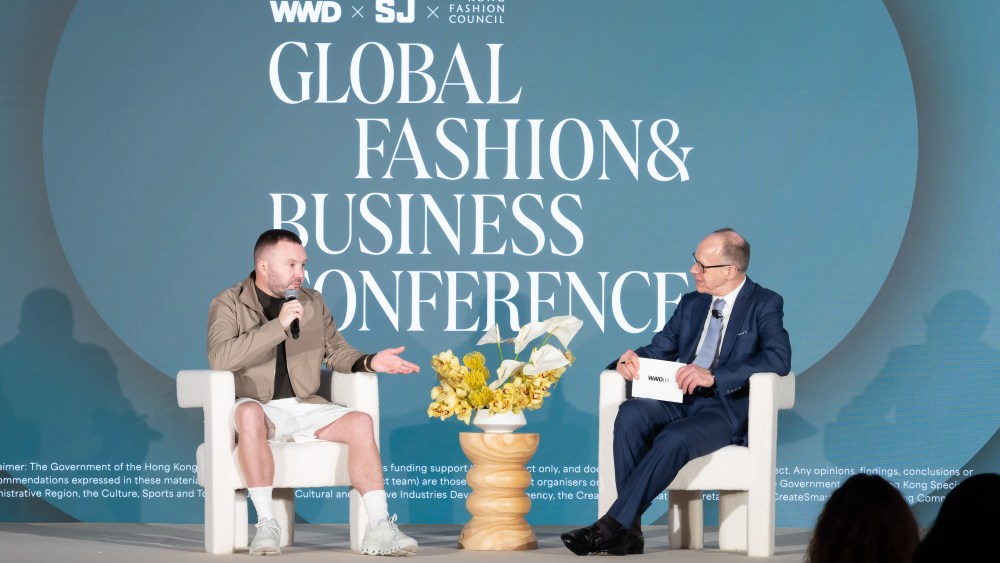
But even the most thrilling of rides eventually become grueling routine, as the British designer told the WWD x SJ Global Fashion and Business Conference in Hong Kong, hosted in partnership with the Hong Kong Fashion Council.
“As you get older, one of the things that’s a real luxury is time,” he said. “Traveling three or four times a week, going to different countries, to sit in a room looking at clothes, [is] fun for a while, but 15 years is quite a long time, right?”
It’s a fair assessment of the heady pace he’s kept since he ended a three-year stint at Dunhill in 2011 and was appointed men’s artistic director of Louis Vuitton, his first position at marquee brands owned by French luxury conglomerate LVMH Moët Hennessy Louis Vuitton.
You May Also Like
Named artistic director of ready-to-wear and accessory collections of Dior Homme in 2018, he took on two years later the role of artistic director of haute couture, ready-to-wear and fur collections for women at Fendi, leading both in parallel for the next four years.
Eventually, a desire for change built up to the leap he and Lucy Beeden, who has been Jones’ right hand of 20 years, took last year. “We decided we didn’t want to do it anymore, so we resigned,” he said. “We felt it was time for a new chapter.”
For this new one, the designer is taking a careful, selective approach to whittle down projects to those who “fit into what works with Kim Jones as a brand or studio,” as he put it.
These span a capsule with a sustainable slant with the Aman luxury hospitality group, a collaboration with Chinese electric carmaker Avatrand and, most recently, the Areal premium line he launched with Chinese down outerwear specialist Bosideng.
If Asia is the backdrop for a number of these projects, that’s because it’s a territory that resonates with him deeply, not because it’s the center of gravity for much of the luxury industry.
“I find the technology here exciting. I find the manufacturers exciting. I find just the conversations I’m having here exciting,” he said. “I’m seeing what’s happening in terms of luxury here — and what it actually means.”
In a nutshell: “Luxury doesn’t mean it’s got to be really expensive, it’s got to be really qualitative,” he continued. “And you can make things [in Asia] that are really qualitative.”
On top of that, the region is where it’s happening — and will continue to happen — in his opinion.
“I just think Asia’s got the pulse at the moment,” he said. “I think it’s an Asian century.”
It also makes sense from a personal perspective. During his Dior tenure, 60 percent of sales were in the region, according to Jones. Fans of his work are aplenty and he loves “the people, the food, the culture” right back.
“Seeing everything is really opening my eyes again,” he added.
Take all the potential offered by the region’s manufacturing innovation, material developments and growing sustainable chops. Paired with his observation of how younger generations feel they can no longer afford traditional luxury, “it was making me think there’s a gap to fill,” he said.
Plus, despite being a dab hand at creating excitement from storied houses by giving them a contemporary culture infusion — Vuitton-meet-Supreme, anyone? — he’s particularly interested in right-priced offerings.
What guides him through these projects, regardless of whether they come with a rich archive or are blank pages, is his understanding of consumers and the central role they play in determining how a brand endures.
“The consumer is the most important part of our process,” Jones said. “There’s so much information online now that people can see everything. You have to be very diligent about what you’re giving them.”

A key learning of his experiences at major houses is how to offer objects, be it clothes or cars, that slot right into the lifestyle of the target consumer. Take that electric vehicle, which he approached stylistically as an extension of his sleek stainless steel, concrete and glass home in London, an architectural marvel.
Such an approach works well in Asia, where luxury shoppers are among the most savvy and sophisticated in the world, quick to assess whether a brand justifies its positioning.
“Consumers in Japan, China, Thailand, Korea, everywhere around Asia are just so smart and they see everything because they’re real professional shoppers,” he said. “You cannot hide anything from them.”
Rather than viewing that scrutiny as a challenge, Jones feels it is in step with his own creative track and interests. The region’s manufacturing innovation and material developments are building its growing sustainability chops, an area he looked keen to explore.
Asked what comes next for him, the designer sounded open to the possibilities and opportunities offered by his changed life-work balance.
“Maybe it’s just partnering up with different companies, doing different projects,” Jones mused. “I’m figuring it out. I’ve only been away from LVMH for nine months, not even that.”
As for a personal label, “if I was going to do it, I’d have to think big, because that’s what I’m used to thinking,” Jones said. “And I’d think about the key price points being really reflective of today’s market, and the quality being the same as [what] I’ve made at other brands.
“I might just wake up one day and go, ‘Yeah, fine,’ then sit down and design it all,” he teased. “That’s how I am sometimes.”
Whatever his plans, Jones remains pragmatic. Fast growth is not something to be expected in this era of normalization for luxury, particularly in light of current global geopolitical headwinds.
Even his own successes can’t be attributed to a particular secret sauce. “Everyone was trying to work out how it happened, but I just think it was right time, right place, bits of luck and hard work,” he said. “That’s what everything is at the end.”
One thing is for certain as far as he is concerned.
“The brands that last are the ones that permeate into culture,” said Jones. “When things permeate into culture, they last forever.”