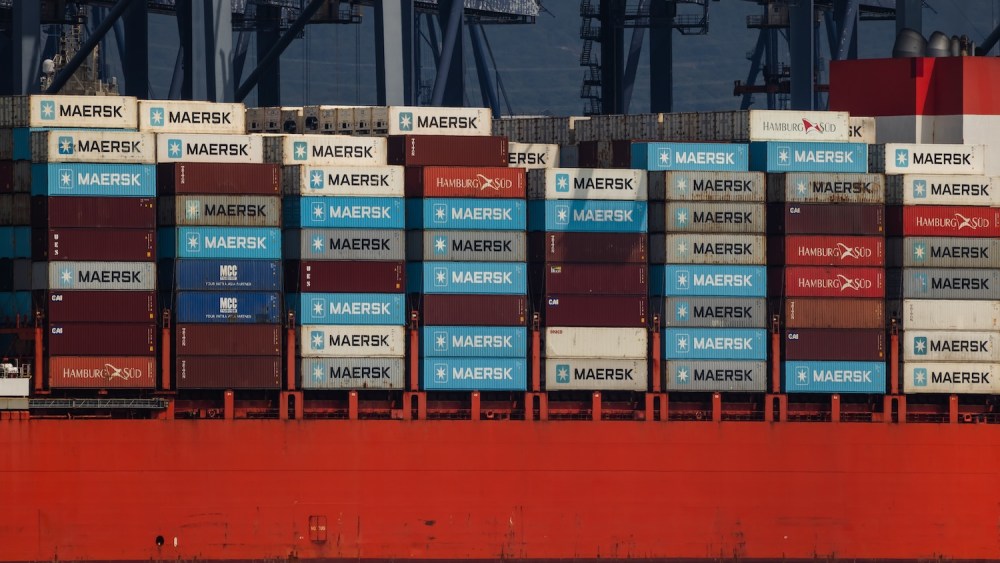
Maersk raised its full-year guidance for the third time this year amid soaring freight rates exacerbated by heavy port congestion since the summer.
For 2026, underlying forecasts for earnings before interest and taxes (EBIT) now sit at $8 billion to $8.5 billion, up substantially from the $4.5 billion to $6.5 billion guide made in August. Underlying EBITDA also benefited, now expected at $14.0 billion to $14.5 billion.
Container demand had weakened for the ocean carrier giant in the third quarter, with Maersk seeing a 0.8 percent decrease in transported volumes to 3.4 million 40-foot equivalent units due to the ongoing congestion at Asian ports.
However, Maersk’s volume on the oceans appears to have underperformed its own industry estimate. The company said global container demand grew between 2 percent and 4 percent from the year prior.
Comparatively, Maersk’s volume lagged behind Cosco Shipping’s 4.5 percent cargo volume growth, as well as Ocean Network Express’s (ONE) 2.2 percent increase in containers moved.
Conversely, Maersk’s average ocean rates rose 46 percent to $3,287 per 40-foot container. The container shipping firm capitalized on an elevated freight-rate environment more efficiently than its rivals, with average rates per 20-foot equivalent unit (TEU) jumping 36.5 percent to $1,709 on average at ONE. Revenue per container increased 25.3 percent to $1,394 per TEU on average at Cosco Shipping.
Maersk CEO Vincent Clerc tied that pricing power to resilient demand meeting capacity that was effectively smaller than the nominal fleet, with strong Far East exports and imports into Africa, Latin America and North America running into the congestion.
That demand met a quarter shaped by disruption, including a particularly active Pacific typhoon season in Asia, the ongoing conflict surrounding the Strait of Hormuz, and water shortages that restricted Panama Canal transits. Maersk said global average port waiting times peaked at 16.6 hours on Aug. 25.
“Rates are now over 10 percent higher than they were when we announced our second quarter results in August, and over 120 percent higher than at the start of 2026,” Clerc said.
For Maersk, third-quarter revenue rose 27 percent to $18.1 billion, with EBITDA of $4.7 billion and EBIT of $3.3 billion, yet shares fell more than 6 percent Thursday on the $5.04 billion EBITDA consensus miss.
The company’s ocean segment carried the quarter, with revenue up 37 percent to $12.6 billion and EBIT up to $2.6 billion from $567 million. East-West volumes fell 4.3 percent and intra-regional volumes rose 6.7 percent.
Bunker prices increased 49 percent to $798 per fuel-oil-equivalent metric ton as fuel prices remain elevated, and Maersk said those costs were recovered through surcharges and spot rates.
Although the carrier has brought more of its services back to the Red Sea, Clerc says the return has had no real impact on freight rates so far.
“On the Red Sea, we have continued a gradual return of our services via the Bab el-Mandeb,” Clerc said. “Suez transits are now just over two-thirds of pre-closure capacity, and this is delivering faster transit times to our customers while also reducing our bunker consumption.”
Clerc would not give a guidance for 2027, saying the contracting season is just starting.
“There is no data point at this stage to talk about. There will be a lot more of this when we meet again in February,” said Clerc. “We are going to have a strong fourth quarter. In this quarter, the spot rates will be significantly higher than they were in the fourth quarter of last year. There is some level of correlation between the background of spot market you have when you enter the contract negotiation and where the contract negotiations actually land.”
Clerc defended Maersk’s order for 26 dual-fuel vessels each for delivery in 2029 and 2030, citing the current volatility seen out across ocean shipping worlwide. The CEO said trade is becoming more imbalanced and congestion means ships sit at anchor, so more ships are needed to move the same trade.
“If you look at order book over expected market growth, the order book has been too big for the market growth for the last 20 years, and yet here we are, all ships are full,” Clerc said. “That’s the first reflection. Maybe it’s time to relook a bit at the model.”
ONE, reporting the same July to September quarter as Maersk, shows how uneven that market has become across different regions. According to the carrier, trans-Pacific demand stayed strong with volumes increasing 12.8 percent, while Asia-Europe volumes inching up just 2.1 percent even as more capacity returned through the Suez.
ONE reported revenue of $6.3 billion, up about 41 percent, and net profit of $1.3 billion, up from $285 million. The carrier also raised its full-year profit forecast to $2 billion from $900 million, but it expects spot rates to ease in its second half.