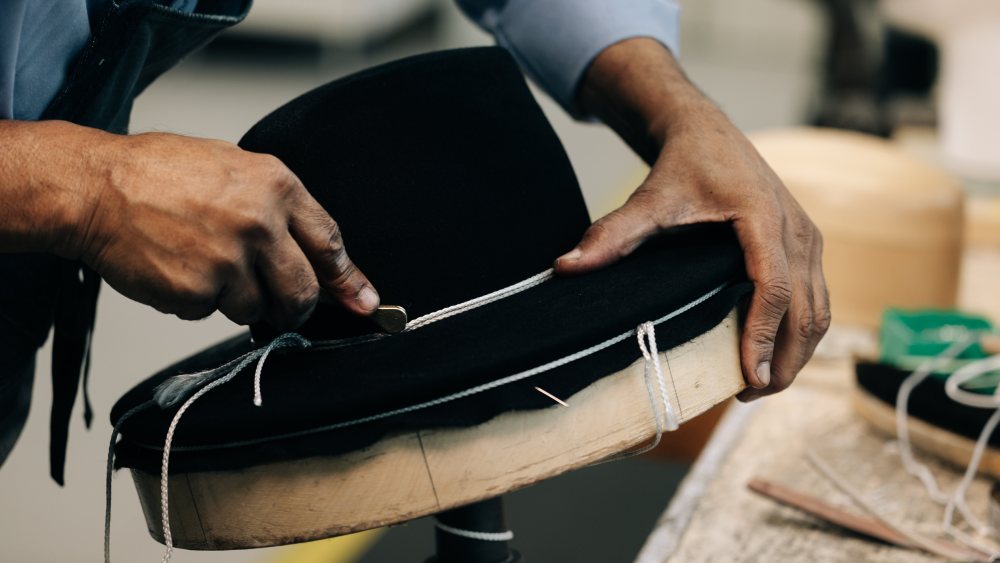
PARIS — At famed Parisian hatmaker Maison Michel, every design begins with a tree.
Thick slices of linden wood, still coated with moss, are lined up in the workshop, where they will be glued together and sculpted into hat blocks — the foundation for styles like the New Abby sailor cap worn by Lily Collins in “Emily in Paris,” or the felt fedoras favored by Jennifer Aniston and Rosie Huntington-Whiteley.
The journey from raw material to finished product is at the heart of an exhibition marking the 90th anniversary of the house, which has been part of Chanel’s network of specialized workshops since 1997.
The display, which opens Sept. 23 at La Galerie du 19M, Chanel’s craftsmanship hub in the north of Paris, focuses as much on the ancient tools and techniques at the heart of the craft as it does on the final designs.
You May Also Like
“Talking about Maison Michel through its finished products doesn’t tell the full story. To tell the story of Maison Michel, you have to show everything that happens here every day,” explained the hatmaker’s artistic director Priscilla Royer.
“Metamorphoses — The Hats of Maison Michel,” which runs until Dec. 13, begins with a display of tree trunks carved into raw hat shapes, alongside a selection of the 4,000 wooden hat blocks contained in its archives.

Specially commissioned art works are dotted throughout the space. Among them is a towering totem pole consisting of hats, including Maison Michel’s signature cap with ears, sculpted by Amaury Darras, winner of the accessories grand prize at last year’s Hyères festival.
Ceiling-high metallic shelves are piled with a rainbow-hued assortment of felt forms, which are steamed and stretched over carved wooden molds to make berets, fedoras or pillbox hats.
Upstairs in the Maison Michel workshop, which caters to clients ranging from fashion houses to the Lido cabaret and film productions, the hats are literally baked in a large oven.
“Light colors can brown when they’re cooked, as can straw, so you have to be very careful with the settings. Colors are also altered by heat, so it really is like a kitchen: the ingredients are never the same from one piece to the next,” said Royer.
Keeping Tradition Alive
Back in the exhibition space, another section is dedicated to the work of the modiste, or milliner, who fashions hats from materials like canvas, organza, leather and tweed.
Maison Michel is one of the last remaining producers to master the art of sewn straw. Workers assemble and shape straw hats on ancient sewing machines, including a 19th-century Weismann whose twin, now decommissioned, is on display in the public galleries located on the building’s ground floor.

“The methods used today haven’t changed since the very beginnings of hat-making, which is quite remarkable. That’s when you really appreciate the craft itself: these are time-honored techniques that have been preserved,” Royer noted.
In a section highlighting runway designs, a recent example takes pride of place: a blue crested cap, with echoes of Sonic the Hedgehog, presented as part of Chanel creative director Matthieu Blazy’s cruise 2027 show in Biarritz.
Other eye-catching designs include a wide-brimmed straw cage hat adorned with fruits and camellia flowers, worn by Claudia Schiffer in Chanel’s spring 1992 haute couture show, and a felt “double hat” for two people created by Belgian designer Tom Van Der Borght in 2021.
Hats also play a key role in a quaint French couture tradition: every Nov. 25, workshops across the city are awash in green and yellow as unmarried women over 25 — dubbed “Catherinettes”’ — don oversize hats in honor of Saint Catherine.
Royer curated the exhibition with Emilie Hammen, director of the Palais Galliera fashion museum, who also runs the Chanel and Le19M Chair in Fashion Savoir-Faire at the Institut Français de la Mode, where she teaches fashion history.
“It’s such a precise and little-known craft — one that really deserves to be shared with the public,” Hammen remarked, noting that what first struck her about the Maison Michel workshop was the sonic ambience.

“There are the sounds of anvils and oven doors closing. At times, it feels like being inside Vulcan’s forge,” she said. “It’s quite powerful, really — and very different from the traditional vision of a fashion atelier, where everything is silent and light.”
Hat Revival
The hats themselves have evolved significantly from the days when they were required wearing for both women and men. These days, they are used as a form of self-expression: think Gracie Abrams’ quilted headbands, Sabrina Carpenter’s Met Gala jeweled skullcap, or Jeremy Strong’s color-coordinated bucket hats.
Meanwhile, extravagant hats are having a runway moment, meaning the orders arriving at Maison Michel are stretching its creative teams.
“We’re seeing a hat revival,” said Royer. “Very recently, the trend was for very short-brimmed hats. Now we’re seeing a rise of dramatic and imposing statement hats, so that gives us room to experiment.”
At the center of the exhibition is a room where Bastiaan Woudt’s large-scale photographs of models sporting graphic designs are juxtaposed with a series of smaller white felt hats in archetypical shapes, such as boaters, turbans and top hats.
Visitors can enter a replica of a milliner’s shop from the early 20th century where L’Usine de Films Amateurs, a participatory short-film studio founded by French director Michel Gondry, will offer free weekly filmmaking workshops.

The space highlights the evolution of headgear as a social signifier since the 19th century, when specific hats were worn for various occasions.
“We’ve moved past many of the conventions dictated by the customs and morality of the past. A hat is no longer simply a way of conforming to social expectations; it has truly become a fashion accessory and a form of self-expression,” said Hammen.
If, as a result, the market for hats has considerably shrunk in the last century, Royer feels no nostalgia for the days when covering your head was de rigueur.
“There were so many rules that it was very restrictive. Nowadays, anything goes. You don’t have to be on a gondola to wear a boater hat,” she said. “You can wear a postman’s cap if you feel like it, and that just feels much more liberating.”