
Homies’ growing presence in the U.S. wasn’t necessarily part of a grand expansion plan.
Founded in 2020 by creative director Vitaly Polyakov and chief executive officer Dmitrii Roshchin, the independent Portugese footwear brand first began to attract American customers who were finding its soft, distinctive shoes on their own.
Paid marketing followed, but it was what happened when the company stopped spending that caught Roshchin’s attention.
“The more important sign was that we continued to see strong demand even when those campaigns were paused,” Roshchin said. “That was when we knew the interest wasn’t temporary and that investing in the market made sense.”
You May Also Like
That investment now includes U.S. order fulfillment. Until recently, American orders were shipped from Portugal, adding delivery time, customs and duties, while making returns and exchanges more cumbersome. Bringing fulfillment Stateside removes some of that friction just as the U.S. is evolving into an important part of the business.

The U.S. is now Homies’ largest individual market, representing about 35 percent of total sales. U.S. sales in July were nearly 10 times their January level, according to the company, with August on track to become its strongest month yet. Roshchin expects the U.S. could account for close to half of Homies’ total sales by the end of the year.
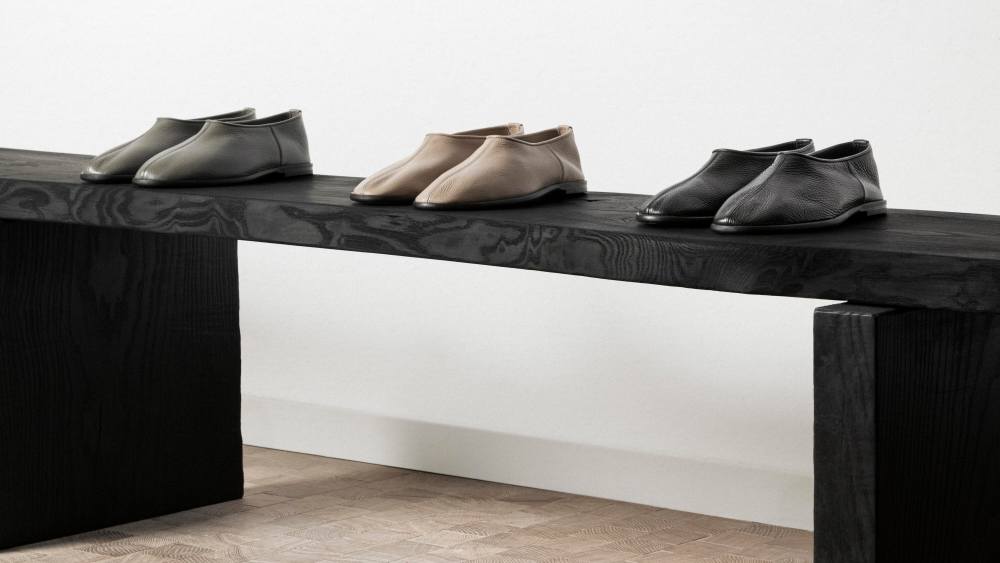
At the center of that growth is footwear that lands somewhere between the familiar and the slightly strange. Heel Socks, the brand’s first creation and still a bestseller, distills the idea: an easy, almost slipper-like shape designed to move beyond the home. “People respond to something that feels familiar but is still difficult to categorize,” Polyakov said of the style. “The shoes are soft yet supportive, minimal yet recognizable.”
There is little in the way of overt branding. Instead, Homies has developed its vocabulary around proportion, lightness and the way leather sits and folds around the foot. “A logo can make a product identifiable, but it doesn’t necessarily make it distinctive,” Polyakov said. “We want the product itself to do that work: through materials, lightness and rationality of design. Ideally, you recognize a pair of Homies before you see the name.”
Polyakov developed some of that pragmatism while living in Antwerp, where he worked with young designers from the Royal Academy of Fine Arts to develop footwear for their collections. Students would bring him sketches — sometimes barely resolved — and he would work through how to translate the idea into an actual shoe.
“When you work in an environment where resources are limited, be it a material or a production tool, you learn how to use what you have in the best, most efficient and most rational way,” Polyakov said. “That’s where our production philosophy comes from.”

That mindset continues at Homies, where new models generally grow out of an existing design rather than beginning with a blank page. “Before we look for something new, we look at what we have already made,” Polyakov said, using the Heel Socks as blueprint. “We keep that recognizable core and then add what the new shoe needs — whether that is a functional change or a new design detail.”
With the logistics of its American business now anchored down, the founders are considering how the brand exists beyond the screen. Wholesale is part of the plan, although Roshchin sees physical retail as an opportunity to give the product context rather than simply adding points of sale.
“Being everywhere has never been the goal,” Roshchin said. “We want to grow through partnerships that feel natural to the brand, with stores that understand design and can place Homies alongside design, art and fashion.”

Pop-ups and collaborations with designers, galleries and hotels are also being considered. A permanent store remains a longer-term possibility, but the founders aren’t in a hurry to put a traditional retail box around the brand. “It could be a temporary space or a project that allows people to enter the world of the brand,” Roshchin said.
Within two or three years, the goal is a U.S. business that combines a strong digital operation, a selective wholesale network and a physical presence in several cities. “We want people to discover Homies online,” Roshchin said, “but also to come across the brand naturally in the places they already visit for design.”