
On the Line is a weekly roundup of sourcing and labor quick hits in the apparel and footwear industry, from worker protests to boardroom maneuvering, tracking the developments shaping conditions on the factory floor and beyond.
More factory closures
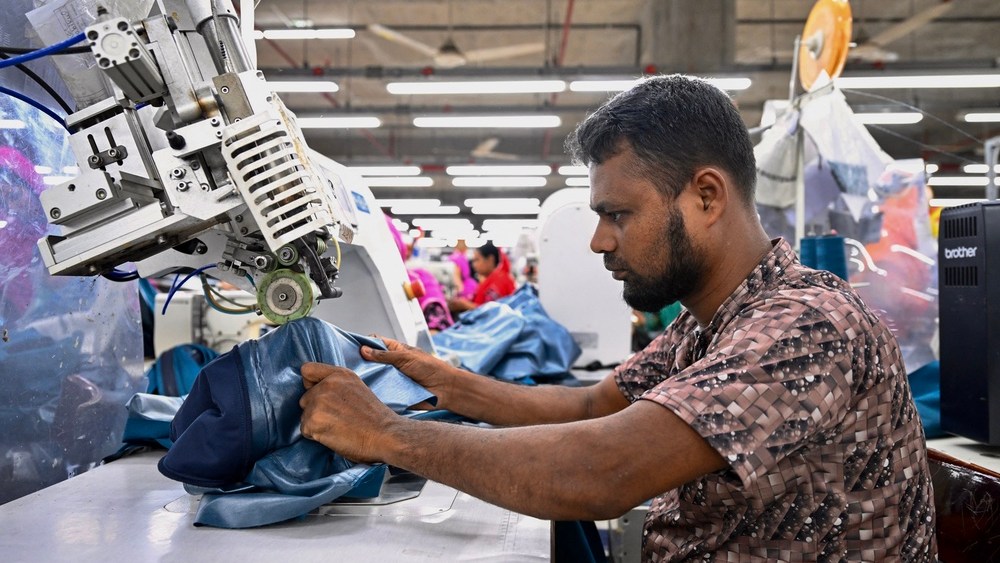
Bangladesh’s order shortage and production cost woes have claimed more victims as Unique Designers and Unique Washing & Dyeing in Gazipur’s Board Bazar neighborhood announced this week that they will be shuttering permanently, leaving at least 1,800 workers unemployed.
The factories, which counted brands such as C&A, Wrangler owner Kontoor Brands, S.Oliver and New Look among their clientele, according to public records, will pay all outstanding wages, employment benefits and other legal dues by July 27, according to a tripartite meeting involving their owners and workers.
The Daily Sun said the closures are part of a broader trend that shows no sign of slowing down. Citing industry data, it said 457 factories across seven major industrial zones in Bangladesh have closed for good between August 2024 and June. Of these, 205 shut down due to insufficient work orders and 190 due to financial strain. Another 11 factories shuttered due to labor unrest, and 51 closed because of political instability, banking issues, gas and electricity shortages, raw material scarcity or relocation.
“An initial shortage of orders later morphed into a working capital crisis. Many factories couldn’t open letters of credit, which cut off raw material imports and disrupted production,” Bangladesh Chamber of Industries President Anwar-ul Alam Chowdhury Parvez told Bonik Barta. “The industry has also felt the impact of global crises, the Covid-19 pandemic, the Russia-Ukraine war and inflation. The recent Middle East crisis has added to those pressures. Taken together, a range of factors has contributed to the factory closures.”
AI harvesting
Garment workers in India are being kitted out with head-mounted cameras that capture their movements as they sew, collecting firsthand data that could lead to greater automation of industrial work—and even replace humans on the production floor.
EgoLab, an Indian data aggregation company among those extracting this information from apparel factories, according to The Guardian, has a clientele that includes major companies like Tesla. Tesla’s CEO, Elon Musk, has said he expects humanoid robots rather than electric vehicles to account for 80 percent of Tesla’s future value.
“South Asia remains the workshop of the world for many labour-intensive industries. If you’re trying to teach a robot how humans work, there are few places that offer the same combination of scale, diversity and density of human labor as India,” Puneet Jindal, the founder of Labellerr AI, a technology company that collects egocentric data in India, told The Guardian. “On any given day, millions of workers are sewing garments, assembling products, sorting goods and performing tasks that robotics companies want machines to learn.”
Beyond training AI, the recordings are also being used to generate productivity reports that rank workers by time spent actively working and estimate losses from “idle” periods.
But the practice raises not only privacy concerns and questions of consent but also broader fears of worker exploitation. As far as The Guardian can tell, the workers are not being compensated for their participation, which could ultimately cost them their jobs.
“The demand for egocentric data is exploding, and new companies are entering the market every month promising to deliver it more cheaply,” Jindal said. “International clients are often willing to pay significantly more for this footage, but the pressure to undercut competitors keeps pushing costs downward. By the time that trickles through the supply chain, the workers generating the data are often left with nothing.”
Improving digital literacy
Speaking of Bangladesh and automation, digital illiteracy, English-only manuals and the lack of a nationally backed skills certification system are some of the biggest barriers to reskilling garment workers and ensuring they’re not left behind in the so-called just transition.
Speaking this week at a national dialogue titled “Ensuring a Just Transition in Bangladesh’s RMG Sector: Public-Private Sector Initiatives and Workers’ Realities,” Raju Ahmed, project coordinator at Karmojibi Nari, a women’s nonprofit, said that while automation and digitalization can improve workplace productivity and sustainability, they also risk displacing low- and semi-skilled workers who lack the skills to adapt.
Ahmed said this could push more workers into precarious jobs such as domestic work, street vending and home-based garment production unless industrial modernization is balanced with social justice.
In a sign of how the sector is trying to adapt, the Export Promotion Bureau this week signed deals with the Bangladesh Garment Manufacturers and Exporters Association, the Bangladesh Knitwear Manufacturers and Exporters Association and the BGMEA University of Fashion and Technology to train 22,815 garment workers, employees and mid-level officials over the next three years. The program is designed to boost productivity, help workers handle modern machinery and improve compliance with international quality standards.