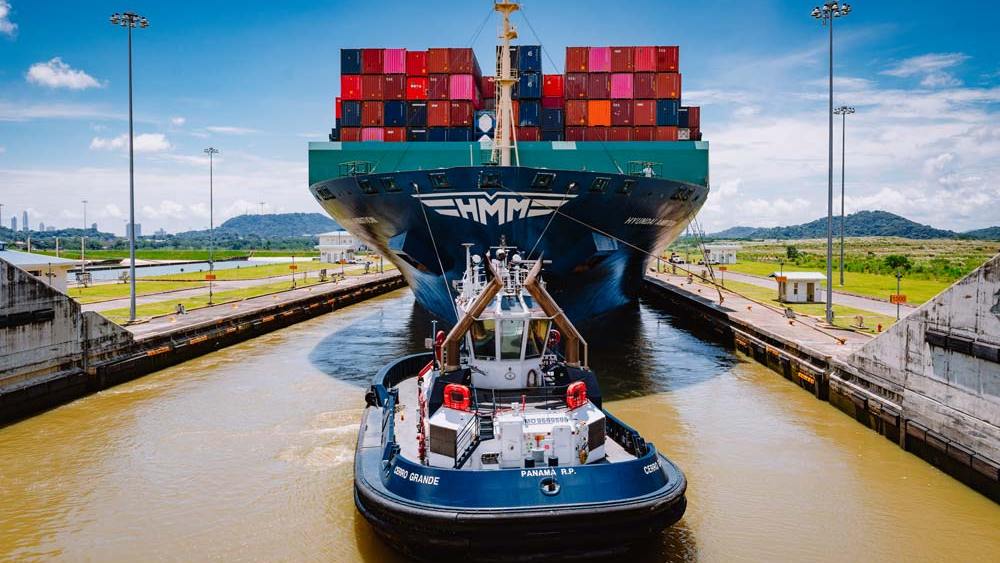
The Panama Canal continues to prepare for potentially extreme El Niño weather patterns this year that could lead to drier-than-normal conditions and a possible redux of the 2023-2024 drought that limited shipping capacity through the trade conduit.
With a possibility for lower water levels at the Panama Canal’s locks later this year, major ocean carriers are prepping to offset any cost increases by imposing surcharges on customers.
Additionally, the waterway’s operator could reportedly suspend part of the booking system for ships seeking passage through the canal.
According to an advisory from shipping agent Norton Lilly, daily auctions for “Period 3” Panamax-class lock slots will be suspended from July 25 until further notice, cutting daily booking capacity from 36 to 34 vessels. Period 3 slots are offered 96 to 48 hours before the transit time and are often the most competitive auctions for vessels operating on a tight schedule without a pre-arranged slot.
The Panama Canal Authority (ACP) has not confirmed the advisory.
The decisions from the carriers and the reported suspension follow multiple notices from the National Oceanic and Atmospheric Administration (NOAA), which has warned that the recurring weather phenomenon will strengthen throughout the remaining year and persist through 2027.
In June, the NOAA anticipated that El Niño would intensify to a “moderate or strong level this fall,” before indicating on July 9 that there was an 81 percent chance of a “very strong” occurrence during the season “that would rank among the largest El Niño events in the historical record going back to 1950.”
Due to operational constraints and increased costs associated with transiting the canal, Mediterranean Shipping Company (MSC) said Monday it will tack on a surcharge of $100 per 20-foot equivalent units (TEUs) on shipments between Asia and the U.S. East and Gulf Coasts. That fee will take effect on any shipment gated into a port as of Aug. 19.
Earlier this month, CMA CGM and Hapag-Lloyd instilled their own fees directly related to canal passage.
CMA CGM will charge $320 extra per TEU on cargo headed to the U.S. East and Gulf Coasts and collect $100 for TEUs traveling to the Central American East Coast and Caribbean islands. Those charges will go into effect July 25.
Hapag-Lloyd plans to charge an additional $130 per TEU for cargo from Far East to North America via the Panama Canal. The surcharge is applicable to all equipment types for sailings commencing on Aug. 15.
The expected changes come as the ACP preps to instill a second batch of draft restrictions this Friday to conserve water in Gatún Lake, the manmade, rainfall-fed reservoir that feeds the canal’s lock system and helps float the vessels through the roughly 50-mile canal.
After already cutting the maximum authorized draft for Neopanamax vessels from 50 feet to 49.5 feet on July 3, the authority will again drop the number to a 49-foot depth.
On Aug. 15, the ACP will implement a third restriction, narrowing Neopanamax vessel drafts to 48.5 feet. Neopanamax ships can carry up to 14,000 TEUs and are longer than 966 feet. These vessels were built after the Panama Canal was expanded to add two new sets of locks in 2016.
As of Wednesday, Gatún Lake’s depth was 84.7 feet, in line with the average 84.7-foot depth July has averaged over the past five years.
However, the ACP is forecasting the lake’s depth to drop almost more than a foot to 83.5 by late September. This would be nearly two feet below the 85.2-foot depth seen since 2021.
The July-through-September figures are dragged down by 2023’s severe lows, when a months-long drought lasted throughout the rest of the year into the early winter of 2024.
At Gatún Lake’s lowest water levels during the drought, drafts for Neopanamax ships were restricted to 44 feet, which restricted the amount of TEUs the vessels could carry by as much as 40 percent. Smaller Panamax ships have remained at a 39.5-foot draft since the mid-2023 restrictions were first implemented.
According to a statement Tuesday, the ACP is studying the feasibility of the Neopanamax locks eventually handling vessels up to 53 meters (173.9 feet) wide, compared with the current 51.25 meters (168.1 feet).
On Tuesday and Wednesday, the authority conducted dry chamber maintenance on the west lane of the Gatún Locks, temporarily reducing the number of available slots for Panamax ships.
The group recently performed a similar maintenance operation at the Pedro Miguel Locks, which was carried out across five days in May.