
Remark AI, an AI-powered commerce platform for luxury brands, is launching an “AI shopping advisor” that combines virtual try-on technology with personalized styling and product guidance.
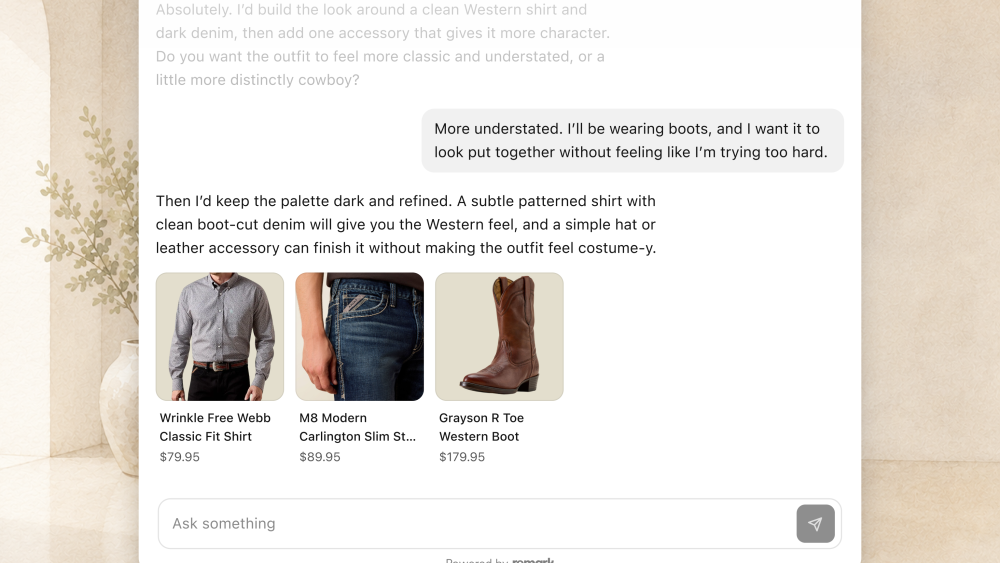
“Unlike traditional virtual try-on tools that place a static image of a garment onto a photo, Remark lets shoppers virtually step into complete looks, stand up and move naturally, and see how the fabric drapes, shifts and responds on their body in real time—as if they were actually wearing it.” the company said, adding that an AI shopping advisor then helps them “evaluate the look, answers product questions, recommends styling options and suggests complementary pieces through natural conversation.”
Theo Satloff, chief executive officer and co-founder of Remark, said he is on a mission to fundamentally transform the online shopping experience by merging the worlds of high-end retail and advanced technology.
Growing up in New York City as the child of a fine jewelry manufacturer, Satloff spent his formative years in iconic department stores such as Nordstrom and Bergdorf Goodman, absorbing the nuances of luxury client relationships.
There, he learned from industry leaders that true salesmanship is not about flattery but about honesty and finding the perfect item for each individual. “Salesmanship is not about telling everyone that they look good and everything. It’s about finding the thing that looks right for each person,” Satloff told Sourcing Journal.
This early education, combined with his later studies in machine learning and computer vision and a stint at Amazon’s Alexa team, laid the foundation for Remark, a platform he describes as “the digital incarnation of the best in-store associate you could possibly think of.” The company was founded in 2022 by Satloff, Ian Patterson and Carl-Philip Majgaard.
Satloff said at the heart of Remark’s philosophy is a commitment to hospitality, a quality he believes is the cornerstone of the luxury experience. He said while top-tier clients, or VICs (very important clients), expect personalized attention, champagne and pre-selected items upon arrival, this white-glove treatment is typically reserved for only 1.5 to 2 percent of shoppers—a segment that generates nearly half of a brand’s revenue.
Remark aims to democratize this experience, ensuring that the other 98 percent of online shoppers receive the same curated, no-nonsense guidance. “That other 60 percent of revenue, or the other 98 percent of shoppers, they should get that same treatment. It shouldn’t be reserved just for the crème de la crème of clients,” Satloff said, adding that whether online or in-store, customers are seeking advice and a curated journey, not a generic, cookie-cutter interface.
Satloff said what sets Remark apart from existing point solutions is its holistic, human-backed approach to the entire customer journey. Unlike tools that only handle virtual try-ons, customer service automation or package tracking in isolation, Remark does it all and takes clienteling to a new level. Satloff also said it was built from a research lab powered by a community of 60,000 North American product experts.
This proprietary database ensures the platform offers genuine, opinionated, and high-taste recommendations rather than regurgitating generic information. “We’re not just regurgitating nonsense; we’re not just making up information,” he explained. “We want to have something proprietary and have a point of view.”
The system learns about the user from the very first interaction—understanding their location, sizing, and style preferences—and carries that context seamlessly through discovery, recommendation, checkout, and even post-purchase follow-ups.
By integrating every stage of the shopping process, Remark ensures that customers never have to start over or repeat themselves. If a package is delayed, the same agent with the same contextual knowledge proactively reaches out to help, mirroring the attentive care of a personal client advisor.
Satloff said this continuous, relationship-driven approach is crucial, especially since online conversion rates can’t match the 30 to 35 percent seen in stores. “At no point are you starting over,” he said. “At each moment, it feels like you’re chatting with [the designer] yourself, like you’re on the phone with someone who cares and understands where you’re coming from.”
Remark’s goal is to replicate the intuition and memory of a human advisor, creating a cohesive experience where the digital rack is always being assembled for the shopper.